Showing posts with label 1944. Show all posts

Wednesday, May 24, 2023

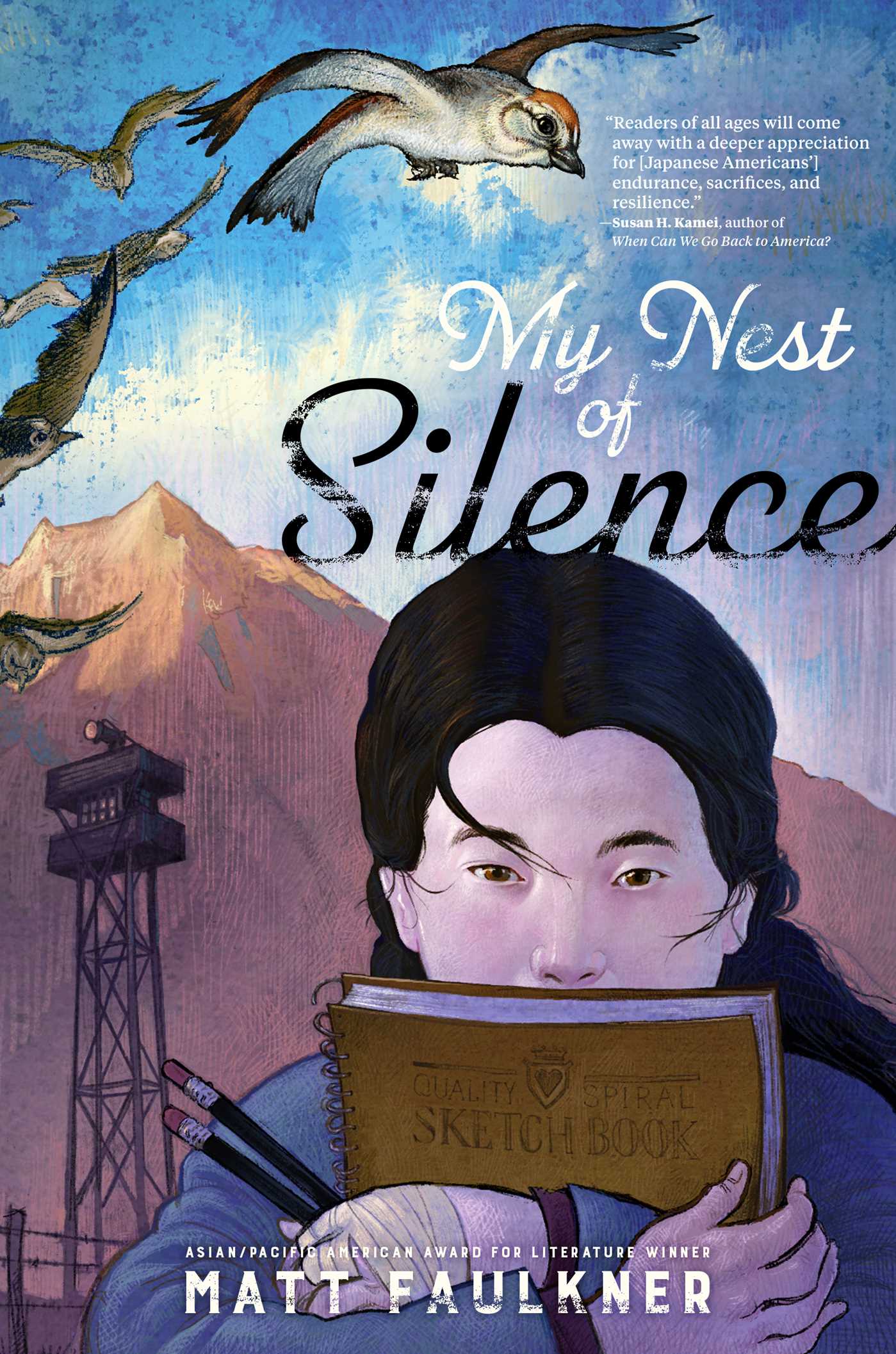
My Nest of Silence by Matt Faulkner

Mari Asai, her older brother Makoto and their parents, Ichiro and Aki are living in the Manzanar prison camp in California. They were sent to the camp after Japan bombed Pearl Harbor. Like most other Japanese-Americans, the Asai were forced to sell their farm in Florino, California.

It's April, 1944 and with Mak turning eighteen, he's decided, against his father's wishes, to enlist in the U.S. army. After Mak leaves on a greyhound bus, Mari decides she won't talk anymore. She's angry at Mak for making this decision without talking to her and she's angry at her father for seeming not to care. But being silent hasn't been easy. Mari is hoping that being silent will bring Mak safely home, but her father feels Mari's silence is "abnormal" while Mama understands that Mari is "upset over Mak leaving." The adults at the camp see Mari's silence as insulting.

Finally after two weeks, a letter from Mak arrives. He tells her that the bus ride from Manzanar to Camp Shelby in Mississippi was long. Although he tells Mari that their drill sergeants are "not a bad bunch of fellows" they are yelled at, have their heads shaved and are sent on a five mile "hike" before bed. Mari suspects that Mak is not telling her the whole story.

Life at Manzanar consists of lots of dust and bad food, although it's not as bad as when they first arrived. Eventually, the Issei and Nisei took over cooking at the camp. But the dust and windstorms are still a problem. One of the oldest people in the camp is Oba-chan Yuki who Mari likes and who is a great storyteller. Oba-chan Yuki has a terrible cough which the constant dust makes worse. One morning after telling Mari and her mother a story, Oba-chan Yuki asks to see Mari's sketchbook. She tells them her daughter Eunice is a water colour painter who has created artwork for Reader's Digest magazine and she offers to have Mari meet Eunice.

Another letter from Mak in July, 1944 tells about the schedule at Camp Shelby and meeting boys who are from Hawai'i. He asks Mari to have Father write to him. A third letter mentions his friend Kazuo (Kaz) who is from Hawai'i and how the Hawaiian Buddhaheads and the Mainland Kotonks are at odds with one another.  But when Kaz learns that Mak's family is in a prison camp, he is proud that Mak enlisted. A fourth letter from Mak reveals that he's put in to be an army mechanic while his friend Whitey Kurasaki has been made a unit leader. 

Back in Manzanar, Mari meets Eunice who praises her artwork and invites Mari to join her art class at the camp. But during her first art class, Mari cuts her finger with a razor blade while sharpening her pencil and her father refuses to allow her to return to the class. After Oba-chan Yuki dies in her sleep, Mari falls ill with pneumonia. As she begins to recover, Mari learns that Eunice and her family have left the camp after obtaining a waiver to move to Chicago, and that baby Keiko and the other orphans have been adopted out. 

As the war drags on, Mari struggles to recover from pneumonia and she becomes emotionally distraught. Mari is worried and sad. After becoming delusional in the old camouflage factory, Mari is hospitalized with a serious fever.  As the U.S. government no longer sees the Japanese as a serious threat and more people leave Manzanar, Mari's parents  argue about where to move after the war, with Father wanting to return to their hometown and Mama wanting to move East where they will be accepted. 

Meanwhile, Mak is determined to help out the war effort in a more meaningful way then driving a jeep. He begs to be sent to the front so he can help his friends Kaz and Whitey but is refused. When the lieutenant he drives for, abandons his orders to go to the front at Bruyeres, Mak and Harry decide to push on and find themselves in a deadly situation that sees them going missing and almost costs them their lives. 

At home, Mari and her parents learn only bits and pieces of what is going on overseas, further adding to Mari's stress. With a second telegram, Mari is certain Mak is dead, leading to a serious crisis. Once Mak's situation is clarified, the Asai family make a decision for their future, Mari begins to hope that life will be better.

Discussion

My Nest of Silence is a novel that combines two stories, one written in narrative prose, the other in graphic novel format. The two stories serve to contrast one another: Mari and her parents struggling to cope amid the injustice and racism of the Japanese internment, while their brother/son willingly sacrifices for the country that has treated them so badly.

The narrative story focuses on a Japanese-American family, the Asai's, sent to Manzanar prison camp and is told from the point of view of their ten-year-old daughter, Mari who decides to take a vow of silence both to punish her father and to protect her beloved brother Mak who has enlisted in the U.S. Army.  Mari's narrative exposes the reality of  life in Manzanar, showing the suffering Japanese American families endured but also highlighting their determination and resiliency in the face of racism and injustice. Mari's family who were farmers in Florin, California have lost their home and all their possessions. They live in dusty, cold barracks, surrounded by barbed wire. Even orphans and the elderly are incarcerated.

Mari struggles to cope with her older brother Mak enlisting and what seems like a lack of understanding by her father. The camp conditions, stress and worry about her brother and their future, lead her to become seriously ill. But Mari's real crisis comes when she believes a second telegram is about Mak having died and she climbs into the rafters of the old camouflage factory. She is almost seriously injured but saved by her father. 

Interspersed with Mari's narrative is Mak's story told through the use of graphic art. Mari receives  letters sent home to her by her brother Makato. These are dated and have some short text. However, the content of the letters is contradicted by what is shown in the graphic novel panels. Mak reveals the strenuous training, awful food, and the struggle to get along with the "Hawaiian Buddhaheads" who dislike the Japanese-American (Kotonk) soldiers as well as their white (haole) superiors, and the racism they encounter from other soldiers. In his letters, Mak doesn't reveal to his sister or family the dangers he and his fellow Japanese-American soldiers encounter, nor the real extent of his wounds later on. Instead, knowing the difficulties his family must deal with at Manzanar, he is positive, encouraging and humorous.

But it is the graphic novel pages that really are the novel's outstanding strength. Faulker successfully captures the sacrifice, bravery and fortitude of these young Japanese-American men, who, in spite of being imprisoned along with their families, chose to fight for their country. They put aside the injustice, the hatred and indignity shown them, and enlisted, perhaps believing in a better America in the future. Set against this sacrifice, is the suffering of their families imprisoned back home.  It is a debt as Faulkner writes in his blog, that must be remembered: 
"I believe it's essential that our country regularly express regret for what we did. That expression won’t fix the vastness of what was done to that community. But it might help. Let’s learn the history of the internment and share it with others. Let’s never forget what we did as a nation to Japanese Americans, so that we can help them heal and so that we may never do it again. Not ever again."

It is novels like My Nest of Silence that will help Americans remember, and move forward the process of healing and forgiveness that is so necessary. 

Book Details:

My Nest of Silence by Matt Faulkner
New York: Atheneum Books for Young Readers    2022
373 pp.

Wednesday, February 17, 2021

Traitor. A novel by Amanda McCrina

Traitor is a historical fiction novel set during World War II that explores the little known events during the war in Poland and the Ukraine. It is told through two narratives, that of Tolya and Aleksey.

Tolya Korolenko is a sniper with the First Ukrainian Front of the Soviet Red Army which has now moved into the Ukraine. On Stalin's orders, the First Ukrainian Front are rounding up and disarming every Polish Resistance fighter left in the city of Lwow. The officers are to be shipped east to the labour camps; the rank and file soldiers offered amnesty if they will join the Soviets.

It is late in the day when Tolya comes across a man assaulting a woman. Tolya fires a bullet into the back of the Soviet, only to see that it is Zampolit Sergei Petrov. Toyla finishes the job with a bullet to the back of the head and offers to help the young woman whom he suspects is Polish resistance. But she is having none of it. Instead she robs the dead Petrov of his gun and ammunition turns on Tolya but leaves him unharmed with his rifle.

Tolya has no regrets about killing Petrov as he's wanted to kill him after what happened in Tarnopol. Tolya's friend and mentor, Comrade Lieutenant Spirin had managed to make it back from behind German lines despite two broken ribs and a bullet in his back. Petrov had him executed by firing squad, believing he'd survived because he was a double agent. After the girl leaves, Tolya is spotted by Russian soldiers and runs through the streets to lose them.

Back with his unit at the train station, as the night settles in, Comrade Lieutenant Maksym Rudenko, the battalion commander warns Tolya not to miss curfew again. He tells him he will inform Comrade Colonel Sokolov, commander of their division, "it was an accidental discharge."

The next day Tolya meets up with Nataliya Koval, a sniper also with the First Ukrainian Front. Koval warns Tolya that the Soviets suspect one of them killed Petrov. She tells him that the NKVD (Narodnyi Komissariat Vnutrennikh Del - the People's Commisariat for Internal Affairs) Soviet secret police will be certain to investigate.They will torture him to reveal "all the other anti-Soviet elements in the company." She warns him that the NKVD will know he had issues with Petrov and that other soldiers will talk. Koval tells Tolya that he could be far into the mountains in two days but he refuses to run. He lies to Koval and promises her he will leave that night for Stryy.

But at noon, the NKVD come for Tolya. Three men take him from the noon mess hall to the station and into a black car. They tell Tolya they are not NKVD, introducing themselves as Andriy, Taras, Yakiv and Aleksey known as Solovey. They are with the L'viv group of the UPA (Ukrainska Povstankska Armiia) - "the Insurgent Army, radical Ukrainian nationalists and anti-Communists." Tolya believes their claim of being part of the UPA and speaking Ukrainian is an attempt to trick him. When they show papers supposedly from the Front's senior NKVD officer Fyodor Volkov at the roadblock, Tolya is certain they are NKVD. 

They leave the city behind and eventually pull off the road.As they begin hiking into the woods, Tolya tells them to just shoot him. Solovey insists they are not NKVD and that they have "extracted" him. Tolya tries unsuccessfully to convince Solovey to let him go but when he refuses, he runs and is shot in the shoulder. When Solovey opens Tolya's shirt, he sees the rosary around his neck and knows this means he is Polish and a Roman Catholic. With Andriy, Taras and Yakiv coming, Solovey rips the rosary off and pockets it. Still Tolya believes the UPA who hate Poles and believe in cleansing the Ukraine, will kill him.

Tolya is given morphine, the bullet removed by a Red Cross nurse and he begins to recuperate in the UPA's field camp. Solovey tells him that their source in the Front arranged to get him "extracted" as he was in danger. But Tolya has no idea what's going on. The Red Cross nurses want to take Tolya to Toporiv to recover but Solovey refuses and offers Tolya another choice after he proves he can still shoot. He is asked to assassinate Fyodor Volkov, the highest ranking NKVD officer in the western Ukraine. Tolya agrees and the group begins planning. When they are told by Yakiv that Volkov is not at headquarters, Tolya goes to sleep. He awakens to find the camp under attack by NKVD forces. They have been betrayed. He and Solovey escape, running into the forest, Tolya without his boots and Solovey with a broken leg from a machine-gun slug. 

Initially they planned to stay at Solovey's grandfather's cabin however they encounter NKVD and realize that this no longer an option and head to Hruszow. Solovey wants Tolya to leave him behind as he is becoming weaker from his injuries but Tolya refuses. At this time Solovey reveals that his real name is Aleksey Yevhenovych Kobryn and he tells Tolya a bit about himself. The issue is settled when they are attacked by the NKVD and Solovey, badly wounded by gunfire, kills himself. Tolya escapes but goes back to bury Solovey and is captured by Vitalik and his UPA squad. 

He is tortured by Vitalik who believes Tolya is really NKVD and that he robbed Solovey. However, when their cabin is surrounded by NKVD who are then surrounded by the Polish Resistance, Tolya is rescued and taken to the home of Mrs. Kijek where he begins to recover from the torture. However, during his convalescence, the NKVD attack the house. As he's taking out the machine gun nests in the forest, Tolya unexpectedly meets up with Nataliya Koval whom he thought was dead. She explains what has happened over the past few months. She gives Tolya a chance to escape along with Mrs. Kijek and her daughter, Lena. The truth about the informer in the Ukrainian Front is revealed.

A second narrative by Aleksey Yevhenovych Kobryn, set three years earlier, in 1941 as the Germans are entering Lwow,  provides some of the backstory of the characters encountered in Tolya's narrative. Like Tolya, Aleksey encounters the various factions fighting in Lwow, including the Nachtigallen, Ukrainians who are the advance troops for the Germans, Vitalik of the UPA, and the Kijeks who work for the Polish Resistance.

Discussion

In Traitor, the complexities of war in Eastern Europe are explored along with the themes of loyalty and betrayal and what it means to be a traitor.

The main story is told through the narrative of Tolya, an eighteen-year-old of mixed Ukrainian and Polish ethnicity. The story is set in Galicia, a region that contains parts of both Poland and the Ukraine. In this region, with a long history of conflict, people were fighting not only occupation by the Germans (Nazis), but the Russians (Communists) as well as each other; Polish against Ukrainian and vice versa. Tolya's mixed heritage makes  him a possible traitor no matter which side he chooses and this seems to be his lot in the story. His father, a Ukrainian had died in prison while his mother was murdered simply because she was Polish. With the death of his parents, he was taken in by his Aunt Olena and his uncle who were Communist Party members but eventually when the Germans arrived in 1941, he was conscripted into the Russian army as a sniper.

Some characters in Aleksey's story are found three years later in Tolya's story: Aleksey is now Solovey of the UPA, Vitalik a brutal man who tortures Tolya and who killed Aleksey's father because he knew too much, and Mrs. Kijek, a nurse who treats both Aleksey and Tolya.

Readers will not find Traitor an easy read. There are many characters, who switch in and out of the various factions and at times it's difficult to know which side a character may be affiliated with.  While this serves to drive home the complexity of the conflict in Galicia during World War II, it can also be very confusing. And Aleksey, one of the narrators, appears as a character under a different name (Solovey) in Tolya's story. Thankfully McCrina does provide her readers with a List of Characters at the back of the book - something that should have been placed more prominently at the front.

Overall the impression after reading this novel is that it is really two books meshed together. What would have made the novel more readable and more enjoyable was to simply tell the stories chronologically, first Aleksey's story set in 1941 with the coming of the Germans as they were initiating Operation Barbarossa, then Tolya's story set in 1944 as the Germans were fleeing the area and the Russians moving in to occupy Galicia. Most adults don't know the 20th century history of this region, never mind teens. The alternating narratives added a layer of complexity that wasn't necessary.

Tolya is representative of the theme of what it means to be a traitor. First there is his heritage. When Lena Kijek mentions that at first she thought Tolya was a Polish conscript, but then realizes he's Ukrainian Tolya doesn't bother to explain. "What was there to say? He wasn't Polish, and he wasn't Ukrainian. He was a traitor to his father's people on account of his mother, and a traitor to his mother's people on account of his father, and a traitor to both on account of the Reds, and a traitor to the Reds on account of Zampolit Petrov."

But Tolya's story is also about the hunt for an informer in the Ukrainian Front - the Russian Red Army moving into the Ukraine in 1944. The Front were afraid the UPA (Ukrainian Insurgent Army) would place an informer into its ranks.In Tarnopol, they believed the informer was now within their ranks. After Colonel Spirin was executed, Zampolit Petrov was certain Tolya was the informer and wanted to act. However, Colonel Sokolov refused mainly because he did not want to lose another soldier. Instead, they allowed the UPA to take Tolya and tracked them to their camp. Koval was part of the NKVD who attacked Solovey and the UPA. The NKVD continued to follow Tolya;  he was recaptured by the UPA, then tortured and freed by the Polish resistance. Eventually the NKVD caught up with him at the Kijek's house where Tolya unexpectedly meets Koval and learns the truth about what has happened over the last few months. She admits to being the informer but she participated in the attacks so as to not blow her cover.

Unlike most young adult novels today, Traitor does incorporate some of the Catholic culture which was a part of the Galicia region into the story. Tolya is Catholic and carries a rosary which is considered by the Ukrainians as a way to identify a Polish person. He only knows some of the prayers, but he prays those bits he knows. Although he has no problem as a sniper taking out other soldiers, in his mind he's constantly recalling the counselling of his priest. Father Dmytro tells him "Hate is like hogweed...easily seeded, easily spread--but have you ever tried to root out hogweed? And you've got to root it out, because it chokes out everything else." 

Aleksey spends time in prayer when he returns to the room he shares with Mykola. "I went to the icons and made my prayers in silence -- To Christ first, with the sign of the cross, then to the Theotokos, then to the saints in turn, Saint Yevhen last of all."  Despite his prayers, Aleksey finds himself  considers stealing. "The obvious thing would be to take advantage of the fact that Altshuer's was closed. I'd stolen before, of course, when I'd needed to. It was easy to justify stealing from Poles and Reds. They were the ones who'd created the need in the first place. Repayment in kind -- God would understand and forgive."  When he kills Strilka, Aleksey's surprised at his lack of reaction. "I waited for the pangs of conscience. It was never as easy as you thought it was going to be. I knew that because I'd failed every time before. I hadn't even been able to kill that Red sentry, down at the station. I hadn't been able to kill Andriy, and I hadn't been able to watch Andriy kill that Pole... It was because I didn't have time to think about it, I decided. It would be harder later."

Traitor is a novel that manages to convey the brutality of war both for soldiers and the general population. It is a reminder that during this time people were murdered simply because they were a certain ethnicity (Jewish, Polish or Ukrainian) or because of their political beliefs or for no reason at all. In this regard, Traitor is an important book for our times.

Book Details:

Traitor: A Novel by Amanda McCrina
New York: Farrar Straus Giroux Books for Young Readers   2020
355 pp.

Monday, March 23, 2020

Allies by Alan Gratz

Allies tells the story of the D-Day invasion of June 1944 over a twenty-four hour period through the eyes of four main characters and a host of minor ones.

Private Dee Carpenter is only sixteen years old. His parents were political refugees from Germany. When Dee was only five-years-old his Uncle Otto vanished in what has become known in Germany as "Night and Fog". His uncle was a labour leader involved in organizing factory workers in Nazi Germany. Dee's parents did not support the Nazi government's policies. As the Nazis gained more and more support, Dee's parents fled to the United States. Dee's real name is Dietrich Zimmerman. When the United States was drawn into the Second World War, Dee decided to enlist, something foreign nationals were allowed to do. Determined to return to his homeland of Germany to "beat Hitler", Dietrich decided to change his name at the suggestion of the recruiter.

Now in the early morning hours of June 6, 1944, as part of Operation Overlord, Dee finds himself aboard a Higgins landing craft on the English Channel, headed towards Omaha Beach in Normandy, France. With him is seventeen-year-old Private Sid Jacobstein, a hulking six-foot four-inches tall Jewish New Yorker bent on revenge. But their landing on Omaha Beach is a disaster as they face a brutal hailstorm of bullets that cuts down many of the soldiers.

Eleven-year-old Samira Zidane and her mother Kenza are racing along the road outside their village in German-occupied northern France. Being outside after curfew is dangerous. If caught it means automatic arrest and jail and even being shot as a spy. Samira's mother is a spy for the French Resistance.

Samira's parents had been students from Algeria at the University of Paris when the Nazis overran France. Samira's father was killed in student protests against the German occupation. Only seven-years-old at the time, Samira and her mother fled to the countryside, working as messengers for the Resistance.

Now Samira's mother must let the Resistance, hiding in the forest south of Villers-Bocage, know that the Allied forces are set to invade France and begin the liberation of Europe. The message has been broadcast in a code over BBC radio.

In the countryside, Samira and her mother witness Nazi soldiers rounding up French farmers to be executed. This is in retaliation for the murder of  a German officer, Major Vogel. When her mother sees a woman lifting her children out the back window of a farmhouse, she rushes forward to help the woman but is captured along with the French family. Samira narrowly escapes capture by hiding in the family's doghouse. Terrified but determined to help her mother, Samira decides to try to find the "Maquis" as the French Resistance is known. She hopes they will help her free her mother.

After managing to outwit a Nazi patrol at a bridge, Samira is found by the Resistance. She delivers the coded message that informs them of the impending Allied invasion. But when Samira begs them to help her free her mother from the Bayeux garrison, they refuse. The Maquis tell her that the message is also an instruction to carry out Operation Tortoise and Operation Green which involve the sabotaging of roads and rail lines to hinder the German response to the invasion. At this Samira decides she will join the Resistance, although they are not keen to have her.

Nineteen-year-old Lance Corporal James McKay of the 1st Canadian Parachute Battalion is from Winnipeg, Manitoba. With him is Lance Corporal Samuel Tremblay, a Cree Indian from Quebec. Both are in the twin engine Albemarle troop transport aircraft, enroute to France where they will parachute in to support the Allied invasion. Their Alpha Company's mission is "to protect the 9th Battalion's left flank on the Merville Battery, then cover their advance to Le Plein." The Merville Battery is an important bunker with four 100-mm howitzer cannons that are aimed at the Normandy beaches where Allied troops will be landing.

However, after a dangerous parachute into France, dodging tracer fire in sky and "Rommel's asparagus" on the ground, James and Sam land mostly unharmed, but seven miles from their objective. Eventually they meet up with survivors from B and C Companies and then Major MacLeod from C Company. Their mission now is to destroy the radio station at Varaville as well as the enemy headquarters there.

Private Bill Richards is a nineteen-year-old Sherman tank driver in the Royal Dragoons. Bill who is from Liverpool, England has a crew that includes his tank commander, Lieutenant Walter Lewis, his co-driver Private Thomas Owens-Cook, and tank gunner Private George Davies, Private Bryan Murphy the tank's gun loader. Their tank, named Achilles, is on a boat with two other Sherman tanks, the Valiant and Coventry's Revenge. Part of Operation Neptune, they are supposed to be landing at the British sector's Gold beach but have drifted west to the American's Omaha Beach. After watching two other tanks, the Indefatigable and Mama's Boy! sink in the rough seas, Lewis orders the boat to take them in closer to shore.

As they land on the beach, Coventry's Revenge is hit by a shell and destroyed. The Achilles hits a mine which disables it, destroying the tank's left tread. Because their tank is too high to fire on the German 88 mm gun that is taking out the tanks, Bill and the others get out of the tank to dig a pit underneath it. He is helped by American soldiers including Dee Carpenter who has managed to make his way up the beach. They are successful but while the Achilles does take out the one German gun, its crew is killed minutes later by a shell from a second German gun.

Corporal Henry Allen belongs to the 320th Barrage Balloon Battalion, an all black unit, in the segregated US Army. Twenty-year-old Henry is from the South Side of Chicago, Ill. and was a premed student at Lincoln University in Pennsylvania when the US entered the war. He decided to train as a medic when the Army wouldn't place him as an officer because white soldiers didn't trust black officers. Now, on Omaha beach among wounded and dying white soldiers, Henry finds the white soldiers have no such qualms.

Henry sets up his medical station on the beach. The invasion at Omaha Beach has been a disaster with hundreds of wounded and dead American soldiers. His own unit, scheduled to come ashore when the beach was secure is now fighting for their lives. As he works through exhaustion to save soldiers, Henry encounters Lieutenant Richard Hoyte, a white soldier from Georgia.  Hoyte who had made Henry's life in boot camp miserable, lies badly wounded on the beach, his right foot destroyed by a mine. Henry helps Hoyte, who now treats him with respect and thanks him for saving his life.

Among the soldiers Henry helps, are Sid who has shrapnel in his leg and Dee who has a bullet in his left arm. Dee and Sid along with other surviving American soldiers decide to get off the beach and try to attack the Germans manning the bunkers. As the invasion continues, each soldier struggles to complete his mission, one step at a time.

Discussion

Allies is an excellent, well-written novel that portrays the reality of the Allied invasion of Normandy, France, on June 6, 1944. In particular the novel focuses in on the battle on Omaha Beach,  located in the American sector, weaving together five story lines over a time period of twenty-four hours.

The main characters are sixteen-year-old American-German immigrant Dee Carpenter and his Jewish buddy Sid Jacobstein, eleven-year-old French-Algerian Samira Zidane and her mother, Private Bill Richards a British Sherman tank driver and his crew, Canadian paratrooper James McKay, and American medic Henry Allen, a black man working to save lives on Omaha beach. Each of these story lines portray the various aspects of Operation Overlord; the invasion by sea with troops and tanks, by air with paratroopers as well as aerial bombardment by the Allies, and help from within France by the French Resistance.

The novel's focus at Normandy is on the battle at Omaha Beach, one of five landings sites for the invasion. Omaha Beach has the distinction of being the sector which suffered the worst casualties during Operation Overlord. The landing on the early morning of June 6 initially was a disaster. The Allies were misinformed as to the strength of the German defenses in this sector. American bombing of the German bunkers the night before was inaccurate and ineffectual. The heavy smoke from the night's Allied bombardment masked the true situation at the beach - the German bunkers remained intact and operational. Rough seas and troops landed in wrong areas also contributed to the disaster.

The first wave of soldiers were decimated by mortars, artillery and machine gun fire. Their landing was supposed to be supported by Sherman tanks, but many sank in the rough seas, were disabled on the beach or destroyed by German shells. Sappers sent to destroy the beach defenses were unsuccessful, as most were killed or wounded. The second wave of troops fared just as badly, this time jammed on the beach with no where to go, making them easy targets for the Germans. Eventually, some soldiers made their way off the beach and were able to secure some of their objectives. Over two thousand American soldiers were either wounded, missing or dead at the end of the day.

Gratz successfully portrays some of the chaos, terror and death of the assault on Omaha Beach. This is no glamorous portrayal of war, although there are moments of valour and sacrifice. There is blood, grit, agony, terror and death. When Dee lands on Omaha Beach, his experience is brutal, shocking and unforgettable:
"Lungs burning, eyes stinging, Dee kicked again, breaking the surface. This time he floated, and what he saw as the waves took him up and down was a scene from hell. Dead bodies bumped into Dee, and the sea was dark with blood. Men screamed and cried out for medics who weren't there. German pillboxes on the high cliffs laid down a deadly cross-fire. "Czech hedgehogs" - huge three-legged, three-armed anti-tank obstacles made from steel bars welded together into an X shape -- littered the beach, undamaged by the Allied battleship barrage. Soldiers lay crumpled on the wet sand around the obstacles like stones."

Dee's experience of watching the death of a tank crew he had been helping only minutes before is also heart-rending.
"Dee scanned the raging bonfire that had been the Achilles, trying to find anyone who had survived. But there was nothing. Whoever had been inside the tank, and the two soldiers who had dug out the crater with him -- they were all dead.
What were their names? Where were they from? Who had they left behind in England who would mourn them when they didn't come home?"
All Dee knows is that the friendly soldier was Bill whom he will remember for the rest of his life.

But the soldiers on the beach are not the only ones who encounter danger and stomach churning fear. As paratrooper James McKay fights his way into France to take out German positions, he witnesses death. As they engage the Germans, James's commander and three other men are  killed instantly from a shell. The finality of it, shocks James.
"But the way Major MacLeod and the others had been there one moment and then just --- just obliterated the next, chilled James to the bone. The thought that his life might end instantly explosively, in the fraction of a second, scared a stillness into hi he knew would be with him the rest of his life."

However, as the fight continues on the beaches and inland, Gratz shows the tide turning and the Allied soldiers beginning to score victories. With this comes hope as the Allies gain a foothold in France. Gratz neatly ties up his story by having some of his characters meet at the end. Dee and Sid reunite after becoming separated when Sid learns Dee is a German. They both meet Samira and her mother, who was saved by the liberation of Bayeux by the Allies.

Gratz also includes a storyline that portrays the courageous contributions made by the French Resistance in helping the Allies. Their work, as Gratz shows, was not without risk. They were a vital component in helping slow the German response to the Allied invasion.

Allies is populated by a unique cast of characters that represent the major players in the invasion; England, Canada, and the United States. The characters are well crafted with Gratz focusing on their humanity, making them very believable. Some are noble like Henry Allen, a black medic who has encountered discrimination both in society and in the army and who chooses to aid the very man who made his life so miserable in boot camp. Some like Richard Hoyte, Allen's tormentor, start out mean, but come to realize Henry's humanity in a moment of intense suffering. Many like James, Dee, Bill and Sid show unwavering courage - acting while filled with fear for their lives, not even certain why they signed up.

Gratz's extensive Author's Note at the back provides good background information on D-Day. On one note however,  Gratz is terribly incorrect. He writes, "Canada was slow to send its soldiers into a war so far from home, so many Canadians who wanted to fight joined the US military to see action right away." This is mostly inaccurate. The Battle of Dunkirk, which occurred from May 26 to June 4, 1940, was an operation to withdraw English, Canadian and Polish troops (among others) from France as they were losing the battle for Western Europe to the Germans. Canada already had troops in Europe fighting by mid-1940. On August 19, 1942, the infamous Dieppe raid was launched. Over six thousand soldiers, the vast majority of which were Canadians, were involved. It was a disaster that led to the deaths of  over three thousand Canadians. Only about fifty American soldiers were involved in the Dieppe raid. It is worth mentioning that it was the United States that was reluctant to send its soldiers into war. In fact, the United States did not enter World War II until after the bombing of Pearl Harbor in December of 1941, although they did supply material to the Allied war effort.  

My own father enlisted in September of 1939, along with his three brothers. He was sent over to England immediately to train and was placed into the signal corps. After the Dieppe disaster, the Allies were reluctant to launch another invasion until they were certain there was a good possibility of success. My father was not part of the attacking forces on D-Day but arrived shortly afterwards and was involved in the liberation of Holland. He stayed on as part of the occupying army in Germany after the war.

Gratz provides his readers with an excellent two page map that shows where the events for each character occur. Allies is well written, engaging and tense. This novel will appeal to those who enjoy historical fiction and in particular, those who want to learn more about the Normandy invasion.

Book Details:

Allies by Alan Gratz
New York: Scholastic Press 2019
322 pp.

Friday, April 27, 2018

Fania's Heart by Anne Renaud

Fania's Heart tells the moving story of Fania (Landau) Fainer  who was a forced labourer at the munitions factory at Auschwitz. In 1944, Zlata Sznajderhaus also a worker at Auschwitz, came up with the idea to make a small booklet in the shape of heart for Fania's twentieth birthday. The heart would be the only thing Fania had left after the war.

Fania was born in 1924 in Bialystock, Poland. One day while out on the street, Fania was singled out because she had the required yellow Jewish star on her clothing and arrested. She was first sent to Lomza Prison and then deported to Stutthof forced labour camp. She would never see her parents nor her brother Leybl or sister  Mushke again. From Stutthof, Fania was sent to Auschwitz-Birkenau in 1943 where she was selected to work as a labourer in the Weichsel Union Metallwerke munitions factory next to the camp. She was only eighteen-years-old. Every morning she was awoken at 5 a.m. and marched to the factory after being given a ration of bread. Every day was a tremendous struggle to survive.

With the approach of her birthday, Fania mentioned to the girls she had come to befriend at the factory that she would be turning twenty soon. Wanting to do something special for her friend, Zlatka Pitluk managed to obtain scissors and paper with the help of the other girls in the factory. She had always loved to draw hearts and with a pencil drew twenty hearts.

The heart's pages were glued together with a mixture of bread and water - a tremendous sacrifice since workers received very little of either. Zlatka then passed the heart booklet on to the other eighteen young women, who managed to keep it hidden and signed the pages with messages and best wishes. Those young women were Berta, Bronia, Cesia, Eva Pany, Fela, Gusia, Hanka, Hanka W., Helene, Irene, Liza, Mala, Mania, Mazal, Mina, Rachela, Ruth and Tonia and Zlatka. Mania wrote, "Freedom, freedom, freedom."

After the pages had been signed, Zlatka was not satisfied because she felt the booklet needed a cover. So she decided to cut a heart shape out of her favourite blouse that she was wearing. This had to be done during work and without being noticed. The heart-shaped booklet was covered with the purple fabric from Zlatka's blouse and embroidered with a red letter "F".

On Fania's birthday, December 12, 1944 the heart was passed carefully down the table hidden in a small "cake" made of bread and water and jam. Although the cake and the heart-shaped booklet were not discovered,  the Kapos became suspicious because Zlatka was moving at their table. One of the Kapos who was a prostitute,  decided to search Zlatka who was wearing her favourite purple blouse beneath the striped uniform worn in Auschwitz. Upon discovering the blouse she questioned Zlatka as to how she was able to pass the inspections each morning and who was inspecting her. Zlatka courageously told the Kapo that she was the one inspecting her and was promptly slapped. She then took Zlatka into another room and abused her.

When Auschwitz was evacuated a month later in January 1945 as the Soviet army advanced westward into Poland, the inmates were sent on a death march. Fania carried the treasured heart underneath her arm to avoid detection. Over 15,000 inmates died on the march, but Fania survived, eating grass along the way. She was then deported to Ravensbruck Womens Camp.

The heart survived the war as did Fania. When she moved to Toronto, Ontario in 1949, she brought the heart with her. It now resides in the Montreal Holocaust Museum after Fania donated it in 1988.

This poignant story of resistance and humanity in the face of evil is told in Renaud's picture book, Fania's Heart. Fania's story is told through the eyes of her daughter, Sandy who finds her mother's heart booklet when she was ten years old. Sandy questions her mother about the strange little book and learns the story of how it came to be. The heart booklet stands as a testament to the power of the human spirit to endure in the darkest moments. Richard Rudnicki's watercolour illustrations help bring Fania's story to life. The back matter contains a detailed Author's Note with further information and photographs. Fania's Heart is a great resource to help young readers understand the reality of the Holocaust.

 Book Details:

Fania's Heart by Anne Renaud
Toronto: Second Story Press     2018

Friday, April 6, 2018

Across A War-Tossed Sea by L.M. Elliott

Fourteen-year-old Charles Bishop and his ten-year-old brother Wesley are celebrating Labor Day 1943 with their American host family, the Ratcliffs at a pond that feeds Four Mile Creek. Charles and Wesley have been sent overseas to America to escape Hitler's bombing of London. The Radcliff family has taken in Charles and Wesley because their father saved Mr. Ratcliff's life during World War I. Now they are living in Tidewater, Virginia with a family that includes seven-year-old twins Johnny and Jamie, two older boys Bobby and twelve-year-old Ron and their older sister, sixteen-year-old Patsy.

Tidewater, is located near Richmond, Virginia, an area heavily involved in the war effort, with factories at Richmond producing parachutes and other war materials, while east along the James River, the U.S. Navy has a base at Norfolk.  From Norfolk, the U.S. military deploys servicemen out of Hampton Roads to the war in Europe and North Africa.

Even though they are thousands of miles away from the war, Wesley continues to have nightmares about the bombing and the treacherous Atlantic crossing. One such nightmare occurs during their Labor Day outing after Wesley falls asleep because of the oppressive heat. Charles is embarrassed by Wesley's struggles but Patsy tries to comfort him. This leads Wesley to tell her about being attacked in the Atlantic and how their ship was not allowed to stop and save those whose ships had been torpedoed. But Ron ridicules Wesley whom he bullies constantly, which makes Charles angry. Patsy intervenes to prevent a fight. 

In September of 1943, Charles begins high school. He's on the football team as a tight end, while Bobby is the quarterback. As some of his school chums are now nighttime air raid wardens, Charles worries that he will be considered a coward. So when he writes home he tells his parents he wants to return to help the fire brigade in extinguishing the incendiary bombs in London.

Meanwhile Wesley finds himself "skipped ahead" to grade seven, the same grade as Ron. While Charles has a best friend in Bobby, Ron is not interested in being Wesley's friend. Instead Ron resents the presence of the Bishop brothers and bullies Wesley constantly. Ron accuses Wesley of cheating on a test but their teacher, Miss Darling discovers the paper he was holding was a telegram from his parents. Charles tries to encourage Wesley to stand up to Ron, telling him to ignore him and to work at being really good at something that Ron isn't so he will look foolish when he bullies him. Wesley decides on working at the spelling bee but although he makes it to the county championships he loses when he spells a word in the British way.

With the approach of Halloween, Charles and Bobby are busy preparing for the football championships, so when Mr. Radcliff asks the boys to help out with harvesting of pumpkins and the mowing and bringing in the hay, Bobby tries to decline. This leads his father to suggest that because help is hard to find he might have to hire the German POWs. Charles becomes so upset he leaves the dinner table and Mr. and Mrs. Ratcliff instead decide they will hire the sons of a local man, Ed. Wesley is sent to tell Charles so the two of them can visit Ed to ask him, but he's unable to find Charles. Instead he decides to visit Ed's house alone and while there he meets Ed and Alma and their son Freddy. Wesley leaves that evening believing he may have found a friend.

Soon everyone is working hard to bring in the harvest; Mr. Ratcliff and Ed and shredding cornstalks, Ed's sons and two friends are raking the hay into a tractor baler and Bobby, Ron and Charles and the twins are plowing the cornfield and planting winter wheat. When the mules bolt, dragging Charles it is Freddy who saves him. Although Wesley and Charles are grateful, Ron is angry that his brother Bobby is more concerned with Charles.

Charles and Wesley have many good and bad experiences; a haunted house for Halloween, a hunting trip that Wesley almost doesn't make because he shoots off a rifle in the Ratcliff home, Wesley's unexpected meeting of a Chickahominy Indian man and Charles joining Patsy whom he is crushing on, to plane-watch. But it is a series of events in the new year of 1944 that change many things for both the Ratcliffs and the Bishop brothers. Wesley gets into a brawl with Ron and his friends but tells Mr. Radcliff only part of the story to make Ron look good. This changes how Ron is viewed by his family and makes he and Wesley friends. Patsy learns that her beau, Henry Forester is missing in action over Europe. And Charles learns from a letter from a school chum that their school has been bombed. Feeling ashamed that he's not at home to help, Charles decides to attempt to canoe down the river to the Newport News-Hampton Roads docks where he hopes to stowaway on a cargo ship for Britain. This almost costs him his life.

Summer brings with it new challenges especially as the German POWs begin to work on the Ratcliff farm. For Charles and Wesley this means confronting their own prejudices and fears.

Discussion

Across A War-Tossed Sea is the third book in a trilogy that includes Under A War-Torn Sky and A Troubled Peace. This book is set in Virginia and tells the adventures of two English boys sent to the safety of America during World War II.

Although safe from incendiary bombs and the threat of invasion, Charles and Wesley Bishop must cope with homesickness, the trauma of their war experiences in London as well as living in America with its very different culture from that in their home country of England. Charles finds the American practice of talking about feelings annoying, especially when it comes to their war experiences in London. "Did they really think that talking or hugging or those molasses cookies and lemonade they endlessly offered could wash away the memories or houses shattering, friends trapped under rubble, or ships exploding and burning while survivors clung to wreckage in ten-foot-high waves?"

Charles' major struggle centers around the shame he feels at not being back in London to help with the war effort. At fourteen, he believes he can contribute and, to his school mates, it looks like he ran away. "Even though he and Bobby were good mates and he was enjoying high school, Charles was antsy to return to England and do his part. Several of his old school chums had become nighttime air raid wardens. Charles feared some of them called him a coward for evacuating to the U.S."  It is this shame after receiving a letter from England from a school chum, that leads him to run away from the Radcliff farm and attempt to canoe down the river to the sea. "More to the point, it felt to Charles as if he school chum's letter had implied that he was a coward for not being in London when the city desperately needed every able hand - a sense of guilt that had dogged Charles ever since he had walked up the gangplank of the ship evacuating him to America."  Charles' attempt to canoe to the Newport News-Hampton Roads docks almost ends in disaster. He does realize the serious repercussions his actions have for both himself (he develops pneumonia) the Ratcliff family (who use their savings to buy medication to save his life) and works to make amends. Eventually Charles is allowed to come home when his father is seriously injured in a bombing.

Charles tries to take the place of their father for his younger brother Wesley,  imagining how he might help Wesley deal with the bullying while coping with his own problems.  "Since crossing three thousand miles of ocean and settling in on the Ratcliff farm, Charles had had to play dad, mum, and big brother all to Wesley. No one comforted him when he was racked with similar nightmares!"

Meanwhile, Wesley struggles to overcome what is clearly post traumatic stress disorder due to the bombing in London and the attack on the ships during their Atlantic crossing. He experiences nightmares and is triggered by loud noises. The novel opens with Wesley experiencing one of his nightmares, much to Charles' annoyance. When Wesley accompanies Freddy and his family to London to see the launch of a aircraft carrier Freddy's father has been working on, he experiences a flashback of a air raid in London. "Abruptly, the five o'clock siren sounded, signaling the end of the work day for some, the beginning of it for others. Most didn't react to the blaring sound. But Wesley flinched and stiffened. Being around big ships all day had brought back a lot of very bad memories. Now the siren's wail sounded like the alarm he'd heard over and over again back home when the Luftwaffe was coming loaded with hellfire. The truck backfired again...He looked nervously to the sky, waiting for the first whistling scream of a bomb falling through the air. He backed away from Freddy, not seeing him, only the rush of hurrying people...He needed to find the nearest shelter, quick!"  Freddy's father and mother help Wesley calm down. However, with time and living in a safer environment, Wesley finds he has fewer

Wesley also has to deal with bullying by Ron Ratcliff. Although his older brother Charles tries to encourage Wesley to ignore Ron, Wesley decides a different way to deal with him. Recognizing that Ron needs affirmation, Wesley points out the good act Ron did when he is attacked by Ron's friends. Although Ron pushed Wesley first, in the end he saves him from a serious beating and Wesley helps him fight when they turn on him too. Affirmed by both his father and his older brother Bobby, both of whom are shocked at Ron's good behaviour, Ron becomes friendlier and stops picking on Wesley.

Charles and Wesley are unaware of  how different life in America is compared with England. Charles likes that Americans have "an ease with giving out compliments that, generally speaking, Brits didn't." Wesley discovers that in America, Negroes must sit at the back of the bus, segregated from white people and that some white Americans are very prejudiced against blacks. However, when a white bus driver helps Freddy and his family when they are threatened by white teens,  his actions demonstrate not all American's feel this way.

But both Charles and Wesley are forced to confront their own prejudices and hatred - against Germans when the German POWs come to work on the farm.  To Charles and Wesley, all Germans are Nazis but they soon discover that this is a very simplistic view when they meet Gunter, a young German soldier who doesn't believe in the Nazi ideology.

When Gunter expresses relief over the Allied invasion of Europe and the hope that the war will end soon, as so many Germans are dying, his strong emotions shock Wesley. "Were those tears in the Jerry's eyes? Wesley was amazed. He had to blink away the image Gunter painted, knowing well the type of horrifying scene he described. Wesley had never though much before about German families suffering the same kind of terror he and Charles had." Wesley and Gunter connect through their mutual interest in "Indians" and the Wild West and their love of reading.

For Charles, it is not so easy. When he learns that the German POWs who are sympathetic to the Americans are at risk of being murdered by other German POWs, Charles feels little sympathy. He is forced to confront his feelings of hate when Gunter is bitten by a deadly water moccasin and is in danger of dying. His moans bring back memories of a neighbour horribly injured in a German bombing but Charles also remembers how Gunter saved the Ratcliff twins from a crashing plane. Putting aside his feelings, Charles helps Gunter by sending Freddy for help and attempting to suck the poison out of the snake bite (a practice that does NOT work). Gunter, who believes he is dying from the snake bite, tells Charles, "...Kill if you must to serve your country. But revenge is a  poison. Like this snake. Fight to end hatred. Fight to bring peace. Yes?" Charles agrees and learns that he must forgive if he's going to do what Gunter asks. "For the first time in a long while, the Lord's Prayer filled Charles's mind and heart: 'Forgive us our trespasses as we...' -- he paused and emphasized the words to himself --'as we forgive those who trespass against us.' " When Charles does leave for England he knows he going "back into a war-tossed world. But he was ready to face it now, to fight, as Gunter had advised -- not for revenge -- but to stop those who brought war and delighted in it."

The novel ends on a positive, upbeat note, despite the fact that the war is still ongoing. Charles is returning to England but he feels differently about Americans than when he first arrived and is grateful to the Ratcliffs. "He'd learned so much from them -- about friendship, about generosity, about standing up to trouble." Wesley has overcome bullying and he tells Charles he's fine to stay behind; he hasn't had nightmares for some time and he's made two good friends in Freddy and Ron.

Elliott successfully recreates the 1940's war era in rural America through the experiences of two young British lads. This author is skilled at incorporating many details of life into the story; racial segregation that existed at this time, farming practices, the war effort in America, the dangers the merchant marine encountered bringing supplies to England and life in general for Americans at this time. Also incorporated seamlessly into the story are facts about the war, Hitler's soldiers and life in London during the war. For example, while Charles is fuming about the German POWs he notes that some are from Rommel's elite panzer divisions that served in Africa. Elliott uses this opportunity to inform readers how SS troops were branded- a practice implemented so they could be quickly identified. "They were tall, muscular, blond, haughty -- perfect Aryan specimens. They probably had the telltale 'SS' tattoo under their armpits, marking them as true believers, devotees of Hitler's racist beliefs." In this way, readers learn historical facts without really realizing it.E lliott has included an Afterword that provides further detailed information on life in wartime Britain, U-boats, segregation, V-1 rockets and German POWs in America.

Across A War-Tossed Sea suffers somewhat from uneven pacing; young readers may find the first hundred pages of the novel slow going. After the first hundred pages though, there are many exciting adventures and experiences which occur quickly, one after the other, engaging the reader to the very end of the novel.

Overall, Across A War-Tossed Sea is another well-written and appealing story by Elliott that explores the themes of tolerance, forgiveness and redemption.

Book Details:

Across A War-Tossed Sea by L. M. Elliott
New York: Disney-Hyperion Books      2014
247 pp.

Friday, February 9, 2018

The Librarian of Auschwitz by Antonio Iturbe

The Librarian of Auschwitz is a fictionalized account of the experiences of Dita Kraus (nee Polachova) who was sent to Auschwitz-Birchenau along with her mother and father in December, 1943.

Dita and her mother were housed in a section of Auschwitz known as Camp BIIb, referred to as the "family camp" which housed families brought in from the Terezin ghetto located in Czechoslovakia. The Nazis used the "family camp" as a propaganda showcase to prove to the outside world that Auschwitz was simply a work camp for the Jews of Poland.

The childrens block was overseen by Fredy Hirsch, a young Jewish sports instructor. He had managed to convince the Nazis to allow him to create a separate hut where the children could play while their parents slaved in the labour camp. The Nazis agreed but refused to allow schooling of the children. However, Hirsch helped create a clandestine school and library. Dita, age fourteen was asked by Hirsch to be the librarian. She  remembers only one book from the library, A Short History of the World by H.G. Wells. However, other people from the camp remembered other books too. The library also contained a "living library" in which people who knew certain books very well would tell the story to the children.

Dita Polachova and her mother were eventually sent to a work camp in Hamburg and then to Bergen-Belsen which was liberated by the British in April, 1945. Dita became ill with typhus and was quarantined. During this time her mother also became ill and died soon after. Dita's father, Hans had perished of starvation at Auschwitz so her mother's death left her an orphan. She returned to Prague and there met her future husband Otto Kraus who had been one of the instructors in the childrens block at Auschwitz. Dita moved to Teplice to stay with her friend, Margit and her father. During this time Otto wrote her every day and she eventually returned to Prague, married him and later emigrated to Israel where she lives today.

Author Antonio Iturbe was looking for information about the library in the childrens block at Auschwitz and surrepitously stumbled across Dita's contact information. This book is the result of both his interviews with Dita Kraus and the research he conducted. Although based on true events with real people, the novel is a work of fiction. Iturbe tells Dita's story using third person present tense narratives of various characters; Dita, Fredy Hirsch, Rudi Rosenberg who is the camp registrar,  Alice Munk who is Rudi's girlfriend, Viktor Pesek an SS guard from Romania and the Jewish girl he likes - Renee, and Ota Keller an instructor in the childrens' block.

Although the novel begins in January of 1944, the backstory of Dita's life is presented very early on as a series of flashbacks. Block 31 is undergoing an inspection by the SS guards, including Dr. Joseph Mengele. Dita is doing her best to go unnoticed as she has two books hidden beneath her smock. Books are forbidden and Dita must not be caught with them, something Dita very much understands. "Books are extremely dangerous; they make people think." To calm herself Dita thinks back on a time before fear overran everything. At age nine, in 1939, Dita's life was a happy one, living in Prague, Czechoslovakia, shopping with her mother and how as a child she had funny names for their neighbours. But all that changed with the arrival of the Nazis, on March 15, 1939.

At this time Dita's family lived in the most modern apartment building in Prague. She remembers her father dressed in neat suits for his job as a lawyer in the social security office. But for the Jews of Prague everything quickly spiraled out of control; immediately they are forced to move from their apartment across the river to one in Smichov. There are ration cards and bans, no school and no using the parks, theatres or shops. A year later saw yet another forced move to the Josefov district, where all the Jews were to now live. So Dita, her parents and her grandparents moved into an rundown apartment. Eventually they were forced to move with all the Jews out of Prague to a small walled town named Terezin which became a Jewish ghetto. It was from there they were deported to what would be the most famous extermination camp.

Dita and her parents arrived in Auschwitz in December 1943. An acquaintance from Terezin, told Dita's mother about the barrack-school. But at fourteen, Dita was too old for the school. However, the director of the school was able to keep a few older teens as assistants. At first the deputy director, Miriam Edelstein would not take Dita but when she learned Dita spoke fluent Czech and German, she had Dita act as a prompter for the play to be performed for the top officers of Auschwitz |II. After the play, Fredy Hirsch, the director of Block 31 offered Dita the job of librarian, a dangerous one because books are banned. Dita accepts. In Hirsch's cubicle, Dita is shown the eight books that comprise the library; an unbound atlas, a Basic Treatise on Geometry, A Short History of the World by H. G. Wells, A Russian Grammar, New Paths to Pyschoanalytic Therapy by Freud, a French novel (which turns out to be The Count of Monte Cristo), and a second Russian novel lacking a cover. While Dita lives in the childrens block, her parents live in separate men's and women's barracks.

Shortly after the barrack inspection, Dita is cornered by Dr. Mengele who tells her he's watching her. Terrified Dita wants to give up her librarian duties but she is concerned Fredy would be disappointed with her. Dita idolizes Fredy whom she remembers seeing at the Hagibor sports field on the outskirts of Prague. He was in charge of the youth activities there. Thinking back on Fredy, Dita decides "She won't quit the library...but she'll have to be alert..." Dita has a seamstress sew two hidden pockets on the inside of her smock so she can hide the books. As the children and teachers use the books more frequently, Dita asks Seppl Lichtenstern, a deputy director, to be given an assistant and for the books to be openly displayed each day on the chimney. Although Lichtenstern is opposed to this, Fredy agrees.

 Dita spends her time taking the books to those who want them and simply trying to survive without attracting the further attention of Dr. Mengele. But although Dita admires Fredy she also is puzzled by him, especially when she overhears his distress at deceiving the Jews in the childrens camp.  Dita wants to tell Fredy about Mengele but to avoid the others in the hut knowing about what happened she hides in a small space behind the woodpile to wait for him to be alone. She falls asleep and when she awakes it is nighttime and she overhears Fredy talking to an SS officer. Fredy is concerned about how he is deceiving the Jewish prisoners. This leaves Dita both confused and angry. As Dita struggles to survive in Auschwitz, she endures the death of her beloved father, watches the "liqudation" of the transport that arrived before hers and the death of the man she greatly admires - Fredy Hirsch. In her quest to discover the truth about Fredy's death, Dita uncovers the real reason behind the childrens block while mustering the courage to go on.

Discussion

Prisoners uniforms on display in Auschwitz.
The Librarian of Auschwitz is a haunting story of life in the infamous extermination camp, Auschwitz-Birkenau run by the Nazis in Poland. It tells the remarkable story of Dita Polachova as she struggles to survive through 1944. As the author states in his Postscript at the back of the novel,  "The bricks used to construct this story are facts, and they are held together in these pages with a mortar of fiction." 

To that end Iturbe weaves together the perspectives of many people with that of Dita's,  capturing the horror, degradation and fear experienced while being a prisoner in the what was perhaps the most efficient of the Nazi extermination camps, Auschwitz-Birkenau in Poland. The Librarian of Auschwitz is not for the faint of heart; there are numerous descriptions of the indignities suffered by the Jewish people at the hands of the SS guards, descriptions of what Jewish women and children experienced when they were gassed, the hideous black skies around Auschwitz filled with the ash of the cremated bodies, information on Dr. Joseph Mengele's gruesome experiments on children and women and many, many more terrible things.

One theme that appears throughout the novel is the role of books and libraries as a form of resistance and provide a sense of normalcy and escape. Dita's early childhood was one surrounded by books. As they leave most of their possessions behind in the move to the walled city of Terezin - transformed to become the Jewish ghetto, Dita's father smuggles in a book, Thomas Mann's The Magic Mountain. This annoys her mother who feels they could have packed more shoes instead. But Dita states, "...That book took me much further than any pair of shoes." For Dita, "The reality in the book became truer and, in a way, more understandable than the one that surrounded her in the walled city." In the Jewish ghetto, Dita learns of a secret library consisting of approximately sixty thousand books, "...from the hundreds of public libraries and private collections belonging to the Jewish community, which the Nazis had closed down and plundered." Dita helps the librarian, Miss Sittigova take a book trolley around the streets of Terezin. The books, although sometimes stolen and used for other purposes offered the Jewish prisoners an opportunity to escape briefly their terrible circumstances. the book trolley is the highlight of the Jewish people's day.

In Auschwitz, neither school nor books are allowed but the Jews under the direction of Fredy Hirsch find a way to circumvent this rule. They establish a clandestine school and a hidden library. Dita views the library and her role as librarian as a form of resistance. "She's a fourteen-year-old girl, and they are the most powerful military weapon of destruction in history, but she's not going to take part silently in the procession again. Not this time. She's going to stand up to them." Even in the face of a threat by Mengele, Dita forges on. Fredy encourages Dita to remain as libarian, "...Of course it's a risk, but we're at war --although there are people here who sometimes forget that. We're soldiers, Edita. Don't believe those who say we're bringing up the rear and then put down their arms. It's war, and each of us has our own front line. This one is ours, and we must fight to the end."

Being the librarian allows Dita to resist in her own small way - something that is very important to her. The Nazis had a penchant for book burning; Ota Keller tells Dita that Freud's "...books were among the first to be burned by Hitler in 1933." Dita also has a copy of The Adventures of the Good Soldier Svejk by Jaroslav Hasek which was also banned and burned by the Nazis. The book helps Dita cope and even makes her smile - something she at first feels shame for but then realizes that it too is a way of resistance. "In a place like Auschwitz, where everything is designed to make you cry, a smile is an act of defiance." 

When the childrens block is to be "vacated" Dita reviews the library books as though they are old friends, mending "their wounds", caressing them. "When they're lined up, the books form a tiny row, a modest display of veterans. But over these past months, they've enabled hundreds of children to walk through the geography of the world, get close to history, and learn math. And also to be drawn into the intricacies of fiction and amplify their lives many times over. Not bad for a handful of old books." It is like leaving behind old friends.

Even at the end of the war, while in the field hospital where her mother Liesel lays dying of typhus, Dita  finds solace in books. She is given two paperback novels by Francis, a British nurse who is carrying for her mother. "While her mother sleeps, she sits down on an empty bed and inhales the smell of paper, fans the pages quickly with her thumb, and smiles at the way it sounds like a deck of cards being shuffled. She opens a page, and the paper rustles. She opens a page, and the paper rustles. She runs her hand up and down the spine again and notices the blobs of glue on the covers. She likes the names of the authors -- English names that sound exotic to her. As she holds the books in her hands, her life begins to fall into place again. Doing this helps her slowly put the pieces of the puzzle back where they belong."

Iturbe incorporates many detailed historical facts into his story, sometimes through the flashbacks of the characters and other times when they fit directly into the storyline. For example while Fredy Hirsch is reminiscing as to how he ended up at Auschwitz this leads him to remember the arrival of 1,260 Jewish children from the Bialystok ghetto in Poland on August, 24, 1943. When the September transport is sent to "quarantine" and eventual extermination, Iturbe notes with precision the historical fact: "During the night of March 8, 1944, 3,792 prisoners from the family camp BIIb were gassed and then incinerated in Crematorium III of Auschwitz-Birkenau."

But The Librarian of Auschwitz is also a portrait of courage and hope, of determination and resistance, of random acts of kindness in a place where hate reigns. Dita never gives up, even at the very last when she goes through one final "selection" by Dr. Mengele, even when her mother dies after gaining her freedom. The death of Dita's mother was the most heart-wrenching moment in the entire novel because it highlights the unfairness that is the hallmark of life. Dita wonders how her mother suffered so much only to die when finally free. "Liesl Adler, who has resisted all the deprivations, tragedies, and miseries of these years, becomes gravelly ill with the arrival of peace. Dita can't believe that after all she has overcome, she isn't going to live in peace. It's not fair."

The canon of Holocaust literature is extensive, but The Librarian of Auschwitz seems to explore the experiences of the Jewish people in a more genuine way. Perhaps this is due to Iturbe's fortuitious meeting with Dita Kraus. In his Postscript, Iturbe writes, "There's a great deal about Auschwitz on the internet, but it only talks about the place."so he decided to visit the extermination camp "to feel the vibration of that accursed place." He writes,"Walking through Auschwitz-Birkenau in solitude means enduring a very cold wind that carries echoes of the voices of those who remained there forever and became part of the mud present-day visitors walk on." The visit gave Iturbe "some sense of what the Holocaust was" but it was his meeting with Dita that provided some depth of understanding about the Holocaust that the author has managed to infuse throughout the novel. Readers will wonder at the profound suffering of the Jewish men, women and children, the incredible indifference of the German people and the fanatical ideology that drove the Nazis to murder millions.


Further information on the following can be found at these links:

Kurt Gerron, a German singer, actor and director and also a Jew who was murdered by the Nazis after being forced to make a propaganda film for them.

Dita Kraus survived three concentration camps; Terezin north of Prague, Auschwitz-Birchenau and Bergen-Belsen.

Picture credit: Auschwitz uniform:  https://beststockphotofree.com/downloads/auschwitz-concentration-camp-uniforms/

Book Details:

The Librarian of Auschwitz by Antonio Iturbe
New York: Henry Holt and Company    2017
424pp.


Monday, June 20, 2016

The Green Glass Sea by Ellen Klages

"Well, there was a quote I couldn't quite recall, and I just found it. Listen." He began to read, very slowly. 'Music is the hidden arithmetic of the soul, which does not know that it deals with numbers. Music is the pleasure the human mind experiences from counting without being aware that it is counting.' That's exactly what I was talking about."
Jimmy Kerrigan to his daughter Dewey as they eat lunch together, Los Alamos, New Mexico.

The Green Glass Sea is a story of family, friendship and loss during World War II. The lives of two girls, Susan Gordon and Dewey Marie Kerrigan intersect as their families are brought to Los Alamos in this narrative about the Manhattan Project and the American effort to develop the atom bomb.

The story begins in 1943 with ten-year-old Dewey Kerrigan being picked up by Corporal Margaret Beckwith on the steps of her neighbour, Mrs. Kovack's house in St. Louis. Dewey had been living with her nana but she had a stroke and had to go into the hospital. Her father is in Chicago helping with the war effort and Dewey hasn't seen him since the Fourth of July.

Corporal Margaret Beckwith tells her that her father is no longer in Chicago but at a location in New Mexico so secret that even she doesn't know. She is placed on a train to Lamy, New Mexico and a porter is assigned to care for her. On the train, Dewey discovers there is an observation car and she takes her magazine, Boy Mechanic, and her radio set to the car to tinker with.

In the observation car Dewey meets a young man, who looks like a bum but who knows about radios. Coincidentally, the man who gives his name as Dick Feynman, is also traveling to Lamy, New Mexico and he knows Dewey's father, Jimmy Kerrigan. Dick tells Dewey that they will be living at a place called the Hill. When they arrive in Lamy, Dick waits with Dewey until she is picked up by Sergeant Prager who takes her to get a pass to the Hill from Dorothy McKibbin. Finally Dewey is reunited with her beloved papa who drives her to their home in Los Alamos. Her father has been sent to Los Alamos to work on creating a special "gadget" that will win the war for the Americans.

The story then jumps to August of 1944. Susan (Suze) Gordon is playing cards with her mom in their house. Suze and her mother and father, who were both professors at Berkeley arrived on the Hill in the fall of 1943. Suze's father is a metallurgist, her mother is a chemist. Although eleven-year-old Suze wants to be friends with girls like Judy, Barbara, Betty and Joyce, she finds herself unable to break into their clique. In an attempt to win their approval, Suze tells the girls that she knows a shortcut to the Tech PX so they can get cokes.

Meanwhile Dewey who has finished a picnic lunch with her papa, decides to go to the dump for parts for her latest project. At the dump she meets her friend Charlie and his little brother Jack. Dewey is in Charlie's eighth grade math class. The boys are there looking for wood for their secret treehouse while Dewey finds copper tubing and a broken typewriter. The three help each other with their cumbersome load of "finds" and make their way back.  On their way they encounter Suze and the girls she is with. When Suze sees Dewey, she ridicules her by calling her "screwy Dewey". Instead of playing with the other kids, Dewey is always working on her radio or some other project at recess. Suze's bullying of Dewey doesn't have the result she expects, as Charlie defends Dewey and even offers to buy her a coke.

A few days later, Suze's mother Terry takes her to visit a friend in another part of the Hill called Morganville. That friend turns out to be Jimmy Kerrigan, Dewey's father. When Suze realizes this she is not friendly towards "screwy Dewey".

The story then moves to March 24, 1945 with Dewey's father telling her he has to meet with General Groves and his committee who have arrived from Washington. After he leaves, Dewey is visited by Suze's mother, Terry Gordon who is looking for Dewey's father and becomes interested in Dewey's "time machine". On Sunday Dewey and her father have a picnic in Bandelier National Monument. Dewey notes that her father seems very sad and troubled. During their time together he tells her that before the war he worked with a German mathematician, Josef who lived in Berlin. Before the war they "were trying to understand how the world works, and borders didn't matter. But they do now."  Now Josef and Dewey's father are in a race to solve the same problems. The General has asked Dewey's father to help them understand papers published by German scientists and this means he has to go to Washington. Terry Gordon offers to take in Dewey for the time Jimmy is away however, Suze is not happy with this. When she expresses her displeasure at "screwy Dewey" coming to live with them, Suze's mom becomes angry and tells her never to use that name again. Moving in with the Gordons turns out to be the least of the many challenges Dewey will face as the war moves towards its devastating conclusion.

Discussion

The Green Glass Sea offers a fascinating look into life for a very specific group of people during World War II: the children of the scientists who worked on creating the first atomic weapon. The atomic bombs dropped on Japan which resulted in the nation's surrender and the end to war in the Pacific were the first weapons of mass destruction ever used. The Green Glass Sea portrays the scientists who worked to develop the atom bomb and their families as highly intelligent people who were determined to help their country win the war in Europe and the Pacific.  These scientists were the top researchers in their fields of physics, chemistry, mathematics, engineering and metallurgy. Their family circumstances were similar to those of most Americans and their children had the same problems all children face growing up.

The two main characters in the novel are two girls who do not like one another but who eventually are drawn into a bond of friendship. Dewey and Suze are very different, yet they face a common struggle to fit in and be accepted. Dewey is brilliant and interested in creating machines. But her intelligence is not the only thing that sets her apart from the other children at the Hill: she has one leg shorter than the other requiring her to wear a special shoe and she wears very thick glasses. Suze is also highly intelligent but in a different way than Dewey: she is very artistic. Like Dewey, Suze's physical appearance sets her apart from others: she is big and strong. While Dewey is quiet and thoughtful, Suze is loud, unkind and a bully. Dewey doesn't care about fitting in but to Suze, fitting in is so important that she is willing to make fun of Dewey in the hopes the other girls on the Hill will include her.  The two girls are thrown together when Dewey comes to live with Suze's family while her father is in Washington. Suze is determined not to welcome her in any way: she doesn't want Dewey to have the top drawers of the dresser, she draws a line across the room dividing their space in two and marks the days off the calendar that Dewey is at her house.

Dewey takes it all in stride; she feels sorry for Suze because the other girls never ask her to play. Over the span of the following two months, Suze's view of Dewey undergoes a radical change.  After the death of President Roosevelt, Suze begins to warm to Dewey, apologizing for damaging her cigar box and the two girls share secrets about their names. When Dewey struggles to find the right pieces for her gadget, Suze decides to help her and in the process discovers that she can make works of art from the nuts, bolts, screws and other metal pieces Dewey has collected. Suze introduces Dewey to superhero comic books. But it is a trip to the dump to look for a drawer to hold Suze's next collage that cements their friendship. When the two girls are confronted and bullied by Barbara and Joyce, they both stand up for the other. And when Dewey is orphaned, Suze shows deep concern for Dewey and is determined that she continue to live with them. "If anyone had told her two months ago that she'd be asking to let Dewey stay with her, she's have told them they were nuts. But it felt right."  The two eventually form their own club, naming it Shazam.

As they get to know each other, Suze's view of Dewey changes. She recognizes that both she and Dewey are different but while Dewey seems comfortable with herself, Suze is not. Dewey teaches Suze to accept herself as she is. Suze realizes that she can be herself with Dewey who accepts Suze as she is. "She'd never had a conversation like this with another kid. She didn't feel like she had to be funny, or try to show Dewey how smart she was..."

Historical fiction succeeds if it instills in readers an reasonably accurate understanding of the era being portrayed. Many scientists working on the Manhattan project did not know exactly what they were working to create. Because the project was so secret, only a small group of scientists knew what they were working towards. Once the testing of the bomb was successful and the immensity of its power was realized, many of the scientists who had worked on the bomb, were strongly opposed to it being used.  Klages succeeds in realistically portraying this opposition in her novel.  Dewey's father appears to recognize how powerful the "gadget" they are attempting to build will be and for that reason he hopes the Germans have not progressed as far as the American scientists.

 After the test at Trinity, and realizing the immense power of the bomb, Terry Gordon expresses serious reservations to her husband, Dick Feynman and Dr. Teller about what they have done and the possibility of using the bomb on civilians. Dewey overhears their conversation:
"She heard Dick Feynman talking, and stopped in the doorway to listen. 'Well, yes. We started for a good reason, and we've been working so hard. It was pleasure. It was excitement,' he said. 'But you stop thinking about -- you know? You just stop. And now..."
And now that we've seen what it can do. My god,' Terry Gordon said, her voice raised, sounding angry. 'They can't use it. Not on civilians. Not on anyone, for that matter. I mean, maybe as a demonstration, but--'
'That's not realistic, Terry,' said Dr. Teller in his Hungarian accent. 'It's no longer an experiment to be demonstrated. It's a weapon, to end this terrible war once and for all.'
'At what cost, Edward? At what cost? Look, Chicago's drafted a petition. If enough of us sign it, they'll have to listen, and --'

Readers learn via a short radio clip what the American government eventually decided to do and today we know that two atomic bombs were dropped on Hiroshima and Nagasaki, Japan. Klages writes in her Author's Note at the back of her novel that she chose not to focus on the bombing of the two cities because the massive loss of life resulting from the atomic bombs is very hard to comprehend and beyond portrayal. She notes that readers experience the difficulty of coming to terms with the death of one person through the character of  Dewey who has to deal with the death of her father. However, the atomic bombs killed approximately 140,000 people in the initial blast with many tens of thousands dying of burns and radiation sickness in the weeks and months that followed. Death on such a scale in incomprehensible.

The title of the novel is a reference to green glass found after the Trinity atom bomb test on July 16, 1945 near Alamogordo, New Mexico. Temperatures generated from an atom bomb explosion were so high that the sand at the Trinity test site was metamorphosed into a new rock called trinitite. Trinitite has a green colour and most of it is mildly radioactive.

The Green Glass Sea is an excellent work of historical fiction about a unique period in history. Few novels have been written for young people about the Manhattan Project and Klages has done an excellent job in making this time period come alive for young readers. It's unfortunate that the book cover is so uninviting. Klages wrote a sequel to this novel,  White Sands, Red Menace which continues the story of Dewey and Suze in the Cold War era. 

For information on the Los Alamos site, the Atomic Heritage Foundation has a webpage: https://ahf.nuclearmuseum.org/ahf/location/los-alamos-nm/: 

The US History website has a page devoted to the Manhattan Project:  https://www.ushistory.org/us/51f.asp


Book Details:
The Green Glass Sea by Ellen Klages
New York: Puffin Books     2006
318 pp.