Sunday, August 11, 2024
The Brightwood Code by Monica Hesse
Monday, July 15, 2024
Spying on Spies: How Elizebeth Smith Friedman Broke The Nazis' Secret Code by Marissa Moss
Monday, December 19, 2022
Cher Ami by Melisandre Potter
Cher Ami was a little pigeon who lived on a farm in England. She would fly across meadows and streams, over rooftops and trees with her friends. Cher Ami always returned home.
The distance was increased daily until Cher Ami could travel long distances.
Melisandre Potter's daughter, Giselle provided the illustrations for Cher Ami. In her A Note From the Artist, Giselle indicates that she viewed photographs of Cher Ami but that her artwork was created to keep this famous homing pigeon the focus of the story. For example, the pigeons were transported to France in crates and not wire cages but her illustration shows the later so that readers can see the pigeons. Giselle Potter's illustrations were rendered in watercolor and ink on paper.
Book Details:
Cher Ami by Melisandre Potter
New York: Christy Ottaviano Books: Little, Brown and Company 2022
Friday, June 17, 2022
Lines of Courage by Jennifer A. Nielsen
In Lines of Courage, Nielsen weaves together the stories of five fictional characters from different countries to bring to life the events of World War I .
Felix Baum
A month after the assassination, the world awaits Serbia's answer to the Kaiser's ten demands. When the deadline passes, war is declared by Austria on Serbia. Felix's papa is to report to Vienna for service. His papa tells him that Austria-Hungary will be fighting not only Russia, but France and Great Britain as well.
Seeing people wounded from the bombing, Kara runs to help her mother treat them. When a woman mentions the Red Cross, Kara's mother reveals that she has been asked to join them but that she cannot leave her daughter. Later Kara learns that her mother has been asked to work on the ambulance trains in France. Kara not only wants her mother to accept but also wants to accompany her.
Then in June their ambulance train is ordered very close to the front. Kara is not allowed to help stretcher wounded back to the train but is forced to wait for them to arrive. However, when an orderly breaks his ankle, Kara is allowed to fill in and partner with Corporal Bryant until a shell severely injures Bryant. Kara's quick thinking saves Bryant when they are caught in a poison gas attack.
Juliette Caron
February, 1916 and Juliette Caron, her younger brothers Marcel and Claude and her mother quickly pack some belongings in preparation for evacuating Verdun. Juliette and her family have already fled from their home in Lille but now as the Germans gain more territory they must flee Verdun too. They are taking valuables to sell in the hopes of bribing the Germans to release Papa from prison in Lille.
With Monique's help, Juliette escapes the farm but is captured by Major Dressler in July. He tells her that he has met with her father in prison and they have become friends. Acting on a promise he made to her father, Dressler escorts Juliette across German lines into French territory where she is reunited with Kara and the hospital train. Juliette is allowed to stay on the train for two months, helping in the kitchen and laundry. Major Stout has reconsidered and reinstates Kara, designating her as a "nurse-in-training". At this time Juliette decides to leave the train and search for her family around Verdun. She hopes her mother may have found refuge in a nearby cave.
The talk about their families and what the war has done to their lives. Dimitri decides he will return to his unit to continue to fight for freedom especially after what he has seen in Europe. When it comes time for him to leave, Juliette gives him a haversack and her red knit hat. He also discovers that she has given him the Austrian war medal.
At the market, Elsa spies Garinov, the Russian captain who ran off with their horse. Scared he might harm them, Elsa's mother writes to her father for direction. Meanwhile they receive a letter from Felix Baum asking to visit them in Freiburg. Conditions continue to deteriorate as Elsa and her family run out of food rations and are unable to sell any of their valuables to buy food. By November of 1918, Dressler writes to tell them that Germany is asking for peace. He also indicates that he will return home after he is released from the army and they will make plans to leave Germany. However, Major Dressler is attacked and seriously injured near Belleray by angry Germans. To help him, Elsa will need the help of many people.
"...Most of the few buildings still standing looked ready to topple over with the next gust of wind. Half of them had at least one wall stripped away. Any memories that might have been preserved for the families who'd lived there once were now open for anyone to view, or they had been long ago scattered about.....
At last she turned onto a road that was familiar. There, not far ahead, stood a house that she recognized, left nearly intact. Her home would be across the road and thirty steps down.
Yet thirty steps later, she stood facing a pile of rubble, rocks and plaster and brick jumbled up with items she vaguely recognized as having belonged to her family once.
This could not have been her home, not this terrible pile of broken dreams. But it was."
Lines of Courage is another outstanding novel by Jennifer Nielsen. Informative, engaging and realistic is it's portrayal of war and its impacts on soldiers and civilians alike.
Lines of Courage by Jennifer A. Nielsen
New York: Scholastic Press 2022
388 pp.
Friday, October 29, 2021
Sergeant Billy by Mireille Messier
Sergeant Billy was a goat who travelled with a group of Canadian soldiers to the muddy trenches of France during World War I.
At the beginning of World War I, a train full of soldiers stop in a small prairie town and spy a goat named Billy. The soldiers ask Daisy, the young girl who owns the goat, if they can borrow him.They believe he will bring them good luck in the war. Daisy agrees and so Billy travels to training camp with the soldiers. They decide to call him Private Billy.
Private Billy marched and trained with the soldiers of the 5th Battalion. When it was time go to England then on to war, the Colonel told his soldiers they could not take Billy. However, they couldn't part with their mascot and they managed to sneak him onto the ship.
When it came time for the Fighting Fifth to leave England and begin fighting, they were told Private Billy could not accompany the troops. Mascots were not allowed at the front. So determined to bring Private Billy to France, they purchased a large wooden crate of oranges, sold them and used the crate to smuggle the goat onto the ship.In the trenches, Private Billy didn't seem to mind the mud, the rats or the bad food. When rations were low, Private Billy ate the colonel's papers! For that he was arrested and put in jail. But Private Billy was forgiven when the colonel saw how unhappy his men were without their mascot. Private Billy was promoted to sergeant for his role in the battalion. At Ypres, he captured an enemy soldier. At Hill 63, Sergeant Billy got trench foot and at Hill 70 he was shell-shocked. He even saved some soldiers lives at Festubert when he butted them into a trench, saving them from an incoming shell. He even became a decorated war hero being awarded the Mons Star.
After the war, the Fifth Battalion returned Sergeant Billy to Daisy in 1919.
Discussion
Sergeant Billy is the true story of a goat adopted by a group of soldiers as they passed through Saskatchewan, enroute to war. It is a story reminiscent to that of Winnie, a bear cub found by Harry Colebourn at a train station and who would become Winnie the Pooh,
Billy the goat was adopted by the 5th Battalion C.E.F. in 1914 as the soldiers headed east by train.The battalion was organized on August 10, 1914 and headed by train to Camp Valcartier in Quebec. On the way, the train stopped at Broadview, Saskatchewan where they saw Daisy Curwain and her goat Bill. The men wanted Bill as their mascot and Daisy agreed.
After their training at Valcartier, they travelled with Billy on the S.S. Lapland at Quebec in a convoy with naval escort from Gaspe" on October 3, 1914. They arrived at Plymouth on October 14, 1914 and disembarked at Devonmouth on October 20th. The battalion spent the winter of 1914-15 training on Salisbury Plain in Wiltshire, England.
When the battalion received orders to go to the front, they were told animals were not allowed to be brought along. The men, determined to bring along their mascot, purchased a crate of oranges from a woman and Billy was placed into the crate and spirited onto the ship. The battalion travelled on the S.S. Lake Michigan arriving at St. Nazaire, France on February 14, 1915.
Life in the trenches appealed to Billy who loved canteen beer and often ate any papers he found. All of the events described in Messier's delightful picture book actually happened. Messier tells all the basic facts of Billy the goat's service in World War II. At the back is a short section on animals in World War I along with some photographs of Sergeant Billy with his beloved troops and on display in the Broadview Museum in Saskatchewan. Canadian artist, Kass Reich handpainted the illustrations using gouache and then added details digitally.
Sergeant Billy is another interesting picture book that highlights the role animals have in helping soldiers during war. In Sergeant Billy's case, he not only helped with morale but even saved the lives of some soldiers.
Book Details:
Sergeant Billy: The True Story of THE GOAT Who Went To War by Mireille Messier
New York: Tundra Books 2019
Saturday, August 8, 2020
DVD: 1917
Lance Corporal Thomas Blake learns that his leave has been cancelled and that he must see General Erinmore immediately. Told to pick a buddy to come with him, Blake choses Lance Corporal William Schofield. They meet with General Erinmore who asks Blake if he has a brother in the 2nd Devons. He responds that his brother Joseph is in the 2nd Devons. On a map Erinmore shows Blake the location of the 2nd Devons and asks him how long it would take him to travel there.
Aerial reconnaissance indicates that the Germans have extensive fortifications, defenses and a new type of artillery. The 2nd are to attack the German line in the morning tomorrow but they do not know about these fortifications. Erinmore can't warn the 2nd because the Germans have cut all their phone lines. Blake and Schofield are to travel to the 2nd Devons at their current position at Croisilles Wood, one mile southeast of the town of Ecoust, and deliver a message to Colonel MacKenzie to call off the attack. If they fail, they will lose two battalions, sixteen hundred men including Blake's brother Joseph Blake.
After being told to leave immediately, Blake and Schofield are given a few supplies and directions to the Yorks. They are to follow the trench west up on Sauchiehall Street, the northwest on Paradise Alley at the front. They are to continue along the front line until they find the Yorks. There they must give a note to Major Stephenson who is holding the line at the shortest span of no-man's land. It is at this point that they will cross. When they express concern about crossing in daylight and being seen they are told not to worry as there should be no resistance. Nevertheless, as they leave, Schofield tries to convince Blake to wait until dark but he refuses, saying he must save his brother.
Blake and Schofield reach the Yorks and learn that Major Stephenson has been killed and replaced by Lieutenant Leslie. The lieutenant believes MacKenzie is crazy to believe the Germans have retreated. Despite his deep cynicism, Leslie, who tells Blake and Schofield there "is nothing like a scrap of ribbon to cheer up a widow", gives them directions on how to cross no-mans land.
The two soldiers succeed in crossing no mans land and enter an abandoned German bunker which they discover has been booby-trapped. Schofield is almost killed by rock debris when a rat trips the wire and causes an explosion. He is saved by Blake who helps lead him out of the bunker and then wash the rock dust out of his eyes. They cross the rest of no-0mans land, and pass through a deserted forest.
At an abandoned farmhouse, Blake and Schofield are almost killed when a German plane is shot out of the sky and crash lands in the ruins of the barn. The two soldiers rescue the pilot, his suit in flames, from the plane. When Schofield wants to shoot the pilot, Blake insists that they help him. While Schofield is getting water from the well, the pilot turns on Blake and fatally stabs him. Schofield promises a dying Blake that he will continue their mission and find the 2nd Devons to bring Erinmore's message and thus save his brother.
Shortly after Blake's death, Schofield is helped by a unit of British soldiers who have just crossed no-mans land near Bapaume. The commander, Captain Smith offers Schofield a ride part of the way to Ecouste. They are going up to the new line as the Newfoundlanders have requested reinforcements. Just outside of Ecouste, Schofield is once again on his own, as the troops cannot cross the downed bridge into the town.
In Ecouste, Schofield is targeted by German snipers and is eventually grazed and knocked out. When he awakens he finds the town burning. Still being chased by German soldiers, Schofield stumbles into a basement where he finds a young woman caring for a starving baby. He gives her all his food, including his canteen filled with milk.
At daylight Schofield continues on his journey but again encounters German soldiers and is pursued until he jumps into the river and is carried downstream to the Croisilles Wood. Schofield doesn't know this is where he has beached until he hears singing which leads him to the 2nd Devons. The soldiers are preparing to go into battle and Schofield now faces a race to save at least some of the soldiers from certain death.
Discussion
1917 follows the journey of two soldiers as they race against time and fend off certain death to warn a British battalion it is walking into a trap by attacking what appear to be retreating German soldiers. The mission is made even more urgent in that the soldier chosen to deliver the message has a brother in the at-risk battalion.
The film 1917 presents a somewhat false view that the British command during the Great War was deeply concerned about the loss of men. In fact, the potential loss of sixteen hundred men is almost insignificant considering that over one hundred thousand British soldiers died during the Battle of the Somme in 1916. For many military commanders, these losses were deemed necessary by those in positions of authority in France, Britain, Germany and even Russia. Soldiers spent years fighting over mere yards of land, despite command knowing that certain death awaited them every time they were ordered out of their putrid trenches.
Putting aside this fictional representation, 1917 does attempt to portray the desolation and destruction of war but the film in many ways is a very sanitized presentation of war; viewers only get a quick glimpse of bodies or part of bodies in no man's land, the fires in Ecoust are in the distance, the strangulation of a German soldier by Schofield is in shadow, soldiers fall in a clean, indifferent way in the first wave of the 2nd Devon's attack and even Blake's death is quick. Granted the film's focus is on the two soldiers and eventually just Schofield and his journey through many obstacles. This is accomplished with amazing cinematography and that is where this film's strength lies. Perhaps the most touching moment is near the film's end, when Schofield talks with Blake's brother, Lieutenant Joseph Blake, asking him if he can write to their mother. He wants her to know Tom didn't die alone.
The casting is particularly strong, with both George Mackay as Schofield and Dean-Charles Chapman as Blake giving solid performances. There are a few big names including Colin Firth as General Erinmore and Benedict Cumberbatch as Colonel MacKenzie in cameo roles.
There have been numerous war movies of late, a theme that doesn't seem sustainable given the current depressing climate of Covid. Movie buffs will likely be looking for lighter fare in the coming months. Nevertheless, 1917 offers a suspenseful, fictional treatment of the Great War, with some beautiful cinematography and a lovely haunting melody at the end.
Saturday, October 26, 2019
A Bear In War by Stephanie Innes and Harry Endrulat
In 1916, with World War I at a stalemate in Europe, ten-year-old Aileen Rogers and her new teddy bear named Teddy are traveling home in their sleigh to their farm in East Farnham, Quebec. Teddy notices that Aileen is wearing a metal brace on her leg and limps. She reveals to Teddy that she had polio and now has to wear a brace to support her weakened leg. This means she can't run and jump like the other children. Teddy tells her that this doesn't matter to him. Aileen's younger brother Howard thinks Teddy is rather small, but her father points out that "Sometimes the smallest ones have the biggest hearts..."There are plenty of chores to do both in the house and on the farm. Aileen and Teddy set the table and after dinner wash the dishes. Afterwards, Aileen and her mother help in the barn, feeding the horses hay and oats. Aileen tells Teddy about the war explaining that war happens "when people from one country fight people from another country." That night as her father reads stories about the war in the Montreal Gazette he is worried.
The morning is filled with more chores, which Aileen does with Teddy "snug in the pocket of Aileen's coat." That afternoon they return to town to attend church. In town they see recruiting posters for the war. There are few men at church as most of them are off fighting in Europe.
One night Aileen's life changes forever when her father tells her that he has enlisted to go fight in the war. Although Aileen is proud of her father, she tells Teddy that she wishes he could stay at home.Aileen's father travels to Valcartier where he trains to be a soldier. Aileen along with her mother, brother and Teddy travel to visit her father at Valcartier.
Aileen's father's letters eventually reveal that he has sailed to England on the RMS Hesperian. After time in England, her father is eventually sent to Belgium. After much consideration, Aileen decides to send her most prized possession, Teddy to her father, "...to remind him of home and to keep him safe." Sadly, although Teddy would return home, Aileen's father did not. Teddy would see all that the war would involve and Aileen's father's heroic efforts to help the soldiers as a medic. He was recovered from a pocket in her father's uniform and sent home.
Discussion
A Bear In War is a truly a deeply moving and endearing picture book. Although the story is based on real events about a young girl losing her father in the Battle of Passchendaele in the fall of 1917, it also a story about love and sacrifice.
![]() |
| Aileen Rogers' Teddy |
The authors tell Aileen's family story from the point of view of Teddy, Aileen's new teddy bear. Teddy is kind and loyal. Aileen and Teddy's relationship is at once sweet and tender. She tells Teddy her secrets, the first being that she has had polio and has to wear a leg brace. Teddy responds, "That makes no difference to me."
Teddy immediately fits into the Rogers family, accompanying Aileen as she helps with dinner and chores on the farm. Like Aileen, Teddy doesn't like war and he misses Daddy. Eventually after her father goes to war, Aileen and Teddy come up with the idea to send him to war as well, in the hopes that Teddy can protect her father. Teddy and Aileen who have been a comfort to one another during this difficult time, decide to make their own sacrifice and send him overseas to France. During his time at war, Teddy tells young readers a bit about what it was like for soldiers during World War I. "A lot of the time we sat in deep trenches. They were wet and cold -- and there were rats everywhere. But the trenches helped protect us from bullets and bombs....Sometimes we got hurt when a bomb exploded nearby. Sharp things would hit us." Sadly Aileen's father does not survive and is killed while treating soldiers during the Battle of Passchendaele. Teddy survives the war and eventually is returned to the Rogers family. His own secret is "that I fought in the war in the pocket of a hero."
A Bear In War captures the uncertainty, fear and loss experienced by the families of soldiers during the long years of the Great War - a war that was supposed to end war but ended up being a continuous blood bath. Aileen's story is very much enhanced by Brian Deine's oil painting illustrations done in soft tones that accent the warmth of Aileen and Teddy's friendship, and how friendship can help carry us through tough times.
A Bear In War is an excellent picture book that offers children a gentle introduction what life was like during the early part of the 20th century, about how families coped during wartime and what life as a soldier was like. Teddy is the teddy bear we all imagined having when we were children.
Teddy image: https://www.warmuseum.ca/firstworldwar/objects-and-photos/art-and-culture/toys-and-models/teddy-bear/
Book Details:
A Bear In War by Stephanie Innes and Harry Endrulat
Toronto: Key Porter Books Limited 2008
Sunday, November 11, 2018
The Eleventh Hour by Jacques Goldstyn
Jim and Jules were born on the same day, in the same town. Except Jules was born two minutes after Jim. They became best friends, having similar interests. But Jim being faster and stronger was always ahead of Jules in everything they did. Jim watched out for Jules who looked up to him.When World War I began in 1914, both Jim and Jules enlisted. But as always, Jules was two minutes late for everything. Two minutes behind Jim to get his uniform, in training and even to to catch the boat over to the war. It was those two minutes however that have a lasting effect on both their lives.
Discussion
Jacques Goldstyn delivers a poignant tale about two friends, one of whom dies just before the Armistice comes into effect on November 11, 1918. Goldstyn is a renowned illustrator whose career was born out of a request to illustrate a children's science book. At the time he was working as a geologist!
The Eleventh Hour was written in memory of George Lawrence Price, who is generally considered to be the last Canadian soldier to die on November 11, 1918. Price was conscripted into the army on October 15, 1917. He had fought in several important battles including the Battle of Amiens and he also had been gassed. Price was killed in Mons, Belgium.
![]() |
| George Lawrence Price |
Like George Lawrence Price, Jim also dies two minutes before the Armistice goes into effect. A devastated Jules, who survived because he was always two minutes behind Jim, returns to Canada and tries to pick up life after the war. However, without his best friend Jim to lead him, Jules soon discovers a huge hole in his life. One thing Jules does do is to honour his friend's sacrifice by attending the ceremonies at the local cenotaph on November 11.
Goldstyn's book is dedicated to his grandfather, Michel Quelever who did survive the First World War, physically uninjured. The Eleventh Hour is illustrated with Goldstyn's signature cartoon-style ink and watercolour drawings which effectively capture the depths of the friendship between the two boys and the horror and chaos of war. The Eleventh Hour is a longer picture book which portrays the sacrifice made by Canadian soldiers in World War I.
For more information about George Lawrence Price.
The Canadian Virtual War Memorial Page.
Book Details:
The Eleventh Hour by Jacques Goldstyn
Toronto: Owlkids Books Inc. 2018
Thursday, October 18, 2018
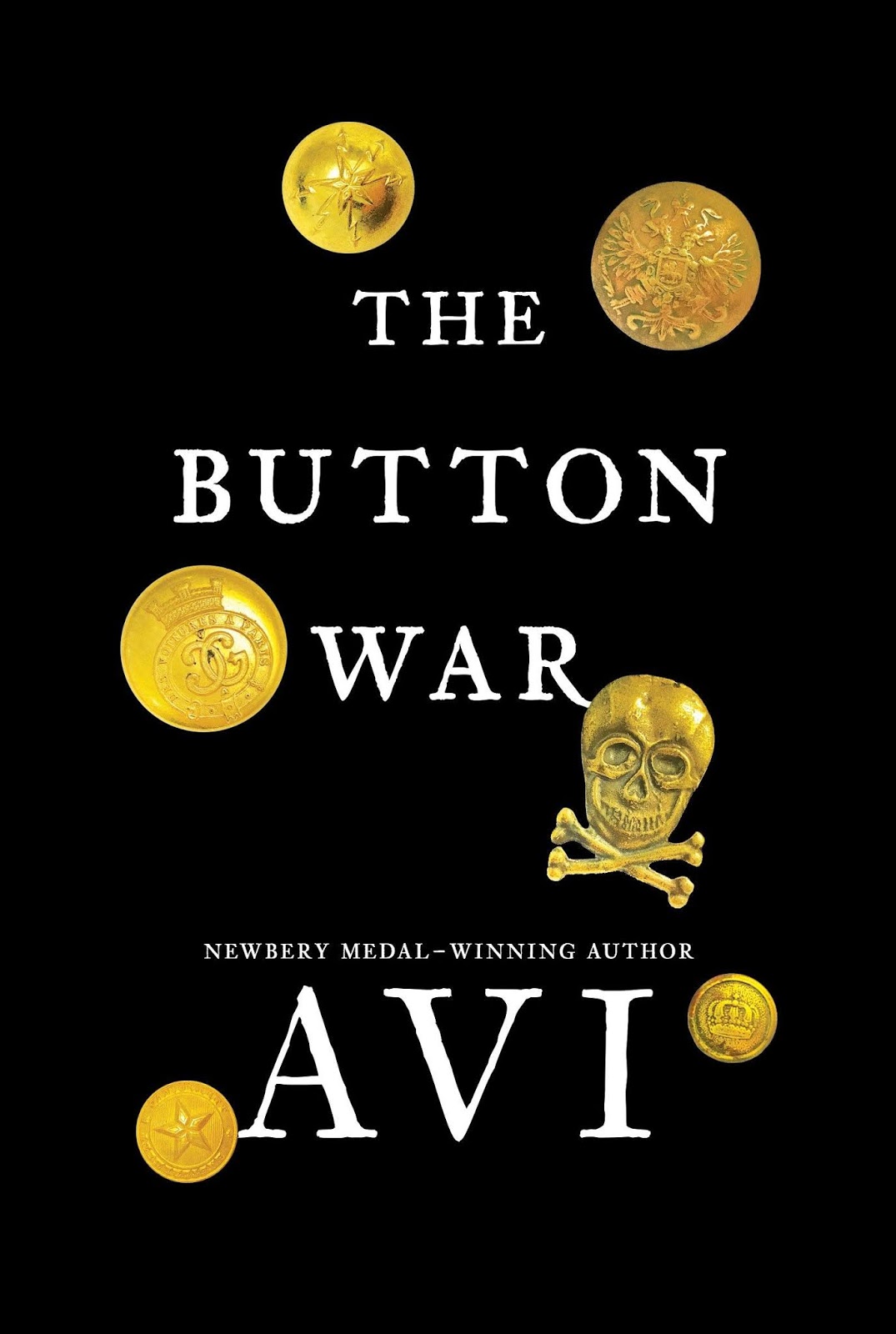
The Button War: A Tale of the Great War by Avi
Jurek believes the ruins are those of an old castle belonging to Poland's first king, King Boleslaw the Brave. He claims to be the descendant of this ancient Polish king and that he owns both the ruins and the surrounding forest. However, the boys mostly think this is a joke. Jurek is the leader of the group, the one who thinks up new things for them to do and who is always daring them. Jurek lives with his eighteen-year-old sister in a one-room shack on the edge of the village. His sister washes the uniforms of the occupying Russians and in this way supports them as their parents are both dead.
Patryk is more fortunate as he lives with his parents in a three-room wooden house with a main room that serves as his parent's bedroom, a kitchen and at the back, his father's workshop. Patryk's father is "a wheelwright repairing and making wooden wagon wheels." Patryk is learning this trade from his father.
One day Patryk finds a small rusty button near the castle ruins. Jurek wants the button and tries to get Patryk to give it to him. When he refuses, Jurek becomes enraged, screaming and threatening Patryk with a large stick. Patryk holds his ground and then tosses the button into the forest. He is shocked by the hatred he sees in Jurek's face.
Later in August, as Patryk is going to school he witnesses the bombing of the old wooden school house by the Germans. It burns to the ground, killing the school teacher and a nine-year-old boy named Cyril. Makary wants to know why the war has come to their tiny village. The boys tell him that although the village is in Poland it has belonged to Russia.
Raclaw reveals that his father was told by the Russian commandant Dmitrov that they are leaving the village because the Germans are advancing. Meanwhile Jurek and Patryk take Raclaw to Jurek's backyard where he too cuts a button off a Russian uniform hanging on the clothesline. Jurek claims that his button with the knight fighting the dragon is the best.
The three boys leave for home but Patryk, wanting to get a Russian button like Jurek's and realizing that with the Russians leaving this might be his only chance, sneaks back to Jurek's house. He steals a button, one that is exactly the same as Jurek's.
The next morning the seven boys watch from the village water pump as the Russians march out of the village.They discuss the withdrawal of the Russians and the coming of the Germans. Jurek brags about his button but when he sees that Patryk has the same button, he becomes enraged and then announces his dare. "Wait! Got a great idea! We'll have a contest! Whoever gets the best button wins. Winner gets to be king. Means everyone has to bow down to him. Best dare ever. Buttons." Jurek insists that they cannot ask for a button but must "get" one.
Shortly after this the German's bomb the retreating Russians. Jurek leads the boys out of the village, to where the bombing happened, and they find many dead Russian soldiers. Jurek determined to find a winning button, climbs into a bomb crater. All the boys follow him but Patryk who is disgusted. This doesn't resolve the button challenge however, and Jurek tells the other boys they must wait until the Germans arrive to get better buttons.
Back in the village the boys decide to scavenge through the ruins of the school house. Ulryk uncovers their late teacher, Mr. Szujski's wooden cane that he used to beat the students with. Jurek snatches the cane away from Ulyrk, insisting that the boy who wins the button dare - the button king - should have the cane. He promptly strikes Drugi hard on the arm. Remembering Jurek's anger in the forest, Patryk knows he cannot let Jurek win the cane or the button dare. "Knowing that if Jurek won the cane, he would use it in the worse way -- as he just had. And that told me that I absolutely couldn't let Jurek be the button king. He'd go crazy."
Patryk's worst fears are realized in ways not even he could have imagined, as the button dare escalates and pushes the boys into the most dangerous of situations.
Discussion
Avi whose real name is Edward Irving Wortiss is the author of many acclaimed children's and teen novels. Like many of the best stories, The Button War had its germ in a story Avi was told by his father years ago. On Avi's website he explains his father's story:
"The story he told was rather unusual. He was raised in a village somewhere in Eastern Europe, but with so many national boundary changes, he could not even say precisely which country. During World War One, he said, his village was invaded and taken over by now this army, now that, from different nations. When these armies took over his village, the soldiers commandeered the women to wash their uniforms. Once washed, the uniforms were hung out to dry. The boys in the village—so my father-in-law related—would sneak about, cut the buttons from the uniforms, collect them, and trade them amongst themselves. This in the midst of The Great War."
As Avi explains, the button dare, which escalates, becoming both increasingly reckless and violent, mimics the escalating conflict that was to become the Great War. The boys begin by stealing buttons from Jurek's sister's clothesline, but are soon retrieving buttons from dead soldiers. From this they quickly move to following the soldiers and eventually even becoming involved in the conflict. The consequences are terrible.Their desire to collect buttons knows no bounds and directly results in the deaths of several of the boys; Drugi is beaten to death by an Austrian soldier for attempting to steal a button and Wojtex is executed for having a Russian button because the German's believe he is a traitor. Jurek's desire to obtain the best button leads him to become involved with the Russians helping them to set up the ambush of German soldiers which results in Raclaw being seriously wounded. As the boys are either killed or drop out, the contest becomes one between Jurek and Patryk.
Through the character of Patryk, Avi demonstrates how its possible to lose sight of what is right and be drawn further into a conflict. While many of the boys are eager at first to partake in Jurek's dare, only Patryk seems to understand the consequences should Jurek win.Patryk was the biggest and the strongest of the boys. His father tells him that God made him this way "to help the weak." Mindful of this, Patryk stays in the dare to try to win because he knows that Jurek will treat the other boys in a brutal manner if he becomes the button king. However, fighting on Jurek's terms doesn't help, as Patryk discovers, because Jurek keeps changing the conditions of the dare. As long as Patryk continues to play by Jurek's rules, he loses and becomes more and more like Jurek and is drawn in deeper. Just as Jurek does, Patryk desecrates the dead by stealing buttons from them and he steals from the living. He risks his life several times, all for buttons. He just can't seem to quit and walk away.
It is actually Ulryk, the boy who wants to be a Catholic priest, who does the right thing. He goes to Father Stanislaw, confesses and then throws his buttons in the river. When Patryk tells him that if he leaves, Jurek will be king, Ulryk, responds, "Not for me." and walks away. Even after Makary is killed by Jurek, Patryk still doesn't give up. He still intends to beat Jurek but the war intervenes. It doesn't stop Jurek who will now kill anyone to win. Finally Patryk does what Ulryk did - he throws the one button he still has away in disgust and runs out of the village to find his parents.
All of this is an allegory for the madness of the Great War where countries fought for four years over small patches of mud-filled, cratered, blackened land for no reason and where men were executed for desertion or bullied into enlisting. Even when it was obvious that no one was winning and that millions of lives,both soldiers and civilians were being lost, no one country would call a truce and end the war. Like the boys in the button war, the leaders of countries involved in World War I lost sight of what they were fighting for and why they were fighting and if they should even continue to fight the war.
The Button War, reminiscent of William Golding's Lord of the Flies, is a dark, tragic novel. It is well written, with realistic characters and a well-created setting that portrays life in a village caught in the middle of a war.
Book Details:
The Button War: A Tale of the Great War by Avi
Somerville, Massachusetts: Candlewick Press 2018
229 pp.
Wednesday, August 2, 2017
DVD: The Promise
The Promise is a fictional account of the systematic extermination of the Armenian Christian population undertaken by the Ottoman Empire during World War I. This event has become known as the Armenian Genocide. The movie, directed by George Kelly was made partly to bring attention to this war crime which has never been acknowledged by many Western countries nor by Turkey.The story begins on the eve of World War I in 1914, in the vast Ottoman Turk Empire. The story is narrated by Michael Boghosian whose family have been apothecaries in the village of Siroun, Southern Turkey for two hundred years. They have served both Christians and Muslims.
Micheal wanted to study medicine at the Imperial School of Medicine in Constantinople but could not afford the fees. He became engaged to Maral and it was decided that he would use the money from her dowry to go to medical school and then return to Siroun to marry her.
At the engagement party, Maral's father Harut gives Michael four hundred gold coins and tells him to make them proud. Michael's father, Vartan gives him a letter for his Uncle Mesrob who lives in Constantinople. Michael tells Maral that he will do the three years of medical studies in two years.
Michael travels to Constantinople where he meets Mesrob, his wife Lena and their two daughters, Yeva and Tamar. He also meets Ana Khesarian, daughter of a famous violinist who is tutor to the Boghosian children. At medical school, Michael meets a Turk, Emre Ogan who is not really interested in medicine but had to choose between it and the military. That Emre is not suited for the medical profession is shown when he faints during a dissection.
![]() |
| Ana and Chris Myers |
At the party, German warships fire a salute, scaring many who are in attendance. Chris confronts the Germans in attendance, resulting in Emre's father stating that Turkey has every right to have a strong navy to protect its borders. Chris counters that the Turks want to expand their borders and declare war on the infidels - the British, French and Russians. When the German's break out in singing the national anthem, Chris reminds Michael, that the Armenians are the resident "infidels" and will be the first to be attacked.
![]() |
| Michael attempts to register for a medical school exemption. |
Meanwhile Emre is confronted by his father who questions him about the exemption given to Michael Boghosian. Dr. Nazim does not accept Emre's explanation that Michael is a friend, telling him the Armenians are a tumour on the nation that must be removed. Michael returns to Mesrob's home where he is made an offer by his uncle to buy him out of his betrothal to Ana. Michael refuses stating he has made a promise that he intends to honour.
Chris's investigations reveal that Armenian villages are being burned to the ground and men are being hanged. He also discovers hundreds of people being marched into the desert and witnesses a woman being shot in front of a small child. Meanwhile in Constantinople, things begin deteriorating. After returning from a concert at the cathedral Ana and Michael barely escape from raging Turks who destroy Armenian shops and beat Armenian citizens in the streets. At this time, Mesrob is arrested, leaving Lena alone with their daughters.
During this night, Michael and Ana become intimately involved. The next day they visit Lena and learn that Mesrob has been taken to Sikedji Prison where he is being investigated for treason. Michael takes the remaining gold from his dowry and he and Emre attempt to bribe the Turks at the prison to release Mesrob. Instead, they take his gold and Michael is arrested while Emre is forced by his father to enlist in the military.
What Chris has feared has come to pass - the Armenians are being slaughtered by the Turks, who are determined to rid themselves of infidels. Determined to reveal to the world what is happening Chris contacts American Ambassador Morgenthau. Chris becomes determined to save the woman he loves and as many of the Armenians as possible. He will barely escape with his own life while most of those he has come to love will not be so fortunate.
Discussion
The Promise is a moving tribute to the 1.5 million Armenian Christians who were systematically murdered during World War I by the Turk government. Although there had been previous massacres, for example the Hamidian massacres in the late 1800's by Sultan Abdul Hamid II, international pressure had been brought to bear to stop these massacres. This was not the case in 1915. Instead, western governments dallied when confronted by what was happening, at the expense of millions of lives.
Wonderful performances are given by Oscar Isaac who plays Michael Boghosian, as well as Charlotte Le Bon and Christian Bale who portray Ana Khesarian and Chris Myers respectively. A strong cast of secondary characters, Marta (Shohreh Aghdashloo), Emre Ogan ( Marwan Kenzari ) and Faruk Pasha (Tamer Hassan) round out the cast.
![]() |
| French helping Armenians onto French warship at Musa Dagh. |
The movie's final scenes portray the attack on over four thousand Armenians at Musa Dagh and their rescue by the French. Chris, Michael, Yeva and Ana are among those making their way to the shore along with other survivors. In fact, on September 12, 1915, the French Navy rescued more than four thousand trapped and unarmed Armenians from Musa Dagh mountain.
The obfuscation of Turkish officials when questioned is very effectively portrayed, particularly in the scene where Ambassador Morgenthau confronts Turkish officials. Not all Turks are portrayed badly; Emre Ogan loses his life for helping save the life of his friend Chris Myers and the Deputy Consul warns Pastor Merrill at the American mission that Faruk Pasha will spare no one and they should leave at once.
Unfortunately, the development of a love triangle involving Michael, Chris and Ana detracts from the main focus of the film. The Armenian Genocide is such a significant human story it doesn't require a plot device like a love triangle to engage viewers. Where the film succeeds is in portraying the humanity of the Armenians who love, marry and have children while the world around them goes to hell. Overall though, The Promise mostly succeeds in portraying a significant event of the 20th century and one in which the term "genocide" was first used to describe the systematic killing of a race of people. It is hoped that more films will be made to educate people on a genocide the much of the world still refuse to acknowledge.
Sunday, June 11, 2017
Movie: Wonder Woman
Jenkins is a fan of the origin story and that's where her movie begins. A young Diana born to Queen Hippolyta of the Amazons is growing up on the Island of Themyscira which is hidden from the human world. Young Diana is determined to train like the other Amazon warriors but she is discouraged by her mother. Queen Hippolyta.
Her mother tells her that the god Zeus created mankind who lived happily and peacefully with one another. However, Zeus's brother Ares, the god of war, hated men. He stirred up discontent and anger among men which caused wars. Ares slew all of the other gods when they attempted to kill him. Zeus, using the last of his powers, attempted to stop Ares but only wounded him. Before he died, Zeus left mankind a secret weapon, the Godkiller, The Amazon's lived on the Island of Themyscira which was protected from the outside world by a special believe the Godkiller is a sword. Queen Hippolyta will not allow her sister, General Antiope to train Diana, however, the two begin training in secret. When they are discovered Antiope convinces Queen Hippolyta to allow her training to continue.
One day when Diana is a young woman, she sees a plane crash into the sea. Realizing that there is someone drowning, she dives off the cliffs into the sea and rescues the pilot. That pilot is Steve Trevor. Trevor has almost no time to catch his breath before the island is attacked by the Germans who have been chasing him. The Amazon's rush to the beach and engage the Germans in a battle to the death. They slay all the Germans but General Antiope is killed saving Diana.
Trevor is taken by the Amazons and questioned using the Lasso of Truth. He reveals that he is an American spy working for British intelligence and that there is a horrible war happening in the outside world, the Great War, a "war to end all wars" that is never-ending. Trevor tells the Amazons that he has stolen the notebook of a scientist, Dr. Maru, who has created a terrible new poison gas. Maru is under the direction of General Ludendorff who believes this gas is the key to Germany winning the war. Maru and Ludendorff must be stopped as the Britain and Germany are in the process of negotiating an armistice. Trevor needs to get back to England so he can give the notebook to his superiors.
Diana believes that Ludendorff is Ares and she sets out with Trevor to return to England. At first she does not have Queen Hippolyta's permission but Diana stands up to her mother and tells her she cannot stand by while innocent people are being killed. She takes the sword and sails for England.
As Diana and Steve work to stop Ludendorff and Dr. Maru and end the war, the must face the dangers of No Mans Land and treachery from an unexpected traitor who is revealed to be the real Ares.
Discussion
Wonder Woman is by far the best DC Comics movie to date. There's a good storyline focusing on the origin of Wonder Woman, a solid cast and epic battle scenes. But more than that DC portrays a superhero who offers something more than just brute strength. Former Israeli soldier and Miss Israel, Gal Gadot shines as Diana who is Wonder Woman. The movie opens with the origin story of Wonder Woman and goes on to tell how a young, naive Diana comes to be the greatest female warrior - Wonder Woman. Patty Jenkins, the movie's director has unabashedly stated that she had a particular vision of what Wonder Woman would look like:
“I, as a woman, want Wonder Woman to be hot as hell, fight badass, and look great at the same time — the same way men want Superman to have huge pecs and an impractically big body. That makes them feel like the hero they want to be. And my hero, in my head, has really long legs.”
Wonder Woman offers a different kind of female hero, one with a more authentic feminism that is aligned with the reality of woman. It is a feminism that is based on strength, independence, courage and compassion. Wonder Woman is a superhero who shows that women can offer the world something else besides physical strength and brute force; compassion, courage in the face of terrible odds and truth. When told why the land between the German and Allies front lines is called "No Man's Land" , Diana remains undeterred. She will attack and move the battle forward. When advised to abandon the German-occupied village of Veld, Diana is moved by compassion and determined to free them. When goaded by Ares to view humans as corrupted and to help him destroy mankind, Diana not only resists but destroys her half-brother. She refuses to kill the villainous Dr. Maru, remembering the words of Steve. She is the very opposite of Ares, offering mankind not war but peace. In this we have a very different kind of superhero. Patty Jenkins describes how Wonder Woman is different from the male superheroes:
"The thing about 'Wonder Woman,' which is very feminine and definitely different, is that her objective is to bring love and truth to mankind. It's not to stop any specific villain and it's not to fight and it's not to stop crime. She'll do all of those things in such a bad-ass way you can't believe it to defend you. And so it's an interesting other thing that brings that moral perspective into it."
The Wonder Woman character was created by William Moulton Marston in 1940. The comic book world at that time had only male superheros. This superhero was to be different because sh would conquer using love and truth. Marston who was a psychologist felt that women did not find their role in society as appealing because their feminine characteristics of love, compassion and truth were seen as weaknesses. So Marston set out to create a character who had these strengths but was also beautiful and powerful. Marston who lived in an open relationship with his wife Elizabeth and another woman Olive, based Wonder Woman mostly on Olive.
In a nod to Marston, the movie draws from his original 1940's comics but also the revised comics by George Perez published in the 1980s. It ties Wonder Woman into the overall DC universe in various ways. For example Diana receives a photograph of herself with Steve Trevor from Bruce Wayne, aka Batman. Several of the costumes, that of Ares and Dr. Maru are replicates of those from earlier editions of the Wonder Woman comics.
Wonder Woman is an enjoyable action movie, with epic battle and fight scenes, beautiful cinematography and solid performances by many of the cast. Chris Pine as Steve Trevor is a realistic love interest for Diana showing the young goddess superhero that humans have some redeemable qualities. He sacrifices his life to destroy Ludendorff's poison gas plane and demonstrates that humans are capable of doing good deeds.
There is some sexual innuendo in the first third of the movie, demonstrating Diana's isolation from the world of men but not portraying her as ignorant, and likely more for comic relief. There is also a frontal nudity shot - from a distance of actor Chris Pine. Not really necessary but Hollywood seems to think it so. It's unfortunate because many young teen girls might be interested in seeing this movie but will be exposed to this unnecessary nudity that has really nothing to do with the storyline and is merely gratuitous.