Monday, November 14, 2022

Tales of the Prehistoric World: Adventures From the Land of the Dinosaurs by Kallie Moore

For dinosaur aficionados, Tales of the Prehistoric World is book filled with some of the most interesting fossil discoveries over the last two hundred years or so.

Tales of the Prehistoric World opens with information on the Geologic Time Scale which geologists have devised to organize the previous four and half million years of Earth history and brief descriptions of the the five major extinctions that occurred during this time.

Chapter One The Beginning presents a description of two billion years of the PreCambrian when life was just getting started. Moore then quickly moves into the Paleozoic Era in Chapter Two when all of the major animal groups appeared in the Cambrian, around 500 million years ago. Life moved onto land from the ocean and a supercontinent named Pangea also formed. Moore includes the discoveries in the Burgess Shale, a story about the largest trilobite, the age of armored fish, and the appearance of the giant arthropods (insects) of the Carboniferous and Permian.
 
Chapter Three is all about the Age of Reptiles which includes the reign of the dinosaurs during the Jurassic. After explaining the formation of Pangea, Moore highlights the first giant dinosaurs, the sauropods (think Diplodocus and Brachiosaurus) and goes on to describe many interesting and unusual fossil finds, each one increasing our knowledge about dinosaurs. Of course no discussion of dinosaurs would be complete without an entry on Tyrannosaurus Rex. Several famous fossil hunters are also featured including Mary Anning considered  and the rivalry between Othniel Charles Marsh and Edward Drinker Cope. This chapter ends with the currently accepted theory of the cause of the demise of the dinosaurs.

In Chapter Four, Moore explores the post-dinosaur world.The Cenozoic began 66 million years ago and is the Era we currently live in. After the demise of the dinosaurs, with the exception of those who would evolve into birds, the age of mammals. Many other animals grew to enormous sizes such at Titanoboa. Primates evolved and from them our ancestors developed. There were a series of ice ages that changed the way the continents looked.

Discussion

Tales of the Prehistoric World focuses on describing some of the more interesting dinosaur fossil discoveries in the last one hundred and fifty years and how those discoveries have helped scientists piece together the reign of the dinosaurs.

To help younger readers understand where dinosaurs fit into the history of our planet, Kallie Moore, a paleontologist, begins with what geologists and paleontologists believe they know about the beginning of life on Earth. The development of life, from single celled organisms to increasingly more complex ones is presented until the Age of Reptiles in which many different types of dinosaurs and how we came to learn about them are featured. The stories after the demise of the dinosaurs are short and sweet, ending abruptly with the Last Mammoth.

Many unusual dinosaur fossils are featured including a frozen reptile fossil found in Antarctica, unique dinosaurs from prehistoric China, the gemstone dinosaurs of Lightning Ridge in New South Wales, Australia, the remarkable story of the lost and then found again fossils of Spinosaurus, the Egg Mountain site in Montana, the unsolved questions about triceratops, and of course the infamous Tyrannosaurs Rex.

The one drawback to this book is the sometimes uninspiring artwork that accompanies each story. Digitally created, the illustrations at times can be confusing as to what they are attempting to portray. With so many fascinating stories that use many correct terms for various dinosaurs, the illustrations simply aren't up to the same level. For example, one story, The Seafaring Ankylosaur is about the  discovery of an almost complete anklyosaur from the Millenium Mine, a huge oil sand quarry in northern Alberta in March, 2011. Shawn Funk, a heavy-equipment operator was digging in the quarry when he noticed a change in coloration and texture of the rocks. His excavator had already chewed off the tail and back end of the fossil. Funk contacted his supervisor who then reached out to the Royal Tyrrell Museum. When geologists arrived they realized that Funk had discovered the fossil remains of a dinosaur. This fossil specimen was particularly special because it had fossilized features like skin that are normally not preserved. For some reason, Moore doesn't mention the location of this remarkable discovery ( oil sands outside of Fort McMurray) that received much press and the accompanying small map showing the location of the fossil discovery in Northern Alberta is meaningless without any labels. (During the time the ankylosaurus lived, North America was split by a large, inland sea.) Was this just a general oversight or was the location of the discovery in the environmentally contentious oil sands to blame?Because the recovered fossil is so unique, a photograph accompanying this story would have been so much more engaging.

There is also no information about the author, Kallie Moore, except in the introduction to the book where she identifies herself as a paleontologist, nor about the illustrator, Becky Thorns. An online search reveals that Moore is the Fossil Librarian, at the University of Montana. 

Still, readers interested in dinosaurs will find Tales of the Prehistoric a great overview of just how much we've learned about dinosaurs over the past one hundred years.

Book Details:

Tales of the Prehistoric World: Adventures From the Land of the Dinosaurs by Kallie Moore
New York: St. Martin's Press
159 pp.


Thursday, November 10, 2022

A Book, Too, Can Be A Star by Charlotte Jones Voiklis and Jennifer Adams

How author Madeleine L'Engle came to write her most famous book, A Wrinkle In Time is told is this picture book written by her granddaughter, Charlotte Jones Voiklis.

The story begins with the background of why stars were so important to Madeleine. One starry, brilliant night when she was a baby, Madeleine's "parents woke her and took her outside to see the splendor of the starry night sky." To Madeleine the stars seemed to be singing and "she realized that there was more to her world than daylight".

Madeleine's father was a writer and her mother was a pianist. Watching her father work she realized that writing offered a way to ask questions. Madeleine noticed that the piano often calmed her mother.

Madeleine was an only child and she was often alone as her parents attended fancy parties. They lived in New York City, not far from the Metropolitan Museum of Art where Madeleine enjoyed looking at paintings. Madeleine thought music and art were also another way of asking and answering questions. This led Madeleine to begin writing her own stories that would also ask and answer questions. She felt that " a book can be a star - a new and fiery creation that can shine light into a dark universe" if someone had a difficult question or felt unsure.

Madeleine continued to write all through her difficult school years when she was sent to a boarding school and later on when she went to a less strict school where she made friends more easily. After college, during the Second World War, Madeleine moved to Greenwich Village in New York City and often visited the planetarium. She also began acting and was able to publish her first novel, The Small Rain. During this time Madeleine met another actor, Hugh Franklin and they fell in love, married and moved to a farmhouse in Connecticut. While Madeleine continued to write, Hugh ran the general store. They now had a family of three children.

Hugh decided he too wanted to tell stories and return to acting so they first took a camping trip across the country before making the move back to New York City. It was in a place called the Painted Desert that Madeleine was inspired by the glittering star filled skies, to write a very different story. The book was finished by the time the family arrived in New York City and at first was rejected by publishers. But when A Wrinkle In Time was published, adults and children loved the book. Madeleine continued to write and to encourage her fans to write too.

Discussion

Madeleine L'Engle's granddaughter, Charlotte felt inspired to write a book about her famous writer-grandmother. Initially, she wrong a first draft of a picture book, but the publisher wanted something very different. So that book was Becoming Madeleine, a middle-grade biography. Charlotte and another author, Jennifer Adams eventually connected to create A Book, Too, Can Be A Star. For Charlotte, the importance of stars was to be the underlying theme of the book - the idea that the world is connected and filled with beauty. The book would begin with the very early and impressionable memory Madeleine had of the starry night sky.

In the note, Why Stars? at the back of the picture book, the authors write, "...the night sky was an important part of how Madeleine nurtured a sense of connection to other beings and to the universe." It's like the sky gave Madeleine a sense of the inter-connectedness of everything, not just among the stars, but here on Earth too.

The title comes out of Madeleine's Newbery Medal acceptance speech in which she talked about how books can enlarge our view of the world, the universe, opening us to new ideas and experiences.

Helping tell Madeleine's story is the vibrant illustrations of artist Adelina Lirius who created them digitally using Procreate. Some aspects of the illustrations were done in a traditional manner using gouache.

A Book, Too, Can Be A Star highlights Madeleine's fortitude and perseverance, as she overcame some difficult years as a shy student in a very rigid boarding school. Madeleine found her own way through writing and acting, using stories to ask questions and seek answers. Inspired by the beauty a the star-filled sky, Madeleine's book, A Wrinkle In Time became a classic for all ages.

Likewise, this is a beautiful and engaging picture book for all ages.

Book Details:

A Book, Too, Can Be A Star: The Story of Madeleine L'Engle and the Making of the Wrinkle in Time by Charlotte Jones Voiklis and Jennifer Adams
New York: Farrar, Straus Giroux   2022

Wednesday, November 9, 2022

The Elephant Girl by James Patterson and Ellen Banda-Aaku

Twelve-year-old Jama Anyango lives with her mother in their manyatta that contains only four enkajijik which her mother built by hand. Surrounding the four huts is a boma, a thick fence of vines to keep out the wild animals. Jama's Baba died four years earlier from an infected cut on his hand.To make ends meet, Jama's mother makes sandals that are much prized and are sold in the city.

Jama and her mother are Maasai and they are preparing to attend the Eunoto ceremony, a traditional Maasai coming of age for the boys in their village. In the past, Maasai boys would live together for ten years in the manyatta, learning how to survive in the bush. Today the tradition is different, as the Maasai no longer move their people and cattle from place to place.

Jama goes to meet her father's great-aunt, Kokoo Naserian who is believed to be around one hundred years old. She was born about ten seasons after the British forced the Maasai from their lands in 1911. Together they walk to the village center to enjoy the celebrations.
 
At the Eunoto ceremony, Jama meets up with her best friend, Nadira and some other girls. While Nadira and the others are interested in boys and getting married, Jama finds herself interested in having the same freedom and power as the boys: attending university and learning how to help the animals. At the celebration, all the girls are  focused on the new boy, Keku who arrived a few months ago with his father Solo Mungu. Keku's father, who works for the Kenya Wildlife Service, is the new head ranger responsible for stopping the poaching in the Naibunga Conservatory. The conservatory lands border Jama's village.

At the ceremony and celebrations, Jama realizes that Nadira and the other girls have been invited to Fatima's family's small safari lodge. So she decides to leave the party early but on her way home overhears Solo Mungu mistreating his wife and Keku.

Jama decides to visit the elephants at the watering hole a few days later to shake her dark mood. She discovered them one day four years earlier after wandering past the boundaries her mother had set for her to be safe. Jama didn't return to the water hole again for some time but she soon found it to be a place of escape and peace. She came to name some of the elephants: the leader was Shaba and there was Lulu, Tabia, Bawa, Modoc and Loasa. This time Jama sees Shaba with her baby elephant whose birth she witnessed weeks earlier and who Jama has named Mbegu.
 
Then on another visit to the watering hole, Jama sees the elephants react with fear. Hiding behind a tree she witnesses a strange man with a raised scar on his left cheek, carrying a gun, and dressed in black. When the elephants and the man move off, Jama begins to walk home but encounters Leku. At the gate to the reserve they see Leku's father in a Kenya Wildlife Service Land Rover and Jama wonders why he hasn't caught the strange man. 
 
Then Jama learns that a poacher has killed one of the elephants in the middle of the night. The village laibon, or spiritual leader warns the villagers about the poachers and that this may make the elephants stampede recklessly. At a village meeting, Kokoo Naserian confronts Solo Mungu over his inability to stop the poachers. Later on that night, Jama sneaks out of the manyatta and sees Mungu taking money from a prospective poacher. When she is discovered hiding, Jama flees with the help of Leku.

However, when Jama and her mother go to the river to do their washing the next day, they are surprised to see the elephants, Lulu, Shaba and Mbegu. Jama decides to confess to her mother that she has been going to the reserve to visit the elephants. Although her mother is disappointed, she is more concerned about Jama's safety. Then the unexpected happens. The elephants move closer to the people at the river and without much warning, Shaba charges. Terrified, Jama begins to run. In the aftermath, life is changed forever for Jama and for Mbegu.

Discussion

The Elephant Girl highlights the issue of illegal poaching and wildlife conservation in Africa, using the story of a fictional young Maasai girl, Jama Anyango who stumbles upon poachers threatening a group of elephants she has been observing. Jama courageously protects a young baby elephant from her villagers who want to kill it in revenge for stampeding and killing her mother. Ultimately her determination and courage set her upon a path that leads to working with rescued elephants at the David Sheldrick Wildlife Trust, a real life organization involved in the conservation, preservation and protection of wildlife including the African elephant and black and white rhinos. The Shelfrick Trust was established forty-five years ago and is the most successful elephant orphan rescue and rehabilitation program in the world. It is based in Nairobi, Kenya but also has a field station in Tsavo East National Park. They work along Kenya Wildlife Service, the Kenya Forest Service and local communities bordering Kenya's National Parks.

The Elephant Girl also portrays the journey of a young Maasai girl, Jama, who while initially insecure, has big dreams for herself.  Jama wants the same freedom and power as the boys in her own village have; to get an education and to be involved in something that deeply matters to her, in this case, elephants. The authors have crafted a likeable heroine, a girl willing to take risks, demonstrated for example in her returning to the watering hole, in protecting Mbegu the baby elephant in danger, and writing to her great-aunt to tell her about the corrupt practices of Solo Mungu who should be protecting the elephants. Readers will learn a something about Maasai history and culture with the authors having incorporated a few Maasai words into the story.

This well-paced story also highlights the issues of physical abuse through the character of Leku and also trauma and loss with Jama who has already lost her father and then loses her mother in the traumatic accident of the elephant stampede. The novel doesn't get bogged down with either of these issues but the authors have the characters experience them in a way that seems realistic: Leku runs away and attempts to live in the forest, while Jama experiences years of sadness and loneliness over the loss of her family.

What this novel could have incorporated is a map showing the location of Kenya in Africa and also of the Sheldrick Trust and a detailed note about the Maasai. Overall, the colourful cover and engaging story make The Elephant Girl an engaging read for juvenile readers who love animals.

Book Details:

The Elephant Girl by James Patterson and Ellen Banda-Aaku
New York: Jimmy Patterson Books/Little, Brown and  Company      2022
261 pp.

Thursday, November 3, 2022

The Whale Who Swam Through Time by Alex Boersma and Nick Pyenson

In The Whale Who Swam Through Time, the life cycle of the bowhead whale, the longest living mammal is explored.

The bowhead whale can live a long time, so this story begins two hundred years earlier, with a young bowhead whale who rests with her mother in the cold, Arctic water. They encounter boats, some are small, others are large, wooden boats with sails. The young whale is just a calf, but within the year she will set out on her own. First she must learn how to break through the thick Arctic ice using her curved snout and eat using her baleen, thick long bristles that filter tiny sea animals including copepods out of the water.

With the passing years, the bowhead whale grows larger and larger until at twenty-five years she is fully grown.

One hundred and fifty years ago, the young whale migrates to a bay with her calf, the fifth she has given birth to. The waters are calm and clear, so sound travels easily. However, the bowhead must deal with whalers who have come to hunt her for her blubber which is used for oil and food. These whaling ships are noisy. The whale and her calf narrowly miss being harpooned, as they dive deep into the oceean.

Fifty years ago even more changes have come about. The whale is now over one hundred years old. Whaling ships have been replaced by large oil platforms. The ocean is no longer quiet. There is the clang of the oil rig's machinery, the roar of a cargo ship's propeller and the pink of a submarine's sonar. These sounds travel very far underwater and make it hard for the bowhead whale to hear the calls of her grandchildren.

Today, the grand bowhead whale is noticing less sea ice, more ships and the danger from their propellers, more oil spills, more fishing lines and plastic garbage in the oceans.But the warmer oceans also mean more food and more whales.What will the next two hundred years hold for her grandchildren?

Discussion

The Whale Who Swam Through Time is an exquisite picture book about the life of the bowhead whale. Boersma and Pyenson focus on telling the story of one whale's life span and the changes she would have experienced over the last two hundred years. This is done using short paragraphs accompanied by the beautiful artwork of author/illustrator Alex Boersma. Although the text is filled with interesting facts about bowhead whales, it is the rich illustrations in a blue, grey and white palette that truly captivate the reader. The illustrations were rendered in" watercolor, gouache, and colored inks on hot press watercolor paper, and finished in Adobe Photoshop."

The authors have included a detailed section at the back of the book that offers much more information on bowhead whales and other Arctic creatures, as well as whaling and on the Inuit peoples in the Arctic. In their Author's Note, Boersma and Pyenson mention that they wondered when you live for over two hundred years, "...what is it like to see the word change around you? That question was the starting point for this book." Writing this picture book required the authors to use their imaginations. "We'll never understand how bowheads experience time, or how they perceive or feel about the changes in their environment, but we hope that this book helps you to both imagine how other creatures exist in this world and consider how our actions impact them." What a great goal to aspire to!

Book Details:

The Whale Who Swam Through Time by Alex Boersma and Nick Pyenson
New York: Roaring Book Press   2022

Monday, October 31, 2022

One Turtle's Last Straw by Eliza Boxer

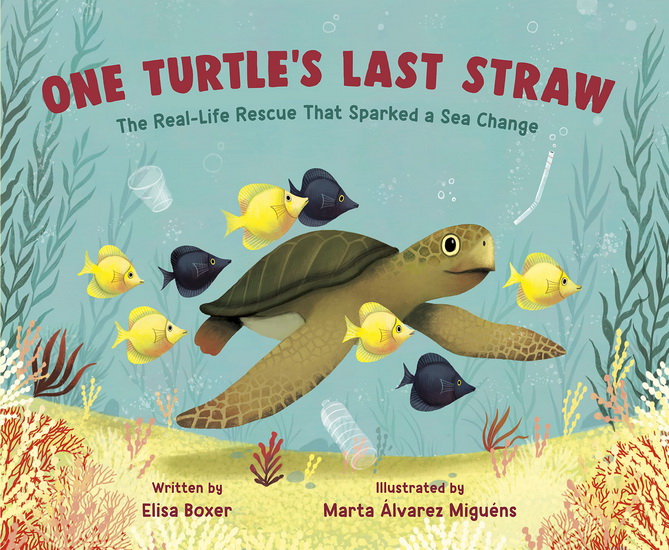
This nonfiction picture book is about a real event that occurred while a group of scientists were working on the ocean. In 2015, Christine Figgener was gathering data for her Ph.D. research off the coast of Costa Rica. They had captured a sea turtle and it appeared to have a barnacle in one of its nostrils so they decided to remove it. Instead, it was found to be a 10cm length of a plastic straw. While struggling to remove the straw, Christine filmed the successful process and then uploaded the video to YouTube. The video went viral and the movement to eliminate plastic straws was born. One Turtle's Last Straw is about that incident and plastics in our oceans.

In One Turtle's Last Straw, the story begins with the straw. A young boy sucks up the last drops of his drink and discards the cup and straw into the trash container. However, the wind lifts the cup out of the trash and sends it swirling down the street where the straw falls through the grate in the street and into the storm sewer. There is finds its way into the ocean. 

 In the ocean a young sea turtle swims through the water but soon becomes caught up in a fishing net. Struggling to free himself, he begins to run out of air but manages to twist free in time. Now hungry he spies a crab on the sea floor and catches it. But in swallowing the delicious crab, he also swallows the plastic straw. When he goes to pass seawater out of his nose, something hard gets stuck. The object is partly wedged in his nose and in his throat making it difficult to swallow. As the weeks pass by, the turtle struggles to survive, unable to smell his food and eat properly.

Then one day he finds himself pulled out of the water off the coast of Costa Rica by some marine biologists who are studying the olive ridley sea turtle. At first they think the object in his nose might be a barnacle but when Dr. Nathan Robinson attempts to remove it, he manages to remove a small piece. Dr. Christine Figgener another marine biologist identifies it as a piece of a plastic straw. She continues filming their efforts to help the turtle, who is hissing and squirming. Eventually they manage to pull out four inches of plastic straw and the turtle stops struggling and is able to breathe now. The turtle is cleaned up and set free, back into the waters around Costa Rica. 

Meanwhile, months later, a young girl dining in a restaurant decides to forgo having a plastic straw in her drink.

Discussion

One Turtle's Last Straw offers young readers the opportunity to learn about the problem of plastics in the world's oceans by portraying a real life event a group of marine biologists experienced during their research. While out on the ocean, off the coast of Costa Rica, they came face to face with the negative impact plastics can have on marine life. 
 
Boxer opens her picture book by providing her readers with a possible scenario describing how a plastic straw might end up in the ocean and how these single-use plastics can have unexpected consequences on the marine environment. The little boy using the straw in the opening panel, had no idea that his straw would end up, not in a landfill, but in the ocean. Once in the ocean, plastics do not readily breakdown and sometimes stay in their original shape for years. It is shown lying on the sea floor, mostly intact.  These plastics are often mistakenly ingested as foods, for example, whales have been found with their stomachs filled with plastic bags. They can also be ingested along with the regular food marine life might eat, such as the turtle in the story inadvertently ingesting the straw along with the crab.

Once ingested, plastics can cause huge problems for marine life who cannot digest them. In One Turtle's Last Straw, this particular sea turtle has two harrowing experiences with plastics in the ocean environment: first becoming trapped in a fishing net, then ingesting the straw. It's interesting that Boxer decided to portray the turtle trapped in the fishing net. We now know that much of the garbage in the Great Pacific Garbage Patch is discarded fishing and trawling equipment from China and Japan. A whopping eighty percent of plastics in the ocean originate in Asia. 

Boxer not only portrays the turtle having the plastic straw removed but also shows the effect the video has on people around the world. A young child, presumably having seen the video of the suffering sea turtle, decides to forgo a plastic straw in her drink. Although the effect of banning plastic straws is probably minimal considering the huge amount of plastics entering the ocean, the goal is awareness and thoughtful action regarding the use of single-use plastics. The story told in One Turtle's Last Straw can motivate younger readers to consider how we can live more sustainably and as good stewards of the Earth. Can we change the way we package the many items that use plastic packaging?

Helping tell the story are the digital illustrations done by Marta Alvarez Miguens using Artstudio and Photoshop. Boxer includes an Author's Note at the back which describes the observations of the scientists who were part of the rescue of the sea turtle, how young people are working to solve pollution issues in Kids Taking Action to Tackle Ocean Pollution, a Bibliography and sources for doing further topic research in Explore Further.

Book Details:

One Turtle's Last Straw by Eliza Boxer
New York: Crown Books for Young Readers    2022

Sunday, October 30, 2022

Signs Of Survival: A Memoir of the Holocaust by Renee Hartman with Joshua M Greene

In Signs of Survival, Renee and Herta relate their harrowing experience of living through the Holocaust and their lives afterwards. Their story is told in alternating first person narration.

Renee was born in 1933, her sister Herta in 1935. Herta writes that there were several generations of deaf people in their family including their parents, Julius and Henrietta. To communicate, they used sign language. Their parents attended the Vienna School for the Deaf: their father was a master jeweller and their mother a dressmaker.

Renee and Herta grew up in Bratislava, a city in the Nazi-occupied Slovak Republic. Fifteen thousand Jews lived in Bratislava at this time. Jews living in Bratislava's wealthier areas were forced to move into the poorer, Old Town area. Renee and Herta's family lived in a fourth floor apartment. Because the Nazis would not allow Jewish children to attend school, Renee did not begin her formal education until after the war. 

The family soon moved to Brno where there was a large Jewish community. They eventually returned to Bratislava but soon the situation in the city began to worsen with Nazi soldiers beating Jewish citizens. Then they were forced to wear the yellow Star of David on their outer clothing.

By 1941, Renee and her family had six extra people living with them in their apartment as the Nazis the Jewish population into the Old Town. She remembers seeing the "transports" where Jews were forced from their homes into transport trucks and taken to "resettlement camps' which they later learned were actually concentration camps to murder them. Because Renee was able to hear, she would listen for the Nazi soldiers and sign to her family that they needed to hide.

In 1943, Renee and Herta were sent by their parents to live on a farm of friends who were also deaf. Their farm was located in the foothills of the Tatra Mountains and they agreed to take the girls only if they were paid a large sum every month. The girls would receive one surprise visit from their father, after that they never saw him again.

When the farm couple did not receive money for over five months they told their girls they could no longer stay and they drove them back to Bratislava and left them on the street. They realized there were almost no Jews left in the city. Alone and unable to locate their parents, the girls lived on the streets for weeks before they finally turned themselves into the police. So would begin their haunting journey into the depths of the Holocaust. 

Fortunately, Renee and Herta survived the Holocaust and came to live a long productive life in America.

Discussion

Signs of Survival is a Holocaust memoir geared towards younger readers and is perfect for introducing them to this difficult topic. It is a witness account of the experiences of two sisters, Renee and Herta Hartmann who lived in Slovakia during the Nazi occupation, their time in the infamous concentration camp, Bergen-Belsen and their life afterwards in America. In this way it offers readers  through eye-witness testimony, the real life experience of the Holocaust as well as their life in the decades afterwards. At this time, while Renee is still living in the United States, Herta passed away in 2021 at the age of eighty-seven.

Renee and Herta do not go into explicit detail about some of the evils of the Holocaust (for example the Slovakian citizens beating their Jewish neighbours, the transports, and life in the concentration camp) but provide enough details that younger readers will understand what happened. This is done in an easy reading style with both Renee and Herta offering their accounts, and done in short chapters. Their account shows two very young children caught up in a situation that forced them to fend for themselves with Renee being the ears for Herta, ensuring that the two sisters remained together even through the worst of situations, from starving on the streets of Bratislava, to suffering through typhus in Bergen-Belsen.

At the back, the author has included an Epilogue about the Holocaust and a section of photographs of the sisters and their families. A map showing the countries of Nazi Europe during World War II would be helpful for readers.  Signs of Survival, the title a play on the use of sign language used by Renee and Herta to communicate and to keep Herta especially safe, is highly recommended for middle grade readers.

Book Details:

Signs of Survival: A Memoir of the Holocaust by Renee Hartman with Joshua M. Greene
New York: Scholastic Press    2021
123 pp.

Saturday, October 29, 2022

Secret Schools. True Stories of the Determination to Learn by Heather Camlot

In Secret Schools, the amazing determination to learn is highlight through the stories of schools held in secret. The book is divided into five sections. 

In Section 1 Cultural Connections: Protecting One's Identity schools for students living in Lithuania under Russian rule, children of Japanese migrant workers in Brazil and Indigenous workers in Ecuador are profiled. In these situations the purpose of the school was to preserve their cultural identity by teaching the children their language and heritage. 

In Section 2 Hope and Dignity: Escaping Slavery and Oppression, the role of schools in the emancipation of enslaved peoples is explored. African people kidnapped from their homes by the hundreds of thousands and enslaved in America, Jewish children and their families forced into the more than one thousand ghettos during World War II by the Nazis, and the thousands of political prisoners in South Africa's Robben Island maximum security prison jailed for opposing apartheid are the focus in this section.

In Section 3 Girl's Rights: Banding Together For Gender Equality stories of brave girls and women attending secret schools in defiance of being denied an education simply because they are female. In this section, the Flying University founded by Jadwiga Szczawinska-Dawidowa and others to educate girls in a Poland controlled by Russia, Prussia and Austria in the 1800's, Iran's Taraqqi Girls' School created in 1911 in a country where it was believed educating women was sinful, and the Golden Needle Sewing School in Herat, Afghanistan where girls were educated under the cover-up of a sewing shop to outwit the Taliban during their reign in the 1990's are featured.

Section 4 Spy Schools: Going Underground and Undercover presents secret schools whose purpose was to train government spies used to protect their countries from both external and internal threats. In this section, readers will learn about the spy school that trained agents for the Soviet Union's KGB spy agency, Camp X which was a secret spy school located on farmland in Whitby, Ontario Canada during World War II to train secret agents for the British Special Operations Executive (SOE) and the top-secret Joint Services School for Linguists (JSSL) that was formed in 1951 to train young British men in Russian language and culture so they could monitor events and communications coming out of Russia during the Cold War.

Finally, Section 5 Radical Learning: Moving in A New Direction focuses on secret schools whose function was to create change. In the 1980's covert study groups or "reading groups were organized by students for students in South Korea to further the pro-democracy movement and bring and end to military rule.In 2014, billionaire CEO of SpaceX, Elon Musk set up an experimental school that used a more open way to teach students. The school known as Ad Astra had a limited number of students and eventually closed. The last secret school featured is one that helps the children of suicide bombers, essentially reversing the radical ideas they have been exposed to so they do not become the next generation of suicide bombers. The school, located in Jakarta, Indonesia is in a secret location and has only a dozen students at any one time.

Discussion

In Secret Schools, Canadian author Heather Camlot explores a wide range of very different secret schools that have existed over the last few hundred years. Each school has arisen out of a unique need, sometimes to preserve a culture that is being actively destroyed, other times to help defend a country or to protect the rights of a group such as girls who are being denied the right to learn and reach their full potential. In Secret Schools, readers learn just how far people will go to get an education, risking everything, even their lives to do so. What we take for granted in North America and Europe isn't always so in some countries.

The book is divided into five sections, each with a title page done in a different colour. Each section provides a very short overview, with at least a page-long explanation on three or four schools that fit into the category being explored. Camlot provides the historical context for each school and there are plenty of comic type illustrations by Erin Taniguchi. Secret Schools is a fascinating read that covers schools that are well known and others that readers will never have heard about.

Book Details:

Secret Schools: True Stories of the Determination to Learn by Heather Camlot
Toronto: Owlkids Books Inc.     2022
47 pp.

Wednesday, October 26, 2022

Stitched UP by Steve Cole

Hanh lived in a village with her parents, sisters and grandma, dreaming of someday finding a good job in fashion. That day seemed to arrive when "the Man" and "the Woman" came to their village. Smartly dressed, they told Hanh's parents they worked for a fashion company opening a new shop in Hanoi. Young girls were being trained and hired as shop assistants. They claimed this was a great opportunity for Hanh. 

The woman claimed to know Hanh's father's cousin in another province, and that his neighbour's daughter, Tuyet would be joining them. She also told Hanh's parents that if she worked for a year, they would give her parents three million dong (just over one hundred US dollars). When Hanh asked how she would continue her schooling, her father suggested she could "catch-up" when she returned after a year. Desperate for money, her parents decided to sign the contract even though her father could not read.

Two days later, Hanh left on a minibus for Hanoi. At the station in Bac Kan, Hanh and her mother met Tuyet who was very excited. Twelve girls boarded the bus that day. On the journey, Hanh and Tuyet met and talked with two other girls Ping and Chau.When they arrived in Hanoi in the middle of the night, they were quickly taken into the factory.

Now three months later, Hanh finds herself not working in a fashion shop but in a sweatshop making jeans and jackets. Along with other boys and girls, Hanh works twelve hours a day, cutting, sanding, pressing and distressing denim until her fingers bleed.

Every morning Hanh and the other girls are awoken by seventeen-year-old Yen who takes them to the factory floor. They must work for two hours before they can use the bathroom and breaks are only eight minutes, twice a day. Thirteen-year-old Tuyet works the large steam presses, Chau sews on the tags and labels, fifteen-year-old Ping "runs small electric sanders over the seams and hems and pocket edges." Hanh uses a sewing machine to embroider designs on the distressed jeans. Kim-Ly sews tiny beads and buttons onto the designs Hanh embroiders.

On this early morning, Tuyet, who has been coughing a lot lately, feels she cannot continue to work because of her asthma. In an attempt to get out of the factory, she falls into Ping who is working behind her. Tuyet claims she burned her hand on the steam press and Ping tells an angry Yen that Tuyet grabbed her sander as she fell. Tuyet is taken away for the day and doesn't reappear until well after dinner that night.

Tuyet returns, her hand wrapped in bloodied gauze, and reveals that she is being made to work in a cotton factory picking up scraps of cotton t-shirts. Tuyet's situation makes Hanh remember a line from a poem written by Ho Chi Minh, "When the prison doors are opened, the real dragon will fly out." This gives her an idea that, with the help of a charity, frees them from the sweatshop.

Discussion

Stitched UP is a short work of realistic fiction focusing in on the reality of fast fashion: that the cheap clothes we wear in North America come at a high cost to those living in the developing world making those clothes.

In Stitched Up, author Steve Cove uses the character of Hanh to reveal the way young girls are exploited and tricked into working in fast fashion sweatshops in countries like Vietnam. They are usually from poor families, desperately in need of money and whose parents may sign contracts they cannot read nor understand. There is often the promise of a good job and money that will be sent home. In reality, as in Hanh's experience, the factories are poorly maintained with many serious workplace safety and health issues where the workers usually underage and/or involved in forced labour. They are either poorly paid or not paid at all. To prevent these workers from leaving they are locked into their cramped living spaces at night.

Hanh, whose family is tricked into signing her into forced labour,  is portrayed as a courageous young girl, determined not to give up on her dream of regaining her freedom and following through with her plans to finish her schooling and have her own business. Although her initial plan doesn't quite work the way she intended, in the end with the help of a local charity that becomes aware of the illegal sweatshop, she and the other children are freed. But during her time working there, Hanh experiences hardship, dangerous working conditions and workplace threats and violence.

Stitched Up offers the message to young readers to rethink buying fast fashion because it exploits young people just like themselves, who have similar dreams for the future. Cove, in his "Why I wanted to tell this story" section at the back of the novel, offers some hard statistics on the number of children in forced labour and a few suggestions for how we can all make a difference.

Stitched Up is a short novel, with a larger font size and comic style illustrations by Oriol Vidal, making it an ideal high interest-low vocabulary offering for reluctant readers. It tackles, with a simple story and believable characters, a global issue we should all be concerned with.

Book Details:

Stitched UP by Steve Cole
Edinburgh: Barrington Stoke Ltd.   2022
122 pp

Monday, October 24, 2022

Finding My Dance by Ria Thundercloud

This picture book is about Wakaja haja piiwiga whose name means "Beautiful Thunder Woman". Today we know her as Ria Thundercloud. Ria is from the Ho-Chunk Nation in Wisconsin and Sandia Pueblo in New Mexico. Although these tribes have different cultures, dance is an important part of each and therefore for Ria too.

When she was four-years-old, Ria was invited to become part of the powwow circle, where Indigenous culture is honoured through song and dance. She would wear a beautiful, orange jingle dress. sewn by her mother. Ria's mother explained that the dress was a healing dress, that dancing in it would pass on blessings. When Ria was about to enter the powwow to dance she was nervous but her youngest brother encouraged her to "dance hard". Ria did just that and she was welcomed into the powwow circle.

After that Ria and her older brothers would travel to powwows all over Indian country, staying with friends and family. They travelled from state to state offering Ria the chance to see Mother Earth in all her glory. Meanwhile, Ria's love for dance was growing. When she was thirteen, Ria began dancing the fast fancy shawl, an athletic dance that mimics the butterfly. 
 
She also began taking other forms of dance including modern, ballet and contemporary. Ria began doing competitive dance, winning International Dance Challenge Champion with her solo, at Nationals in Las Vegas, Nevada. Sometimes Ria found classical dance challenging as it was much different from Indigenous dancing. But dance also gave Ria a means of coping with the every day stresses she encountered.

When she finished high school, Ria became a professional dancer and travelled the world to perform. But she always loved to return home to dance too. As an adult, Ria was given a gift of a beautiful set of eagle wings that had been plucked, dried and dressed. Ria's people believe that eagle feathers carry their prayers to their ancestors. Ria began performing an eagle dance with her new wings, making her feel beautiful and strong.

Another gift Ria received was the beautiful daughter, Yelihwaha.wihta which means "She Brings Good Energy". Unlike when she was younger and wouldn't correct people when they mispoke her name, Ria corrects those who say her daughter's name wrong. Her culture and her language still exist and are honoured. Ria's daughter is by her side as she dances her way through this life as a beautiful, thunder woman.

Discussion

It's great to see young Indigenous performers and artists being brought to life in the picture book format, making their stories accessible to young readers. In Finding My Dance, Ria Thundercloud chronicles her journey from a young girl beginning to perform as an Indigenous dancer to being a professional dancer. This picture book is unique in that her story is told in Ria's voice.   Along the way, Ria faced her own challenges.

Rita is the daughter of Roger Thundercloud and Jessica Bearskin. She has a seven-year-old daughter, Cyra Thundercloud. Ria faced her own challenges growing up, experiencing some racism in school for being Indigenous.

But her resiliency and persistence has paid off. Ria continues to perform at powwows while also focusing on contemporary, ballet and hip hop dance. Ria is a graduate of the Institute of American Indian Arts, a college located on the ancestral lands of the Pueblo nations in Santa Fe, New Mexico. 

What would have added considerably to this picture book memoir is the inclusion of photographs of Ria growing up and of her dancing in her regalia. Picture books are used not just by young readers but often by older readers as an intro to a topic or a person of interest. Likewise a simple map showing the relative territories of the Ho-Chunk Nation and Sandia Pueblo would also have been helpful. An Author's Note sharing some information on Ria's cultural heritage would also have been appropriate.

Nevertheless, Finding My Dance is a unique book highlighting Ria Thundercloud's efforts to be a voice and a role model for a new generation of young Indigenous women as they reclaim their heritage.

For some information on Ria's heritage the links below may be helpful:


Book Details:

Finding My Dance by Ria Thundercloud
New York: Penguin Workshop     2022

Friday, October 21, 2022

Maya's Song by Renee Watson

Marguerite Annie Johnson was born in St. Louis on April 4, 1928. Her family was made up of her father Bailey, he mother Vivian and her older brother Bailey Jr. who called her Maya. Maya's father spoke French and had served in the navy. As a black man living in St. Louis, he was looked down upon so he decided to move his family to California where he found work as a doorman.

When she was three-years-old, Maya's parents divorced and she and Bailey Jr. were sent to live with their grandmother, Miss Annie in Stamps, Arkansas. Miss Annie owned a general store and she also owned land that white people lived on. The store was filled with oranges, onions, boxes of soda crackers and tins of sardines. Miss Annie's store was the heart of the town, where other Negroes came to eat and where barbers set up shop in the shade and where troubadours made music.

Sunday mornings, Maya attended church with Miss Annie. On other days, Maya learned to read and write. She read the words of many great poets including Shakespeare, Paul Laurence Dunbar and Langston Hughes. Uncle Willie taught Maya how to do math. When the Klansmen came looking for Willie, Maya and Bailey Jr. hid him in a crate topped off with onions and potatoes.

When Maya was six-years-old she, along with Bailey, returned to living with her mother. When she was seven, Maya was assaulted by her mother's boyfriend. He had told her not to tell anyone but Maya told her brother Bailey and he told their mother. A few days later, the man who hurt Maya died and she believed this was because she spoke out. Maya thought that if she had kept quiet, he might still be alive. So she stopped speaking.

When she would not speak, Maya's mother believed that maybe sending her back to Arkansas might help. So she and Bailey returned to Momma's home. There Maya felt that she would not be forced to speak and she didn't for five years. Instead she listened and took in the words spoken around her.

It was a family friend, Ms. Flowers who unlocked Maya's words. When she wouldn't speak, Ms. Flowers read poetry to Maya. She could see however that Maya loved poetry and she explained to her "you can't really love poetry unless you say it out loud...You can't really love poetry till you speak it, till you let the words in you out." Maya took a poetry book and began reading the words aloud.

When she was sixteen-years-old, Maya gave birth to a son, Guy Bailey Johnson. To support herself and her son, Maya began singing Calypso at the Purple Onion Night Club in San Francisco. She danced and sang, travelling with a group of performers across Europe and the Middle East.

When Maya moved to Harlem she met many people involved in the civil rights movement including James Baldwin and Martin Luther King Jr.The murder of King resulted in Maya losing her voice for five days. Her Cabaret For Freedom donated all its money to the Southern Christian Leadership Conference to support King's cause. The 1960's saw Maya travel to Ghana where she taught at the University of Ghana and also hosted Malcolm X. After the assassinations of Malcolm X and Martin Luther King Jr., Maya began telling her own stories. Soon everyone wanted to read and hear Maya's stories. Editor Robert Loomis encouraged her to let him publish them. Her first book was titled I Know Why The Caged Bird Sings. Maya's words were heard by millions at the inauguration of President Bill Clinton.


Discussion

This exquisite picture book biography offers young readers a gentle portrayal of Maya Angelou's life s0 fraught with difficulties and trauma. Renee Watson captures the determination, fortitude and perseverance of a woman who had a difficult childhood. Maya succeeded despite a broken home, sexual abuse, single motherhood and racial discrimination.  Despite all these hardships, Maya lived a rich life, was involved in the civil rights movement and had many different careers as a performer, writer, and poet. Afraid that her voice was powerful enough to kill people, she eventually discovered that her voice was a tool for empowerment.

Author Renee Watson has found inspiration in Maya Angelou's words, her poetry and her life. As has been the case in her own life, Watson hopes that "...young readers are inspired by Maya Angelou's story, that they know the power of their own voice, that they use it to whisper, to shout, I am here. My story matters. I am here!"

The major events of Maya's life are vividly captured by artist Bryan Collier's illustrations rendered in watercolour and collage. In his Illustrator's Note, Collier mentions his use of colours to portray certain emotions; blue for sadness and bright colours when Maya is happy. His beautiful watercolours of Maya capture a rich spectrum of emotions and bring to life this most fascinating woman.

  Maya's Song is a great introduction for young readers to the amazing Maya Angelou.

Book Details:

Maya's Song by Renee Watson
New York: HarperCollins Childrens Books     2022


Wednesday, October 19, 2022

Winterkill by Marsha Forchuk Skrypuch

Twelve-year-old Nyl Chorny and his father Tato have just returned from inspecting their wheat field when they see hundreds of uniformed young people, part of the Young Communist League, marching into their village of Felivka, near Kharkiv, Soviet Ukraine. Also marching are the Young Pioneers with their red ties, and adult marchers in city clothes. 

When Nyl and his father reach their house, he sees his nine-year-old brother Slavko and eleven-year-old sister Yulia along with his mother seated at their kitchen table. With them are two visitors from Canada, George White and his daughter Alice. They have come to assist with Stalin's "five-year-plan", to modernize the Soviet Union. But instead of helping people like Nyl's family, they are taking away their farms and forcing them onto one large collective farm called the kolkhoz. Now Comrade White and his daughter Alice are taking an inventory of everything in their house including "the decades-old pysanky - colorful hand-decorated eggs". Alice is disturbed at the presence of the icons on the walls and the prayer corner and advises Nyl's family to remove them or at least hide them. Comrade White, sounding like the lead shock worker, Tupolev, tries to convince Nyl's father to join the kolkhoz, the farming collective. He tells Tato they will give him tractors and modern equipment for farming, and that they will be able to grow more grain and be better off. When Tato refuses, Comrade White calls him a traitor and calls the farmers who won't join, kulaks. 

Everyone is called to the village square where they see many soldiers and a tractor being driven into the square. Tupolev tells them that the Soviet Union is the only country in the world that manufactures tractors, but Nyl is skeptical when he notices English letters on the tractor. When Tupolev's speech is interrupted by the ringing of the church bells, he incites the crowd to murder Father Ivan and his wife and tear down the church. Nyl and his family along with the villagers watch in horror at the brutal murders and their church being destroyed by a frenzied mob. Comrade Tupolev doesn't allow the villagers to have a funeral for the priest and his wife, however Nyl's mother leads them in singing Vichnay Pamyat, an ancient chant sung for funerals.
 
The violence continues with the murder of Nyl's Uncle Illya outside his own home by Comrade Chort. A shock worker enters the house telling them that Illya's wife and baby daughter, Auntie Pawlina and Tanya, must leave the house immediately. He states that Comrade Chorny was killed because he resisted arrest for being a kulak. He also  begins emptying the house of all the Chorny's belongings. The shock workers destroy the compilation of old folk songs the Chorny's were collecting. 

When Nyl returns to his own home, across the street, he finds their house too has been looted; the bowl of pysanky destroyed, their icons missing along with their altar. In its place is a Soviet flag, a framed portrait of Stalin and miniature toy tractors. Nyl's sister Yulia volunteers to bring home the atheist altar she made at school, something that shocks Nyl. Nyl's family decides to move their hidden stores of grain in the hopes they can save some for themselves. That night Comrade Chort and his wife Yelena move into Uncle Illya's home.

A few days later, Tato tells his family they need to escape but Nyl's mother believes there is more danger in leaving. Auntie Pawlina suggests they go to Polish Ukraine, to Ternopil where she has cousins.  

Then one day after school, everyone is ordered to be at the meeting hall in the village council building, both villagers and the kolkhozniks. After Tupolev reads a speech by Stalin stating that steeling property and killing people was not part of the plan, the villagers demand the return of their livestock and property. Led by the women, they raid the kolkhoz to retrieve their stolen property. Comrade Berkovich tells the villagers that the government wants to send in troops to settle down the village. To avoid this, he suggests they need to show that they are working together. He encourages people to farm their land this summer. so there will be a good harvest.

The summer of 1930, Nyl and his father plant fields of corn, millet and wheat and harvest a bumper crop. Tupolev's estimate of wheat they will be paid for leads Nyl's family to once again debate whether to stay in Felivka or leave.

As it turns out, Stalin betrays the people of the Soviet Ukraine including Nyl's family. After a harvest supper and dance celebrating the bumper crop, at the invitation of Tupolev and hosted in the kolkhoz, the landowners are tricked into meeting in the village council room. While they are locked in the building, the military arrives and steal the villager's entire harvest including their stored grain and their vegetables and potatoes. 

Faced with a winter of starvation, Nyl and Slavko decide to travel to the Kharkiv tractor factory seeking work. After working there they learn that the tractor factory won't be functioning for at least a year and return home. Their family decides that Aunt Pawlina and Tanya will travel to Ternopil with the money they have saved. Meanwhile Yulia decides to abandon her family and move to the kolkhoz, against her family's wishes.

In the spring of 1931, after the death of Tato, Nyls, Slavko and their mother decide to plan to leave for Ternopil. During the summer, they forage and save, storing  much food for their journey. However, their plans are thwarted by Comrade Chort who has their food confiscated and their mother jailed. After being released from jail, Nyl's mother is never the same again.  The following winter is spent hungry and then Nyls' mother is murdered by Chort in the spring of 1932. Nyls now realizes he and Slavko must leave Felivka if they are to have any chance of survival. Somehow they must make the journey to Ternopil to meet up with Aunt Pawlina and Tanya. But a chance meeting with Alice, changes everything for Nyls.
 
Discussion
 
Winterkill is a timely novel that explores the Holodomor,famine of 1932-33, a man-made catastrophe orchestrated by Josef Stalin, leader of the Soviet Union in the 1930's.  In Ukrainian, holodomor translates to "death by hunger". The main victims of the holodomor were Ukrainian farmers and rural villagers. Stalin, fearful of the growing Ukrainian culture in Soviet Ukraine began to systematically murder Ukrainian intellectuals, church leaders and those who supported previous Ukrainian cultural initiatives as well as the Ukrainian peasant class. As part of Stalin's Five Year Plan to collectivize agriculture, Ukrainian farmers were forced to give up their small farms, their livestock and their grain harvest. Any resistance was met with brutality, murder and forced deportation. Those who resisted were labelled kulaks and punished with deportation or simply murdered. Stalin instituted strict grain quotas that could not be met with the dissolution of the smaller farms; his collectivization of farms was a failure. When villages could not meet their quotas, the Soviet Red Army prevented people from leaving to find food and many starved to death.
 
In Winterkill, the story opens with the residents of Felivka being pressured to join the collective farms called kolkhoz, by giving up their farms and their land as well as their livestock. To effect this change, "shock workers" went from house to house inventorying everything possession, including foodstuffs and livestock. One of the workers was Alice White and her father.
 
Skrypuch incorporates many historic events known to have occurred in Soviet-occupied Ukraine, including the murder of Orthodox priests and the complete destruction of churches and family altars, the labelling of Ukrainian farmers unwilling to join the kolkhoz as "kulaks" , a demeaning term that meant "rich peasants", who were then deported or murdered, and had their property taken from them. the stealing of almost every scrap of food produced by the farmers including their own vegetable gardens, and the murder/deportation of those who resisted. Skrypuch wants her readers to know the reality of the Holodomor, which was not recognized as a genocide until 1953, based on the conditions set out by Raphael Lemkin, an international criminal law expert.

As events play out in the novel, eventually Nyls and his brother Slavko are left to fend for themselves and they realize they must flee if they are to survive. However, Slavko decides to stay at the factory while Nyls is determined to escape to what he hopes will be the chance at a better life. With the help of Alice, who has come to understand that they too were duped by Stalin, they encounter a Canadian journalist named Rhea, who advises them to escape to Russia.

Several characters in the novel are based on either real people or from the testimony of people who lived through the Holodomor. Rhea is based on Rhea Clyman, a Polish- Canadian journalist who was reporting on the Soviet reforms in the late 1920's. She soon became disillusioned with what she saw. Her travels by car in 1932 with two other women, through what she called the "Famine-Lands", from Moscow to Kharkiv revealed abandoned villages, starving people, and empty stores. Rhea was one of the first to report on the famine and she managed to publish forty-four feature articles in the Toronto Telegram from 1932 to 1933. Rhea also reported on the large number of "kulaks" who had been deported and were working as slave labour in the Soviet Union. Skrypuch has dedicated Winterkill to Rhea Clyman and her determined effort to get the truth out about what was happening in Soviet Ukraine.

The character, Alice White is based on a real person, Alice Mertzka whom Rhea and her companions met in Kharkiv. Alice explained that she was from Toronto and that she and her father who had been employed at Massey Harris in Canada, had come to work at the tractor plant in Kharkiv. However, they too found themselves starving. In Winterkill, Alice is confronted by Nyls who explains to her what is really happening and how her simple "inventory" resulted in the destruction of his own family. This leads Alice White to attempt to make amends by helping Nyls to escape the famine.

The main character and narrator, Nyls is based on Skrypuch's interviews with survivors and her research of survivor accounts of the Holodomor. Nyl's is an intelligent, thoughtful boy who witnesses the complete destruction of everything he has known: his village and his way of life, as well as the betrayal of his family by his sister and the loss of his beloved parents. Through his eyes, young readers come to experience this loss and hopefully learn more about this historic genocide.

Winterkill is well-written but does contain a some violence including brief descriptions of brutal murders and starvation. For that reason it is recommended for older readers aged 12 and up. Skrypuch  has provided an Author's Note at the back as well as a map of Soviet Ukraine and the loss of population as a result of the Holodomor genocide. Young readers are to be encouraged to explore this topic further. Another excellent offering by this well known, award-winning Canadian author, timely, in light of the current Russian invasion of Ukraine.

Book Details:

Winterkill by Marsha Forchuk Skrypuch
New York: Scholastic Inc.     2022
266 pp.

Wednesday, October 12, 2022

Sky Wolf's Call: The gift of Indigenous Knowledge by Eldon Yellowhorn and Kathy Lowinger

Canada shares the land with around six hundred First Nations while within the United States, there are five hundred seventy-three tribes. Their collective Indigenous knowledge shares many similar ideas including,

"Everything is connected.
The world is a gift.
The sacred is a vital part of knowing.
We are always learning."

The first chapter explores what this means by taking each idea and providing examples from Indigenous knowledge. For example, to explain the first Indigenous concept, Yellowhorn demonstrates the connection between pecan nuts and the squirrels who collect them as food. In this chapter readers learn about the Menominee Nation who manage a sawmill with forest conservation practices that ensure the forest will exist generations from now. Other Indigenous practices such as learning to use the cocao beans to make a delicious drink or repurposing the qulliq, an oil lamp once used by the Inuit to heat their homes and cook food is now part of Inuit ceremonies.

In the Mi'kmaq language, Etauapmumk means "two-eyed seeing": "One eye sees with the strengths of Indigenous ways of knowing and the other eye sees a scientific worldview. Etuapmumk means learning to use both eyes together for the benefit of all." As an example, the Inuit who live in the Arctic can observe the changes climate change has brought about in the sea ice and the animals that live there. They inform the scientists who study the effects of climate change.

 Chapter 2, Water Knowledge explores the knowledge that comes from the Indigenous belief that water is sacred and needs to be protected. The beaver is an example of the connection between  water, animals and humans. Indigenous use of water knowledge is given in a few examples: the Hohokam canals used to irrigate crops, the Mi'kmaw use of waterways to travel great distances and the Calusa in Florida who "built their watercraft from hollowed-out cypress logs."

This chapter highlights some of the issues Indigenous peoples have experienced regarding water: the effect dams like the Grand Coulee Dam have had on salmon runs on the Columbia River, lack of potable water for over fifty years in the Anishinable community of Grassy Narrows in northwestern Ontario. This chapter also profiles several Indigenous activists who have worked to protect water.

Chapter 3 considers Fire and Smoke knowledge. It's believed that smoke connects our breath to the heavens and fire is a great gift that cooks our food and can be part of the life cycle. This chapter explores smudging and sacred pipes as well as the Navajo Fire Dance. It also presents the ways Indigenous peoples used cultural burns to help keep forests healthy.

Chapter 4 explores Indigenous knowledge as it relates to food security. The Mi'kmaq term, Netukulimuk informs Indigenous ways. It means, "take only what is needed and waste nothing." In this chapter the gifts of the buffalo, the salmon and plants are explored. Some of the topics covered include the restoration of free-roaming buffalo to the Great Plains in both Canada and the U.S. by Indigenous scientists, the reclaiming of ancient aquaculture such as restoring ancient clam gardens used for centuries by the Coastal peoples in British Columbia, Alaska and Baffin Island, and the use of the "three sisters" - corn, beans and squash to feed Indigenous peoples for centuries.

Chapter 5 Healing Knowledge Ways explores how "Indigenous peoples think about health and healing." It is a system based on the belief that there must be harmony between the body, mind and spirit. Indigenous healing focuses on restoring that harmony. This includes the Medicine Wheel, the Sweat Lodge and playing games. Indigenous knowledge also focuses on restoring harmony between man and the environment. One of the examples in this chapter is the Lutsel K'e Dene First Nation who are leaders in boreal forest conservation.

Sky Knowledge, Chapter 6 focuses on  how "Indigenous astronomers studied the sun, moon, planets and stars to give us our maps, our calendar, beliefs about how to govern, and even directions for building our homes." In this chapter, Wayfinding using Polaris, marking time using the lunar cycle and Indigenous scientists who now study the sky are the focus here.

How Indigenous peoples are working to ensure their knowledge is not lost, is the focus of Chapter 7. Oral narratives were the means Indigenous peoples passed knowledge from one generation to the next. How this was done is the focus here with the importance of language in the transfer of knowledge discussed. The profiles of several Indigenous knowledge keepers is highlighted.

In Sky Wolf's Call, Chapter 8, the story of the Sky Wolf encourages us to work together as everything in our world is connected, to cherish the gifts of our world, and to give thank for these gifts.

Discussion

Sky Wolf's Call is a fascinating look into the various types of Indigenous Knowledge and how it is being applied by today's Indigenous peoples and Indigenous scientists.

Yellowhorn begins by introducing his readers to what makes up Indigenous knowledge and how it is passed on and retelling the Blackfoot story of cultural hero and trickster,Naapi and the Sky Wolves who helped Indigenous peoples survive on the new world that Naapi had created. Using this Blackfoot story of the lessons the Sky Wolves gave, Sky Wolf's Call goes on to present the various kinds of Indigenous knowledge beginning with water knowledge.

A constant theme in this informative book is the braiding together of Indigenous knowledge with Indigenous peoples stories, the teachings of the Elders and Knowledge Keepers, and Indigenous observations and inventions. The authors use Indigenous stories to showcase their beliefs and how these informed their practices, particularly in the management of natural resources. 

One special strength of Sky Wolf's Call are the Meet sections where the contributions of a specific Indigenous Knowledge Keeper is featured. There are plenty of photographs to engage younger readers and Yellowhorn includes plenty of very interesting facts.

SkyWolf's Call is both informative and engaging, offering readers a window into the beliefs and practices of Canada's Indigenous peoples. It is a unique approach to the natural world and the understanding of the interconnectedness between humans and our world and offers a call to all peoples to work to preserve the gift of our planet.

Includes a Glossary, Selected Reading, Sources and Contacts, Image credits and an Index.

Book Details:

Sky Wolf's Call by Eldon Yellowhorn and Kath Lowinger
Toronto: Annick Press Ltd.
120 pp.