Monday, June 26, 2023

Hungry Ghost by Victoria Ying


Hungry Ghost is a touching graphic novel about one girl's journey out of an eating disorder, towards self-acceptance, self-love and healing. 

For as long as Valerie Chu can remember, her mother has watched what she eats. She remembers the birthday party where she first met Jordan, her best friend and where she was told to taste and not eat. Valerie has always wanted to be "gwai" or good or obedient.

But at school, although Val gets  good marks, she forces herself to throw up in the school washroom. To Val, it's something she has to do to be pretty. Val's mother reaffirms this belief when she remarks how fat her friend is when she sees Val walking home with Jordan. Val finds it comforting to "get rid" of the food she eats at family dinners. She also spends a lot of time online looking at other people's bodies and comparing them to hers.

When Val, Jordan and their friend Allan hang out together, Val tells them that her father is planning a trip to Base Camp 1 at Mount Everest. During this time with her friends, Val finds herself wishing that she and Allan were together. When they order burgers at the Fender Bender, Val is glad she purged earlier in the night, after dinner at home. But the time with her friends is stressful for Val who believes that in order to be liked by boys she has to be thin

Lunar New Year celebrations turn out to be very challenging for Val, with extended family visiting to celebrate. Val gets mixed messages: Auntie Shelby warns her not to get fat, while Auntie Nikki tells her she's beautiful. Val struggles with her need to purge after eating. When her mother serves pig trotters and dumplings, Val is conflicted over whether she should eat.

At a family meeting prior to his trip to Everest, Val's father briefs them on what to do if he doesn't survive. This is something he does frequently, as he loves to embark on challenging adventures.

As her father embarks on his trip, Val along with Jordan and their classmates travel to Paris, France. It's her first trip away from home, with friends and with a boy - Allan whom she is crushing on. For Val, Paris is the most romantic city in the world, and who knows what will happen between her and Allan? At dinner, Mrs. Owens encourages the students to order in French but Val notices the menu has lots of carbs and wonders how the French women stay so thin. Jordan doesn't care and Allan never noticed.

Dinner creates more stress as Val can't use a bathroom right away to purge. Eventually she becomes so distraught over eating dinner that even a moment alone with Allan in the art museum can't stop her from rushing to the bathroom to purge. Sensing Val is distressed about something, Jordan takes her on a impromptu exploration of the city, looking at fashion and eating delicious crepes. But when Val posts a picture of herself eating the crepe on Instagram, her mother responds critically.

Val's Paris trip is cut short when she is awoken during the night to learn that her father's plane on the way to Everest has crashed. She returns home to San Jose to find her mother unable to cope and mostly sleeping. However, after the funeral Val's mother continues to monitor her eating and calories. 

But coping with her father's death and her mother's control are not all Val must contend with. When she learns that her friend Allan has chosen Jordan over her, Val is forced to confront her own feelings about her body and how she views others. She must also decide whether she is going to live life on her own terms or those her of her mother.

Discussion

Hungry Ghost was written by Victoria Ying, a young writer who herself has struggled with an eating disorder and now considers herself fully recovered. In her Afterword, Ying writes, 
"When you have an eating disorder, all you can think about is food. First in the eating of it, and then in the guilt around having eaten it. It's an exhausting state of being.
I freed myself by letting go of any expectation for my body to fit the cultural ideal. I chose to be free, and I've never been happier."


In Hungry Ghost, Valerie, believes that being thin will make her happy. This is something she has learned from her mother who often makes comments about Val's friend, Jordan who has a full figure. Val thinks, "Poor Jordan. She's my favorite person in the whole world, but a football player wouldn't look at her twice." 

For Val, looking pretty takes work...and pain and sacrifice. Keeping herself thin is equated with "being good". She does this by eating and then purging, an eating disorder known as bulimia. Val can appear to eat normally but purges afterwards, so she looks normal to her friends and family. She describes it as making her feel "warm, comforted." Her purging allows Val to hide her eating disorder and blend in. 

While Val's mother treats her as though she doesn't think about what she's eating, in fact, it becomes apparent that this is all Val is thinking about. Her brief time in Paris sees her quickly notice the bodies of the French women there,  in contrast to her classmates who are busy enjoying the sights and sounds of Paris. After eating, Val becomes consumed with the task of finding a washroom to purge the calories she just consumed. However, at the same time, Val is beginning to notice that her friend Jordan, is a very happy person despite having a different body shape -despite being what her mother labels as "fat". For the first time Val asks herself, "Why am I so afraid? Maybe it doesn't take being thin to be....happy."

Her father's death forces Val to re-evaluate her own life. Val's father lived life on his own terms without any regrets. However, Val feels like she's "lived like a prisoner to my body." She believes her father would be disappointed in her. She wonders "Will people care that much about my body when I die? Am I my body?...How can this thing, this thing that I hate -- how could anyone care about it that much?"

The crisis point comes when Jordan visits Val after returning home from the Paris trip and reveals that she and Allan kissed at the top of the Eiffel Tower. Shocked, Val asks Jordan why Allan would choose her, since she is not pretty and she's fat. Jordan can't believe that her best friend sees her as "fat and ugly" and she leaves. Later on, at dinner in a hotel, Val admits to her mother that she purges but the only thing that matter sto her mother is that Val is thin. At this point though, Val has made huge strides because she has admitted to her mother that she is sick.

It is Val's Aunt Nikki who helps set her on the path to recovery. She explains that although Val's mother loves her in the best way she knows how, it might  not be enough. Aunt Nikki advises that Val will have to find her own way to be happy. To that end, Val apologizes to Jordan and courageously reveals her illness to her best friend. This is a wonderful act of courage, as those with eating disorders often experience profound guilt and shame. Val tells Jordan that she believed that a person has to be thin to be happy but now realizes that she was self-centered and understands that being happy with who you are is the best way. With counselling and the decision to attend the school she wants instead of staying home with her mother, Val begins to heal and to have some self-acceptance. It is her choice to get better.

Ying has written a truly touching and deeply emotional story that promises to encourage those who are struggling with an eating disorder - and to offer them the hope that healing is possible. Although the novel makes it sound like a few counselling sessions and some deep thinking can cure an eating disorder, Hungry Ghost does get across the important message that first steps include acknowledging their illness,  and making the decision to seek help - sometimes referred to as taking ownership of their illness.  Val did all of this and although we don't know the end of the story, the novel does end on a very positive and hopeful tone.

Congratulations to Victoria Ying for writing such a difficult story. She too reflects the courage and determination of her character Valerie Chu. 

Book Details:

Hungry Ghost by Victoria Ying
New York: First Second    2023
200 pp.

Wednesday, June 21, 2023

Grand Canyon by Jason Chin

Grand Canyon is an exquisitely illustrated picture book about the formation of this amazing landform located in the United States.

The Grand Canyon is located in the state of Arizona and forms the major feature of the Grand Canyon National Park. It is one of the largest canyons in the world, an astonishing two hundred seventy-seven miles long and more than a mile deep.  The climate in the canyon varies from top to bottom, meaning there are different plants and animals as well.

The warmest part of the canyon is the Inner Gorge which is at the very bottom. Water is brought into the Inner Gorge by creeks, giving life to many different species. These creeks run into the Colorado River which runs the entire length of the canyon. This river has eroded through the various layers of rocks for over five million years.

The Colorado River is currently eroding into the very bottom rocks of the canyon, the Vishnu Basement Formation which is at least 1.64 Billion years old.

Walking up out of the canyon, means passing younger and younger rocks. From the basement layer, a hiker will first encounter the rocks of the Grand Canyon Supergroup (1.2 billion years old), the the Bright Angel Shale containing trilobite fossils when the area was covered by a sea. 

The Redwall Limestone comes next, overlain by the Hermit formation which formed 280  million years ago when giant dragonflies filled the sky and fish, amphibians and reptiles had evolved. the sea had treated but rivers were an important part of the landscape.

Above the Hermit Formation is the Cocinino Sandstone, formed 275 million years ago when the area was filled with sand dunes. The Cocinino Sandstone is overlain by the Toroweap Formation then capped by the Kaibab Formation which was deposited when the ocean once again covered this area 270 million years ago. Bryozoans, sponges and corals were a part of this diverse ecosystem, along with trilobites, nautiloids and sharks. 

As the hiker and his daughter climb through these different rock formations, the present-day ecosystem of the canyon also changes, offering a wide range of climates and habitats to experience.

Discussion

Grand Canyon by Jason Chin is a beautifully illustrated book that offers readers information about the geology, climate and wildlife of the Grand Canyon. This is done through the story of a young girl and her father as they walk the South Kaibab Trail up to the South Rim of the canyon.

To help readers become oriented, Chin offers two cross-sections at the beginning of the book: the ecological communities in Grand Canyon which highlights the boreal forest for example, and the Rock Layers in Grand Canyon which identifies the different rock formations and their ages. As the hikers make their way along the trail they also journey through geologic time from the oldest formation to younger and younger rocks. Chin explains what the Grand Canyon area was like during this time by highlighting fossils or geologic features they see in the rocks. For example  in the Grand Canyon Supergroup he writes that hikers "may find ripple marks preserved in the stone. Clues like these tell us what this place was like when the rock formed. They are like windows...." A cutout showing the ripple entices the reader to turn the page and view an illustration of what that vast sea with ripples on the tidal flat might have looked like 1.2 billion years ago! 

Following each geological period are colourful picture panels showing the ecological community the hikers experience as they climb past the rocks in the canyon. For example, as the hikers encounter the Redwall Limestone formed 340 million years ago from a vast sea, they see the California condor, an endangered vulture that nests in the caves of this rock formation. Chin also includes native species found in each of the ecological communities as well as how some geologic processes such as erosion, occur. 

Grand Canyon is rich in detail and facts, all presented in a wonderfully engaging way. There is a beautiful two-page panorama view of the Grand Canyon and at the back of the book there are numerous notes on the Grand Canyon. These include Human History of the canyon, Grand Canyon Ecology, Grand Canyon Geology which informs on sedimentary rocks and fossils, How Canyons Are Formed, The Colorado River, Grand Mystery which presents a short geologic history of the canyon area. A Note From The Author also explains his interest in geology and rocks, and how the illustrations for the book were designed based on his research. The illustrations were rendered with pen and ink, watercolour and gouache. There is a beautiful generalized cross-section of the Grand Canyon at the back of the book. Chin has also included a list of selected sources in the back matter.

Anyone who has marveled at the Grand Canyon and wishes to know more, will enjoy Jason Chin's masterpiece picture book Grand Canyon.

Book Details:

Grand Canyon by Jason Chin
New York: Roaring Brook Press   2017

Tuesday, June 20, 2023

When Clouds Touch Us by Thanhha Lai

Eleven-year-old Ha lives with her mother and her brothers Quang and Khoi in Alabama. They fled their home country of Vietnam, without her father who was missing in action, something her mother won't talk about. Ha's middle brother, Vu Lee lives in San Francisco.

Ha is in grade six and has a best friend, Pam who wants to celebrate their birthdays together. She decides they will celebrate this on Ha's birth date with a special party.

At a family meeting, Ha's mother announces that she wants to move the family to Texas where Vietnamese seem to have more opportunities. Ha's mother wants this because she hopes this will take some of the responsibility away from Ha's older brother Quang who is working as a mechanic and so that Khoi can study to become an animal doctor. She also doesn't like that Pam's mother pays for Ha when the two girls do things together.

A first family vote has the three children Quang, Khoi and Ha vote to stay in Alabama. But a second vote sees Khoi side with their mother, creating a tie. Ha knows that her mother is scheming and will bring Vu Lee into the vote. He does return home and the family decides to move to Texas. They begin packing but Ha's mother delays their travel to Texas so Ha can have her day-of-birth party with Pam. After the party and roller skating, Ha, her mother and Khoi leave. 

In her new school in Texas, no one remembers Ha's name and she finds herself the only Asian student. Her mother works in a radio factory, while Vu Lee works in a bakery as well as at a second job finishing wood. They live in a pay-by-week rental. Eventually, Ha and her family move into an apartment. They have no furniture or beds. Starting over is hard, and for Ha this is just the beginning of many more changes.

Discussion

Thanhha Lai has crafted a realistic portrayal of a Vietnamese family's struggles to settle in 1977 America. The Vietnam War, which the Americans and South Vietnamese lost, has only been over for two years. Initially Ha's family, having fled Vietnam without her father, had settled in Alabama. However, Ha's mother has heard there is a larger Vietnamese community in Texas along with better job opportunities. In the beginning, life seems no better for Ha in Texas.

When the family moves into their first apartment they have very little - five boxes and four pillowcases. But her mother tells them to "...lengthen your gaze, toward where land meets cloud."  All Ha wants though, is an end to refugee living. She is in her third Grade Six class in the past month and she misses evenings with her mother who works late. Added to this, Ha has her first menstrual period at school despite some help by her teacher, she is left waiting on a bench for over two hours for her bus. 

Although she meets a few friend, Diggy, who is Puerto Rican, she knows this friendship will likely not survive their eventual move to a house. When Ha tells her mother about things that happen at school, her mother  panics, trying to protect her only daughter by having Ha presented at a Buddhist temple where she is scrutinized by Vietnamese mothers looking for prospective wives for their sons. Because her mother works long hours, Ha takes to signing school forms and her report card.

Ha also has to endure an insensitive class discussion of the My Lai Massacre which she doesn't know about because she was three-years-old when it happened in 1968. Charlie Company, part of the American Division's 11th Infantry Brigade, numbering less than one hundred men, was ordered to search for Viet Cong guerillas in nearby Son My. However, when they searched the village, they found no guerillas, only women, children and elderly men. Lieutenant William Calley, after ordering the villagers rounded up, gave the order to shoot them. The soldiers also raped a number of women. The massacre was only stopped by Warrant Officer Hugh Thompson who placed his helicopter between the soldiers and the fleeing villagers. They flew many wounded villagers to a medical hospital for care. Five hundred and four people were killed, including one hundred eighty-two women, seventeen of whom were pregnant. The U.S. military attempted a cover-up but the war crime was exposed when Rod Ridenhour, a soldier in the 11th Brigade gave an interview to an investigative reporter after the military refused to act.

When Ha confronts her mother about this event, she tells Ha that she has invested in her children rather than being angry. 
"Instead I chose you children,
vowing to educate
your minds and hearts
so you would know the result
of your every action.

Choices to no
pick up a gun,
glorify a leader,
hide behind commands,
claim honor, blame others.

You would then 
begin to create
a different history." 

Ha's mother advises,
"Contemplate on yourself
until you're a solid anchor,
then ensure kindness to family
then society then earth."

Beautiful words, that ring true for everyone.

The lack of understanding between Vietnamese and American culture reaches a crisis point when Ha's mother is accused of abuse, after Ha returns to school having been ill. Treated at home by her mother, Ha has a leaf imprint on her back which is mistaken for the marks of a beating. Ha's mother stands up to school officials and with the help of a Vietnamese doctor they are exonerated.

When Clouds Touch ends on a much happier note: with the help of her brothers and her own contribution, Ha's family is able to buy a home. The clouds on the horizon have dived down to touch Ha and her family. And Ha discovers that her mother is their true anchor, working to provide a home that they can return to, one that replaces what was lost from war. Even more so, her mother refuses Ha's offer to study nearby, to be with her mother. But Ha's mother tells her,
"I relinquish you
to a world
unknown to me."

In some ways all mothers do so, but even more so, the refugee mother.

When Clouds Touch Us is a fitting sequel to Inside Out & Back Again which was written over a decade ago..

Book Details:

When Clouds Touch Us by Thanhha Lai
New York: Harper Collins Children's Books    2023
244 pp.

Sunday, June 18, 2023

Fury of the Vikings by Dominic Sandbrook

In Fury of the Vikings, Dominic Sandbrook traces the history of the Viking rampage through the known world during a three-hundred-year period beginning with the Norse mythology.

The Prologue opens with the attack on the monastery on the island of Lindisfarne, off the Northumbrian coast on June 8, 793.  The monastery held the remains of St. Cuthbert. The attackers killed and enslaved the monks, destroyed exquisitely crafted Bibles, and plundered the treasures of the monastery. It was the beginning of three hundred years of Viking raids that saw pirates from Denmark, Norway and Sweden loot and pillage their way across England, Scotland, Wales and Ireland as well as France, Southern Spain and North Africa. In the East, they established a new kingdom at Kyiv which eventually became Russia and Ukraine. The Vikings traveled as far east as the Holy Land, Turkey and the deserts of Asia. They even attempted to destroyed Constantinople. They founded new settlements on Iceland and Greenland as well as travelling further west to North America. But the Vikings never called themselves that. Instead the label comes from the voyage to go "viking" or plundering. But the name became synonymous with the people who raided the coasts of Britain and Europe.

No story of Viking history would be complete without beginning with the Norse myths, with the kingdom of fire - Muspelheim, with Buri the forefather of the gods, his son Bor who had three sons, Odin, Vili and Ve. The Norse people believed the world consisted of nine realms spread over three levels and that Midgard or Middle Earth was one. There was  Asgard, the kingdom of Odin and the Aesir. Vanaheim was another dynasty of gods, the Vanir. Alfheim was the land of light-elves connecting Asgard to the middle level - the fourth kingdom Midgard or Middle Earth.

In Midgard, the ice covering the land finally melted and humans came to live there. "From hunters they became farmers living in wooden longhouses." As they built up their own society, they heard fantastic stories of the Romans to the south who lived lives in wealth and comfort.  During the sixth century B.C., there was a three year period without spring or summer, cold and with frequent snows. As the harvests failed, people starved. By the seventh century, the Western Roman Empire had collapsed, leaving the world to the south in disarray. Meanwhile, the men of Denmark, Norway and Sweden began to rebuild, sailing east and west, trading furs, cloth and tools, fishing and farming. 

By the eighth century, some of the North chieftains would sail along the fjords of Norway to attack settlements along the coast. The loot they obtained from these raids made them wealthy and able to build great wooden halls and earn loyal followers called housecarls. The existence of these wealthy chieftains or sea kings was unknown to the people of northern France, the Anglo-Saxon kingdoms (now England), western Germany or the Low countries. 

The raids first began in the East, in the Baltic where Lithuania, Latvia and Estonia are located. They took furs, slaves and amber. The Norsemen explored south along the rivers that traversed the forests of Europe to Lake Ladoga, in what is now Russia.

But on a summer day in 789 B.C., the people of England had their first encounter with the people who came to be knowns as "Vikings".  The attack on Lindisfarne signalled the beginning of a new era of raids, plundering and death. Further attacks on monasteries along the coast and in Scotland and Ireland only further enticed the Norsemen who saw the Christians as weak and afraid. 

While the Franks had dominated western Europe for the past three centuries, in the 800's, civil unrest and war saw them become vulnerable, and the Norsemen took advantage. The next three hundred years would see the Norsemen ravage the Anglo-Saxons in England, taking huge hauls of silver and enslaving the women, destroying the Christian culture and eventually ruling a large part of the country. 

The Norsemen's voyages would eventually traverse a large part of the known world. They would travel to Constantinople or Miklagard as they called it, in an attempt to conquer the city. They would establish river towns in what is now eastern Russia, Belarus and Ukraine. They would attack towns and cities throughout Christendom, including France, Italy, Spain, Morocco, Ibiza and Majorca, returning home with huge hauls of gold and silver.  They would settle Iceland and Greenland and travel west to Vinland, now called Canada. There is evidence  their voyages extended as far east as Afghanistan and Baghdad and that they had fought for the Emperor Basil II in Israel, Turkey, Greece, Georgia and Armenia. Their influence on European culture would be significant and lasting.

Discussion

Fury of the Vikings is a fascinating, detailed and enjoyable account of the Viking Age.  Fury of the Vikings sets the stage for the Viking era with details about Norse mythology, offering young readers insight into how the Norse people viewed the world around them and their place in it. From this point on, the author chronicles the rise of the Norsemen, beginning with the rebuilding of their society after three years of devastating cold, likely brought on by volcanic eruptions. They moved from raiding their own villages and settlements to those of their richer Christian neighbours to the south. They quickly discovered the Christians were rich, weak and afraid and thus began centuries of pillaging, plundering and murder.

It's impossible to write about the Viking era without including a wide cast of characters, some courageous, but many cruel and ruthless. In England, there was King Aethelred who valiantly defended Wessex, the last holdout in the country from the Danes. His son, Alfred of Wessex saved his corner of England from the invaders, thus keeping alive the dream of a united England some day. Edward, Alfred's heir, his older sister Aethelflaed and his son Athelstan, were formidable adversaries of the Danes, reclaiming occupied English lands and uniting Angles and Saxons under one king. 

Other characters include the well known Erik the Red, a Norseman brought to Iceland by his father and whose fiery temper led him to settle Greenland. There is St. Olga, the cruel widow of Igor, Grand Prince of Kyiv, who supposedly buried alive the Derevlians, but who came to be baptized and ruled until her son could take over. Others like Eric Bloodaxe, a warrior and a killer, son of the first sea-king to rule Norway, are less well known.

Sandbrook descriptions of various battles and confrontations between rival Vikings, and between the Vikings and the leaders of lands they were bent on pillaging, demonstrate the cruelty of this era.  The Norsemen not only murdered entire villages and towns, enslaving women and children, but also plundered and desecrated many Christian monasteries and relics. 

Sandbrook, describing the plundering of the city of Canterbury by Sweyn Forkbeard's chief warlord, Thorkell the Tall, writes, "What happened next was like a scene from the last days of mankind. 'Some were slaughtered with the sword, some destroyed by the flames,' wrote one chronicler. 'Many were also thrown from the walls, while some were killed by being hung up by their private parts. The women were dragged by their hair through the streets of the city, and then, being thrown into the flames, were thus put to death; infants were torn from their mother's breasts and were either caught on the points of spears, or ground to pieces under the wheels of vehicles."  It was a brutal revenge for the English massacring of Danes in the St. Brice's Day Massacre. 

Fury of Vikings portrays how extensive the Viking presence was throughout England, Scotland, and Ireland, through northern and western Europe and extending well into Asia and how this presence influenced the local culture. For example, Sandbrook points out that in the United Kingdom today,  many words, surnames and places names are derived directly from Dane influence. 

Like the other books in the Adventures in Time series, Fury of the Vikings is  filled with tidbits of interesting information. Sandbrook, in his Author's Note, writes, "To weave all these tales together, I read as many Viking books as I could, mercilessly looting their most dazzling treasures." 

Fury of the Vikings will definitely satisfy young readers who are familiar with Norse mythology and who have a strong interest in Viking history and culture. It is another strong and fascinating installment in Sandbrook's books on history for young people.

Book Details:

Fury of the Vikings by Dominic Sandbrook
Canada: Particular Books     2022
341 pp.

Monday, June 5, 2023

The Blackbird Girls by Anne Blankman

Valentina Kaplan lives in Pripyat, Ukraine with her mother Galina Yurievna Goldman Kaplan and her father, Nicolai.

One Saturday morning in April, 1986, she awakens to find that there are no blue jays, blackbirds or sparrows in the sky or on her windowsill waiting to eat the pieces of salami. To the south, instead of the robin-egg blue sky, there is a crimson glow with blue smoke lifting into the sky. Underneath that smoke is the nuclear power station,  the V.I. Lenin Power Station, also called Chernobyl, where her father works. Valentina's father is usually home from his night shift at the power station by morning, but today he hasn't returned.

Although Valentina is beginning to panic, her mother reminds her that they were running a safety drill at the station and that he might simply be late. She also tells Valentina that they must act normal, go to school and work so they don't attract the attention of the government and the secret police. And because they are Jews and hated, it was important to be safe. 

Outside, Valentina notes that the air tastes like metal and sees policemen everywhere. At school, Valentina meets Oksana Savchenko, a Ukrainian girl with blond hair and blue eyes. Oksana lives with her father, Ilya who works at the power plant. She dislikes Valentina who is Jewish because her father has told her that all Jews are liars who work together to try to destroy everyone else. Valentina's father had been given the promotion at the nuclear station that should have gone to Oksana's father. Oksana challenges Valentina to a race in the  hopes she can win and go home to brag to her father, but she loses the race. When Oksana taunts Valentina about being Jewish, their teacher, Svetlana Dmitrievna steps and punishes the two girls by having them kneel on rice. 

While none of her classmates seem concerned, when they leave school at noon, Valentina sees military trucks with drivers wearing gas masks driving into Pripyat. As the two girls return to their apartments in the same building, Valentina meets Dyadya Sergei who is very brown from "tanning" on the roof. In Oksana's apartment just as they are getting ready to eat, Valentina and her mother, Galina Yurievna arrive and tell Oksana and her mother Eleonora that she has learned that reactor number four exploded during the safety drill, causing the explosion and a fire. The men are now at the hospital and the mothers and daughters leave carrying their family's radiation medicine: a glass bottle of milk and cucumbers. On their way out of the building they encounter Dyadya Sergei who is now suddenly desperately ill. Oksana's mother tells him he needs to get to the hospital. Oksana wonders if there is something in the air that can hurt them.

At Pripyat Hospital it is chaotic and filled with horrific smells. Valentina and her mother find her father, Nicolai, burning with fever, sweating profusely. Valentina is hauled out of the room by a doctor who tells them that the explosion has made her father's body very radioactive and that being close to him might kill her. He tells them to leave immediately and that he cannot tell the other families because the government is worried about causing widespread panic. The doctor also tells them that their husbands are being flown to a special hospital in Moscow and that they should return with clothing for them.  But when they return they learn that the men have already been taken to Moscow.

In her apartment, Oksana tries to study but instead focuses on drawing. Her father wanted her to study engineering and Oksana was good at math and science but she hated these subjects. Oksana's mother reveals that her father was buried under the rubble from the explosion and is dead. Her mother mostly ignores Oksana and is worried about being alone. In Valentina's apartment, her mother makes her take the tablets, they shower and throw away the clothing they were wearing. 

The next day they are ordered to be evacuated from Pripyat. When they are checked with dosimeters, Oksana's mother is sent to the hospital as her radiation levels are too high. A terrified, distraught Oksana is taken in by Valentina's mother who tells her they must take the bus to Kiev where she has a friend who can help them. On the bus, Oksana notes all the dead blackbirds and sparrows and the damaged trees and bushes.

In Kiev, Oksana wants to travel to Minsk where her mother has been hospitalized but Valentina's mother discourages her from doing so, telling her the trip is too far and that she will call to find out about her mother. Instead they take the subway to Dimeezskaya Street where Valentina's mother's friend, Masha Petrovna lives

At the apartment, the girls bathe and that's when Valentina sees Oksana's wounded back and scars. They are unable to learn much about Oksana's mother and unable to reach her relatives near Pripyat. When they listen to the foreign radio station they learn that "... high levels of radiation were detected at a Swedish nuclear power plant this morning..." and that "Swedish nuclear experts traced the weekend's wind currents and determined the radiation originated from the Soviet Union."  With the government denying everything, Valentina's mother realizes this is much worse than she believed. As a result Masha insists Valentina's mother and the girls leave immediately, believing them to be a health risk. 

Valentina's mother decides they will travel to Leningrad to live with her mother but when they try to get train tickets, only two are available so Valentina and Oksana are put on the train while she stays behind. In Leningrad the two girls are met by Valentina's grandmother or Babulya, Rits Grigorievna. 

Life with Babulya proves to undo the lies that Oksana has been told by her father about Jews. Not only that but for the first time in her life, she begins to feel good about herself and truly loved. Oksana learns the truth about herself and it is this belief in her own goodness that ultimate saves Oksana when she finds herself back in an abusive situation with her mother.

Interspersed with Valentina and Oksana's stories, is the story of twelve-year-old Rifka Friedman who is living in Kiev, Ukraine, Soviet Union with her pregnant mother and two younger brothers. In August of 1941, the Germans begin their invasion of the country. Rifka's mother, who has just given birth to her brother Avrum, insists that she flee east with her fifteen year old cousin, Nathan. 

The two leave but when the German army catches up to them, Rifka and Nathan hide in a farmer's barn. However, the farmer forces Nathan to work for him, while Rifka must continue on alone. She escapes the German bombing with the help of fleeing Ukrainian refugees who do not realize she is Jewish. Rifka realizes this when they accept her presence and uses the name Yelena. However, as fall turns to bitter winter and Rifka suffers from hunger and the cold, she is overheard mumbling in her sleep about Adonai - the Jewish word for God. She is forced out into the cold. Near death, Rifka is rescued by a young Muslim girl, Feruza Chorieva and her mother Ona.

Rifka stays the remainder of the war in Tashket, Uzbekistan, a part of the Soviet Union, living with Feruza and her seven siblings. Feruza and her mother Una accept Rifka even though she is Jewish. She attends school but works on their farm and is treated with love and care. Believing God has abandoned her, Rifka decides to ignore God.

When the war ends, Rifka returns to Kiev to find her family have all been murdered. In despair and unsure what to do she travels to Leningrad. There at the Shabbat service at the Grand Choral Synagogue, she meets a young boy, Yuri Goldman, whom she eventually marries. They have a daughter, Galina, which mean "light". Galina will go on to marry and have her own daughter, Valentina, thus completing the circle and connecting all the characters.

Discussion

The Blackbird Girls is a beautifully crafted story about friendship that spans a forty-year period and two major catastrophes, the German invasion of Ukraine in 1941 and the Chernobyl disaster of 1986.

The novel opens in April, 1986 in the city of Pripyat, Ukraine on a Saturday morning as two girls, Ukrainian Oksana Savchenko and Jewish Valentina Kaplan are going about their day, attending school in the morning as usual. The Chernobyl nuclear reactor has malfunctioned during a test overnight, has exploded and is now on fire. The people of Pripyat are unaware of the deadly situation they are in. They believe whatever has happened, their government will protect them and their men who work at the reactor. As the day progresses and the situation worsens, they are evacuated. However, Oksana's mother is taken away because she has been exposed to a higher level of radiation, having worked for a short time on the rooftop garden. Oksana finds herself alone, her father having died during the explosion, with no where to go. It is Valentina's mother who kindly takes charge of Oksana, telling her they will care for her.

From this point forward, against the backdrop of the Chernobyl disaster and their evacuation, this story focuses on the relationship between Oksana Savchenko and the Jewish Kaplans.  Although the two girls are classmates, they are not friends. Oksana has been told by her parents that "All Jews are liars...They're always watching you, trying to find a way to steal your job away from you or take your place...." Oksana has been told her father didn't get the promotion he deserved because of Valentina's father. Her deeply entrenched anti-Semitic views make Oksana reluctant to be connected with the Kaplans.

In Kiev, Oksana continues to feel alone and afraid. "What should she do? Who would help her? She couldn't stay with the Kaplans. Her father hated them." When Valentina's mother insists that Oksana stay with them in Kiev, Oksana continues to feel conflicted. "Stay with Jews. In the same room. Eat the same foods. Sleep under the same ceiling." Oksana realizes she has no one to rescue her except two Jews. 

As Valentina and Oksana are sent on alone to Leningrad to Valentina's grandmother, Oksana begins to realize that what she's been told about Jews by her father doesn't seem to be true. Valentina's gratitude towards Oksana for helping her understand her father's last words trigger Oksana to remember her father saying "that gratitude from a Jew was a poisoned gift. That they were liars...."  These revelations create a deep sense of conflict within Oksana regarding her father.

Babulya's modest apartment, called a kommunalka or community apartment is where the poorest people lived. Oksana's father had said that Jews were secretly rich and hid their money. But Babulya's home and lifestyle was that of a poor person. These revelations crush Oksana. Was her father just mistaken or lying? If her father was wrong about Jews perhaps he had been wrong about other things too. Oksana feels confused and angry.

Valentina and Babulya's kindness deepen Oksana's conviction that she has been lied too. Oksana arrives at Babulya's with a badly infected wound from a cigarette burn inflicted on her by her abusive father. Her abuse is discovered when Valentina and her grandmother have to take her to the hospital. This revelation  makes Valentina realize how little she really knows about her classmate. The kindness Oksana experiences begins to change her. When Valentina is bulled at their new school, Oksana defends her.  She also begins to believe in herself, that she is good, not weak or bad as her father had repeatedly told her. Valentina changes too, deciding she no longer wants to hurt Oksana.

Oksana's deepest desire is to be reunited with her mother, believing that with her abusive father now dead, she and her mother will have the chance to forge a meaningful relationship. However, this doesn't come to pass when her mother becomes involved with yet another abusive man. Losing all hope, Oksana reaches out to the one person who has been a faithful friend, and that is Valentina. In an act of friendship and love that unites the three main characters and transcends time, Valentina and her mother reach out to Feruza, to once again rescue someone in dire need.

The Blackbird Girls is a wonderful story of the healing power of friendship. Blankman has created realistic characters who suffer deeply but also grow as a result of the kindness of others. Just as Feruza and her mother helped Rifka heal from the extreme suffering and hate she experienced during World War II, Rifka now a grandmother (Babuyla) and Valentina help Oksana heal from the abuse and lack of love within her own family. This gives Oksana the courage to leave and find safety once again with Feruza, bringing the circle of healing to a close.

The blackbirds, mentioned throughout the novel and in the title, are "...a symbol for eternity" Feruza tells Rifka. Feruza believes their friendship will last their entire lives, binding them together no matter where they are. Like Rifka and Feruza, Valentina and Oksana are also "blackbird girls".  Valentina, who wants to have Oksana return to Leningrad, fears she will never see Oksana again. Babulya tells her "Distance between true friends doesn't matter when their friendship lives in their hearts..." and that Oksana, after hearing her story about living with Feruza, believes that Valentina is her "blackbird girl". 

Blankman had wanted to write a book about the Chernobyl disaster ever since she met a new friend at the ninth-grade sleepover. That friend, Victoria Belfer Zabarko told her she had survived the disaster as a child. Victoria was one of thousands of Soviet children who were sent out of the Chernobyl region. Her parents had one plane ticket which they used to send her to relatives in Tashkent, Uzbekistan. Eventually, her whole family would emigrate to the United States. 

The Blackbird Girls offers a historical perspective on both the 1986 Chernobyl nuclear disaster, as well as the German invasion of the Soviet Union during World War II. Surprisingly, even in 1986, widespread anti-Semitism still existed in the Soviet Union, something many readers may not realize. Overall, The Blackbird Girls is a well-written piece of historical fiction that offers many themes to explore including abuse, the meaning and role of friendship, and racism. Blankman offers resources in the back matter for those suffering from abuse and there is a section, Further Reading providing fiction and nonfiction resources on the Soviet Union. 

This is a novel that may have been overlooked since it was published in 2020 just prior to the onset of the Covid pandemic. Well worth the read!

Book Details:

The Blackbird Girls by Anne Blankman
New York: Viking    2020
340 pp.

Wednesday, May 24, 2023

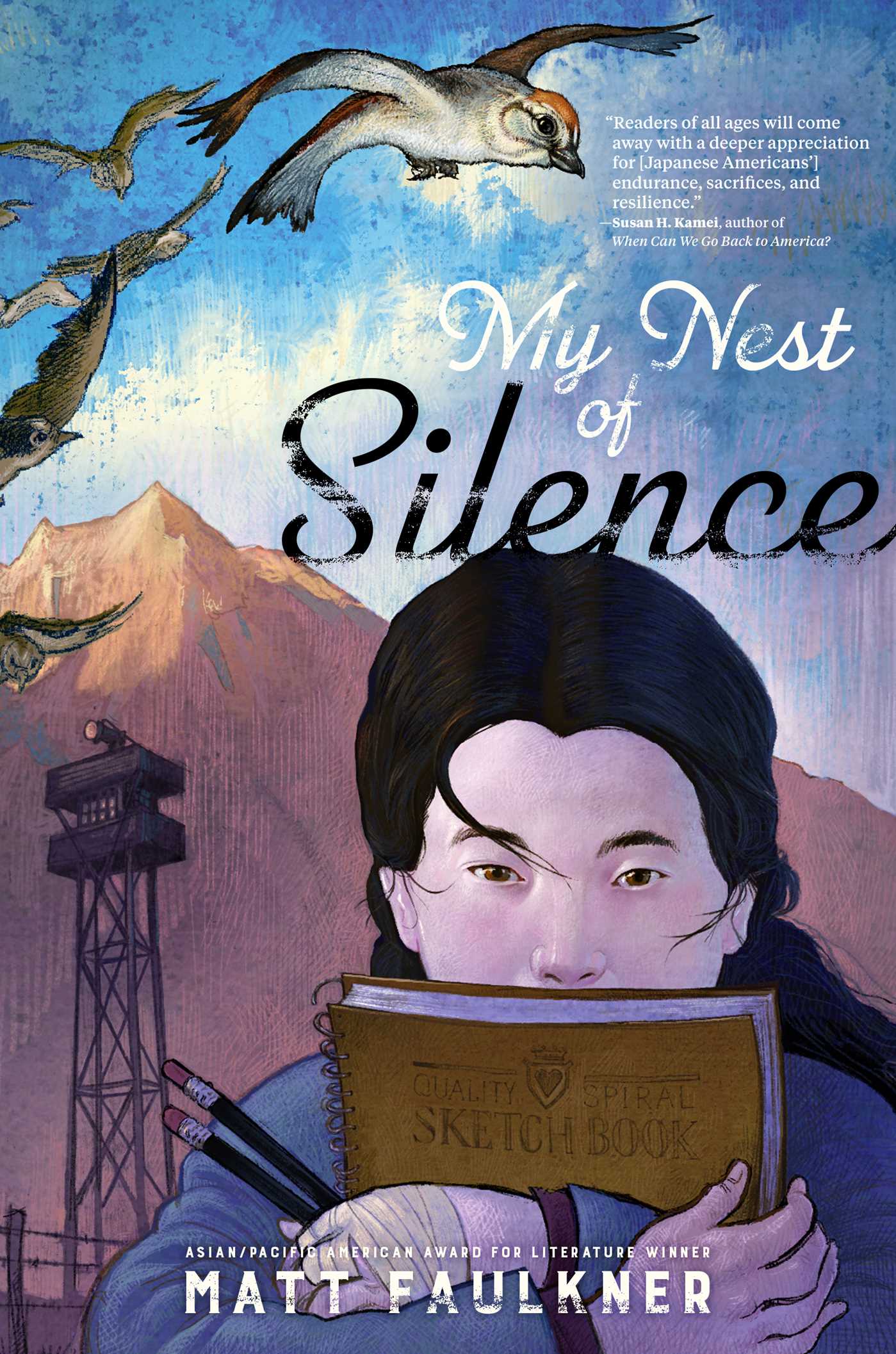
My Nest of Silence by Matt Faulkner

Mari Asai, her older brother Makoto and their parents, Ichiro and Aki are living in the Manzanar prison camp in California. They were sent to the camp after Japan bombed Pearl Harbor. Like most other Japanese-Americans, the Asai were forced to sell their farm in Florino, California.

It's April, 1944 and with Mak turning eighteen, he's decided, against his father's wishes, to enlist in the U.S. army. After Mak leaves on a greyhound bus, Mari decides she won't talk anymore. She's angry at Mak for making this decision without talking to her and she's angry at her father for seeming not to care. But being silent hasn't been easy. Mari is hoping that being silent will bring Mak safely home, but her father feels Mari's silence is "abnormal" while Mama understands that Mari is "upset over Mak leaving." The adults at the camp see Mari's silence as insulting.

Finally after two weeks, a letter from Mak arrives. He tells her that the bus ride from Manzanar to Camp Shelby in Mississippi was long. Although he tells Mari that their drill sergeants are "not a bad bunch of fellows" they are yelled at, have their heads shaved and are sent on a five mile "hike" before bed. Mari suspects that Mak is not telling her the whole story.

Life at Manzanar consists of lots of dust and bad food, although it's not as bad as when they first arrived. Eventually, the Issei and Nisei took over cooking at the camp. But the dust and windstorms are still a problem. One of the oldest people in the camp is Oba-chan Yuki who Mari likes and who is a great storyteller. Oba-chan Yuki has a terrible cough which the constant dust makes worse. One morning after telling Mari and her mother a story, Oba-chan Yuki asks to see Mari's sketchbook. She tells them her daughter Eunice is a water colour painter who has created artwork for Reader's Digest magazine and she offers to have Mari meet Eunice.

Another letter from Mak in July, 1944 tells about the schedule at Camp Shelby and meeting boys who are from Hawai'i. He asks Mari to have Father write to him. A third letter mentions his friend Kazuo (Kaz) who is from Hawai'i and how the Hawaiian Buddhaheads and the Mainland Kotonks are at odds with one another.  But when Kaz learns that Mak's family is in a prison camp, he is proud that Mak enlisted. A fourth letter from Mak reveals that he's put in to be an army mechanic while his friend Whitey Kurasaki has been made a unit leader. 

Back in Manzanar, Mari meets Eunice who praises her artwork and invites Mari to join her art class at the camp. But during her first art class, Mari cuts her finger with a razor blade while sharpening her pencil and her father refuses to allow her to return to the class. After Oba-chan Yuki dies in her sleep, Mari falls ill with pneumonia. As she begins to recover, Mari learns that Eunice and her family have left the camp after obtaining a waiver to move to Chicago, and that baby Keiko and the other orphans have been adopted out. 

As the war drags on, Mari struggles to recover from pneumonia and she becomes emotionally distraught. Mari is worried and sad. After becoming delusional in the old camouflage factory, Mari is hospitalized with a serious fever.  As the U.S. government no longer sees the Japanese as a serious threat and more people leave Manzanar, Mari's parents  argue about where to move after the war, with Father wanting to return to their hometown and Mama wanting to move East where they will be accepted. 

Meanwhile, Mak is determined to help out the war effort in a more meaningful way then driving a jeep. He begs to be sent to the front so he can help his friends Kaz and Whitey but is refused. When the lieutenant he drives for, abandons his orders to go to the front at Bruyeres, Mak and Harry decide to push on and find themselves in a deadly situation that sees them going missing and almost costs them their lives. 

At home, Mari and her parents learn only bits and pieces of what is going on overseas, further adding to Mari's stress. With a second telegram, Mari is certain Mak is dead, leading to a serious crisis. Once Mak's situation is clarified, the Asai family make a decision for their future, Mari begins to hope that life will be better.

Discussion

My Nest of Silence is a novel that combines two stories, one written in narrative prose, the other in graphic novel format. The two stories serve to contrast one another: Mari and her parents struggling to cope amid the injustice and racism of the Japanese internment, while their brother/son willingly sacrifices for the country that has treated them so badly.

The narrative story focuses on a Japanese-American family, the Asai's, sent to Manzanar prison camp and is told from the point of view of their ten-year-old daughter, Mari who decides to take a vow of silence both to punish her father and to protect her beloved brother Mak who has enlisted in the U.S. Army.  Mari's narrative exposes the reality of  life in Manzanar, showing the suffering Japanese American families endured but also highlighting their determination and resiliency in the face of racism and injustice. Mari's family who were farmers in Florin, California have lost their home and all their possessions. They live in dusty, cold barracks, surrounded by barbed wire. Even orphans and the elderly are incarcerated.

Mari struggles to cope with her older brother Mak enlisting and what seems like a lack of understanding by her father. The camp conditions, stress and worry about her brother and their future, lead her to become seriously ill. But Mari's real crisis comes when she believes a second telegram is about Mak having died and she climbs into the rafters of the old camouflage factory. She is almost seriously injured but saved by her father. 

Interspersed with Mari's narrative is Mak's story told through the use of graphic art. Mari receives  letters sent home to her by her brother Makato. These are dated and have some short text. However, the content of the letters is contradicted by what is shown in the graphic novel panels. Mak reveals the strenuous training, awful food, and the struggle to get along with the "Hawaiian Buddhaheads" who dislike the Japanese-American (Kotonk) soldiers as well as their white (haole) superiors, and the racism they encounter from other soldiers. In his letters, Mak doesn't reveal to his sister or family the dangers he and his fellow Japanese-American soldiers encounter, nor the real extent of his wounds later on. Instead, knowing the difficulties his family must deal with at Manzanar, he is positive, encouraging and humorous.

But it is the graphic novel pages that really are the novel's outstanding strength. Faulker successfully captures the sacrifice, bravery and fortitude of these young Japanese-American men, who, in spite of being imprisoned along with their families, chose to fight for their country. They put aside the injustice, the hatred and indignity shown them, and enlisted, perhaps believing in a better America in the future. Set against this sacrifice, is the suffering of their families imprisoned back home.  It is a debt as Faulkner writes in his blog, that must be remembered: 
"I believe it's essential that our country regularly express regret for what we did. That expression won’t fix the vastness of what was done to that community. But it might help. Let’s learn the history of the internment and share it with others. Let’s never forget what we did as a nation to Japanese Americans, so that we can help them heal and so that we may never do it again. Not ever again."

It is novels like My Nest of Silence that will help Americans remember, and move forward the process of healing and forgiveness that is so necessary. 

Book Details:

My Nest of Silence by Matt Faulkner
New York: Atheneum Books for Young Readers    2022
373 pp.

Tuesday, May 23, 2023

Last Flight by Kristen Mai Giang

Saigon, Vietnam is a city with busy streets. We were used to the sounds of sandals on the pavement and motorbikes. But the war brought new sounds: heavy boots and booms that felt nearer and nearer. When it was time for Ma to have her baby, Ba drove her holding a lantern on his motorbike. There were now eight in our family.

Then we learned that Saigon was falling. Since Ba worked for Pan Am, an American airline, he told us we would go to America. Pan Am promised to fly their workers out of the country. As the war came closer, the booms became louder and some days we could smell tear gas. Eventually only one flight out of the country remained and we had to be on that flight. 

However, we did not have the papers required by Vietnamese citizens to leave the country. In the hopes of solving this problem, Mr. Topping who was Ba's boss at Pan Am decided to declare his Pan Am Vietnamese staff as his family and signed adoption papers for over three hundred people!  But they also needed a plane and a flight crew.

The last night before the flight, we slept at Ba's office. In the morning buses took us to the airport. But Ma and Ba were worried because people were saying the airport was closed. However, at the airport we saw a Pan Am plane landing. President Gerald Ford had declared the flight an emergency rescue flight and a volunteer crew were on the plane. Hundreds of people clamored aboard the plane. When it was decided the plane was too heavy, we threw out bags to make more room. 

Soon the plane raced down the runway and was in the air. We left Saigon behind and faced the biggest job of all, starting over.

Discussion

Last Flight is the story of Kristen Mai Giang's family's escape from Saigon on April 24, 1975, a mere six days before the city's surrender to the North Vietnamese army. Kristen Mai Giang was only eighteen months old when her family left Vietnam. The story recounted in the picture book is a fictionalized version of what happened, based largely on her older sister Linh's memories as well as those of Allan Topping whom the author interviewed.  For example, her family never knew Allan Topping but his role in saving more than four hundred people just before the fall of Saigon is well documented. In addition to that, he was also responsible for evacuating more than six hundred Vietnamese orphans out of the country in Operation Baby Life, the week prior.

Airways Magazine has an excellent article that describes the situation leading up to the last Pan Am flight, identified as 1965/31. The details of the flight were kept secret so that the airport would not be overrun with people attempting to board. The flight would take not only Pan Am employees but anyone else it could, who wanted to leave the country. 

Giang, in her Author's Note, writes that she "wanted to highlight what seemed to me the real miracle of this story, -- the simple and sometimes stunning ways people choose to help each other." Last Flight does just that, showing how Linh helped her mother pack, how she put one stuffed puppy into a bag so her little sister could be brave, how she helped the little ones stay quiet at Ba's office and how her Ma and Ba gave money to help pay for more people to escape on the last flight.

The artwork for Last Flight was created by retired pediatrician, Dow Phumiruk using pencil and coloured using Photoshop.

Included in the back matter is a photograph of the author's familiy shortly after their arrival in the United States, an Author's Note, Flight Facts about the last Pan Am flight out of Vietnam, and a Bibliography.

Book Details:

Last Flight by Kristen Mai Giang
Montclair: Levine Querido     2023

Friday, May 19, 2023

Oolichan Moon by Samantha Beynon

Two sisters, Little Sister and Big Sister, loved visiting their grandmother and grandfather. They were respected Elders who lived according to the traditional ways of their people, Nisga'a. One thing they really loved was a tasty fish called oolichan.

When the sisters woke up they both wondered if this was the time of year the Nisga'a catch oolichan. They decided to go downstairs and ask grandmother (jiji). Grandmother told Little Sister that the oolichan are very important to the Nisga'a and that to some Elders they were known as the "saviour fish".  

They were considered the "saviour fish" because they were the first fresh fish of the new year.  After the long winter months their people sometimes ran short of the dried fish that helped them through the winter. In early spring, millions of oolichan filled the rivers.

Grandmother explains to the girls that there were many reasons why the oolichan were saviours to their people. The fish is rich in vitamins which helps keep people healthy.  They also are so rich in oil that they can be lit and used like a candle when they are dried. The oil is often administered to a person who is sick.

Even more important is that the oil is like liquid gold to the Nisga'a people. Grandmother tells Little Sister and Big Sister that the oolichan are boiled in large, watertight boxes called brentwood boxes. The oil was skimmed off and traded to other nations. And yes, Grandmother tells the sisters that this is the time of the oolichan moon! At the  door is Daada, their auntie with a bag of fresh oolichan!

Discussion

Oolichan Moon is about an amazing little fish, called oolichan by the Nisga'a, that has been central to their culture for generations. Known as Thaleichthys pacificus to biologists, this small, smelt-like fish spends most of its life in the ocean but returns to the freshwater streams and rivers where it was born, to spawn and die. The oolichan run usually happens in March.

As noted in this picture book, the oolichan was considered a saviour fish because it was the first fresh food of the spring, just as the First Nations peoples along the coast were running short of their winter stores. The fish were so plentiful that they could be caught using a net or an oolichan rake. Today, oolichan is considered an endangered species. 

Although the sisters in the story speak about loving to eat the tasty oolichan, the author in her note titled "Oolichan Grease" writes that most of the fish caught were used to extract the oil. Oolichan fat is more like olive oil than fish oil, with about fifty-five percent mono-unsaturated fats and a low polyunsaturated fat content. This type of oil content means the oil doesn't spoil as readily and is the reason the fish when dried can be lighted like a candle. Oolichan has also been an important medicine for the Indigenous peoples of the Pacific Northwest.

Young readers learn all about the oolichan through the interaction of two sisters, Little Sister and Big Sister with their beloved Jiji or Grandmother. Although Little Sister asks many questions and keeps interrupting, Grandmother is patient with her, happy that her young grandchildren want to know about their heritage and culture. Informing her grandchildren offers a vehicle for informing the reader too. Beynon not only highlights the importance of the oolichan in the Nisga'a culture but also demonstrates the importance of intergenerational relationships to Indigenous peoples.This relationship has been a way of passing on traditional knowledge to the younger generation.

Oolichan Moon is illustrated by Lucy Trimble who is from the Frog Clan. Trimble's richly coloured illustrations contain many elements of traditional Indigenous design and artwork. Author Samantha Beynon who is of Nisga'a, Ts'msyen and European heritage, has incorporated related Nisga'a vocabulary in her story and has included several separate pages at the back: Nisga'a Vocabulary, A Fish Central to Nisga'a Culture, Oolichan Grease and Oolichan Fishing.

Book Details:

Oolichan Moon by Samantha Beynon
Madeira Park, B.C. :  Harbour Publishing,   2022

Wednesday, May 17, 2023

The Tower of Life: How Yaffa Eliach Rebuilt Her Town in Stories and Photographs by Chana Stiefel

Yaffa was a girl who lied in a shtetl, a small Jewish town, called Eishyshok. Yaffa's family and most other families in the shtetl had roots that went back over nine hundred years. Their stories were part of the shtetl, and helped keep their faith and traditions alive. Yaffa and her brother Yitzchak played their way through the seasons, sledding and skating in winter, swimming in the lake in the summer. Yaffa would help her Grandma Chaya sell candles on market days. Yaffa and her friends would have their fortunes told for a fee. 

Yaffa's Grandma Alte has a photography studio above the family's pharmacy. Her grandfather brought a camera from America years earlier and Grandma Alte has now become one of the town's photographers. She photographed shopkeepers, newlyweds and babies. Pictures of the Jewish New Year were mailed all over the world to family and friends. Even Yaffa had her picture taken when she was six years old, feeding the chickens. But that year things changed...

German tanks and soldiers came to Eishyshok. Jewish schools and businesses were shut down and the Jews rounded up and forced into the synagogue. Yaffa's father fled out a window and fled with his family into the forest. Yaffa stuffed a few family photographs into her shoes. Almost all of Eishyshok's Jews were killed over a two day period. But Yaffa, her brother Yitzchak and her parents were saved by a kind farmer who hid them in his underground shelter.

As they hid over the months, Yaffa learned to read and her father shared stories of their town's holidays and weddings. During the war they would live in many different places but Yaffa kept safe the photographs she had saved. 

After the war, Yaffa did not return to Eishyshok, but instead moved to Jerusalem. She grew up, married and moved with her family to America. There she became a history professor.

When a new museum was being built in Washington that would document the Holocaust, President Jimmy Carter asked Yaffa to design a memorial. Instead of focusing on death and suffering, Yaffa chose to highlight the lives of those who were lost in the Holocaust. She remembered the people of her shtetl, the children, brides and grooms, the milkmen and the musicians. Remembering the photographs she carefully saved during the Holocaust, she wondered if others had done the same. Perhaps she could build a memorial to the lives of Eishyshok, photograph by photograph and that's what she set out to do.

Discussion

The Tower of Life gives young readers the backstory of a memorial known as the Tower of Faces which is part of the United States Holocaust Memorial Museum located in Washington, D.C. The designer of the memorial, Yaffa Eliach survived the Holocaust along with her father and brother Yitzchak. Most of their village were not so lucky. In 1941, almost the entire Jewish population of the shtetl was murdered by the Einsatgruppen (the Nazi killing squads). When Yaffa returned for a visit in 1987, not only was there not one single Jewish resident in living in Eishyshok, but the Jewish cemeteries had been destroyed, the main synagogue was a sports center and the events of the massacre largely erased and forgotten. 

To commemorate what happened in Eishyshok, and to honour the lives of the Jewish people, Yaffa collected six thousand photographs of the residents of Eishyshok that were taken between 1890 and 1941.  Of these photographs, Yaffa chose just over one thousand photos to be used in the permanent memorial which opened in 1993. The photographs not only represent the innocent victims of the massacre but also shtetl life prior to the Holocaust. Of course for the late Yaffa Eliach (she passed away in 2016), the photographs were also a memory of what happened. 

Author Chana Steifel makes use of the picture book format to tell Yaffa's story and that of the creation of the Tower of Faces memorial. It is a compelling read that makes both the story of the Holocaust and the Tower of  Faces accessible to a younger audience. Illustrator Susan Gal's artwork mirrors the events  of Yaffa Eliach's life: life in the shtetl prior to the Holocaust is portrayed in vivid colours of greens, reds, yellows and blues, while the arrival of  the Nazis and the subsequent massacre sees the palette change to reds, oranges and blacks. The people of the shtetl in life before the Holocaust have recognizable faces and features, smiling and interacting with one another. They have a dynamic community, bonded by over nine hundred years of history.  During the massacre, all is chaos and darkness, with faces of fear. Yaffa's work to research and collect photographs for the memorial over a period of seventeen years, is portrayed again in vivid colours. The faces of relatives and friends, as they look at old photographs, are shown filled with the joy of remembering.

The Tower of Life is a fascinating account of  Yaffa Eliach's determination to remember the victims in a way that honored the best parts of their lives, their zest for living, for loving and being with family. The author has included a timeline of Yaffa's life in A Snapshot of Yaffa's Life and Legacy, as well as a Bibliography.


Book Details:

The Tower of Life by Chana Stiefel
New York: Scholastic Press      2022

Monday, May 15, 2023

The Secret Pocket by Peggy Janicki

Mary's 'Utsoo (grandmother) and 'Utsiyan (grandfather) had a smoke house next to their lake. The smoke house was used to smoke meat, fish, berries and maitlus (a cake made out of berries). 'Utsoo spent so much time in the smoke house tending the fire that she had a pad and pillows to rest on. There was Utsoo's hugs and sweetened tea, and the feeling of being loved.

But at the end of summer, this all changed when one day a priest and nun came to visit their family. Mary and her family were busy fishing at their lake, and she and her brothers and sisters were playing on the beach. It was decided that Mary along with her sister Aggie and her brother James would be sent far from home to Lejac residential school. 

At the school, Mary who was too young to attend Kindergarten, wandered the hallways during class time. She was homesick for 'Uloo, 'Uba, 'Utsoo, and "Utsiyan. She also rarely saw her brother James who lived on the boys side of the school. The were not allowed to speak Dakelh. 

At Lejac, Mary was always hungry and cold. They were taught by the Sisters who were strict and often cruel. Mary was often homesick. Fall, winter, spring and early summer were spent at the Lejac residential school. But when she was home, Mary helped 'Uloo (mother) with mending and learned to sew moccasins together, beading them. Mary's father who was Chief, would visit Lejac to check on his children. These visits had to be arranged ahead of time and Mary and her siblings were given extra food so that it appeared they were being cared for.

But Mary and the other girls found ways to survive. They soon learned that it was fairly easy to take food from the kitchen. Then they had a brilliant idea! With rags from the rag box, Mary and her schoolmates used their sewing skills to sew pockets into their petticoats. The pockets were used to hide the food they took from the kitchen. They took apples, carrots and bread to feed themselves and their school mates. This extra food ensured they had enough to eat and to survive.

Discussion

The Secret Pocket tells how a resilient group of young Indigenous girls, struggling in one of Canada's residential schools came up with a brilliant idea that helped them survive. The author, Margaret (Peggy) Janicki is an award-winning  Dakelh teacher from the Nak'azdli Whut'en First Nation. Her mother, Mary attended Lejac residential school but never spoke about her experiences until later in life. In her Author's Note, Peggy Janicki recounts how her mother shared the story of the secret pocket while recovering from a broken hip. This story has since been gifted to Indigenous graduates at the University of the Fraser Valley in the form of a secret pocket sewn into the stole of each graduate. The secret pocket holds a copy of Mary's story. More about Peggy Janicki can be found at her website.

The Lejac residential school opened in 1922 on the shore of Fraser Lake in British Columbia. It was run by the Oblates of Immaculate Mary and the Sisters of the Child Jesus. The school remained open until 1976. As with many residential schools, former students indicated they were physically and sexually abused, and there were deaths of students at the school as well. In 1937, four young boys froze to death after running away from the school and attempting to make the journey home to the Nadleh reserve.

Mary's story is one of resilience, courage, and perseverance. The Secret Pocket is yet another story that highlights the suffering Indigenous children endured in the Canadian residential school system but more importantly also demonstrates their ingenuity and determination. As Mary reflects back on this period of her life, she notes, "Now as a great-grandmother, I look back at this time and see what sweet little geniuses we were. In the full face of genocide and cruelty, we secured our families' path for generation to come. We sewed our survival into every stitch. We come from a strong line of artists and geniuses, so we stitch with easy skill." In other words, the secret pockets thwarted the goal of assimilation and destruction of the Indigenous culture. It was a fight for their future.

The author includes a Glossary of terms at the back as well as an Author's Note that explains how she came to learn about the secret pocket from her mother. The digital illustrations were done by "Eastern Fraser Valley-based artist Carrielynn Victor who is a descendant of Coast Salish ancestors that have been sustained by S'olh Temexw (their land) since time immemorial and Western European ancestors that settled around Northern Turtle Island beginning in the 1600's."

The Secret Pocket offers Canadian readers of all ages another opportunity to reflect on the history of Canada's residential schools and the chance for all to experience intergenerational healing through the stories of our Indigenous peoples.

Book Details:

The Secret Pocket by Peggy by Janicki
Orca Book Publishers     2023

Saturday, May 13, 2023

The Watchmaker's Daughter by Larry Loftis

Those who have read Corrie ten Boom's autobiography, The Hiding Place will relish this new, well-researched offering by New York Times award winning author, Larry Loftis. The Watchmaker's Daughter begins by setting the stage for the drama that would play out during World War II and the Nazi occupation of Holland. In Chapter 1, The Watchmakers, the history of the ten Boom family and the start of their watchmaking business is described. The story really begins in 1837 when Willem ten Boom rented the house at Barteljorisstraat 19 in Haarlem, Holland. In 1844, Willem, now married to Geertruida van Gogh, began praying for "God's ancient people", the Jews. This practice would be passed on to his children and grandchildren in the years to come.

Geertruida passed away from tuberculosis in 1856 and in 1858, Willem married Elizabeth Bell. Their first son, Casper eventually opened his own watchmaking shop. After the death of his father, Casper and his wife, Cor, along with their family of four children, Elisabeth (Betsie),  Willem, Arnolda (Nollie) and Cornelia (Corrie), returned to Haarlem, where they took over the shop. It was Corrie who expressed interest in continuing the family business, while Willem decided to study theology at the University of Leiden. Eventually he became pastor at a church in Zuylen near Utrecht. Willem became interested in the development of anti-Semitism, which was particularly evident in both France and Germany. 

Corrie's mother died in 1921, the year that Corrie became the first licensed female watchmaker in Holland. Meanwhile, Willem continued studying the evil of anti-Semitism and accepted a position as a special missionary to the Jews in Amsterdam. Incredibly, he studied at the Institutum Judaicum in Leipzig, Germany where for the next three years he completed work on his doctoral thesis, "The birth of modern racial anti-Semitism in France and Germany". At this time, Adolf Hitler was writing Mein Kampf which was published in two volumes in 1925 and 1926. Willem's dissertation was published in 1928, just five years before Hitler would rise to power in Germany. 

After finishing his Ph.D, Willem began his ministry to Jews in Amsterdam. In 1933, German president Paul von Hindenburg installed Adolf Hitler as chancellor of Germany and the persecution of Jews began. Boycotts of Jewish businesses, and the barring of Jews from all civil service jobs, schools and universities included, as well as the prohibition of Jews from practicing law or medicine became the law. The Nuremberg Laws, enacted in 1935 stripped German Jews of citizenship and made it illegal for them to marry "Aryans". Persecution of Jews and Christians who opposed the persecution was ramped up after the 1936 Olympics. 

While the situation remained normal in Holland, in March 1938, Germany annexed Austria and the persecution of Austrian Jews began. The Munich Agreement between Germany, France and Britain did little to stop Hitler. The attempted assassination of Third Secretary Ernst vom Rath by Herschel Grynszpan in retaliation for the forced transport of eighteen thousand German Jews brought on Kristallnacht - Night of the Broken Glass on November 9th. 

The first hint of the coming storm in Holland arrived within the Beje when Casper had to fire a young German apprentice, Otto Altschuler after they learned he brutally assaulted a man the shop had hired to help with repairs. That man was the elderly, gentle Mr. Christoffels.

As Hitler began his march through Europe, Holland was invaded on May 10, 1940. Despite fierce resistance, the Germans quickly occupied the Netherlands and began to target the Jewish population with ever-restrictive laws. As the persecution raged on in 1941, Corrie and her father, Casper began discussing and planning how they would help their Jewish neighbours. Soon they began hiding Jews who came to Beje for help, sending them on to safe houses. But this was only the beginning of resistance by the ten Boom family and in particular Corrie and her brother Willem. They quickly became involved in the underground, and built a secret room at the back of their house which became "the hiding place". What was once just a simple task of hiding Jews for a night before they could be moved, became a high stakes "cat and mouse" game with the Nazis. Corrie and her family would not escape unscathed.

Discussion

The Watchmaker's Daughter is a moving account of the life of Corrie ten Boom, beginning from her early life, through the war years as she and her family worked to save Jews, her arrest and imprisonment in various concentration camps, and her ministry after the war to both camp survivors and the German people.

Loftis who had authored a number of narrative nonfiction books focused on World War II espionage, was looking for new subject material. He knew about Corrie ten Boom and that her experience focused on the Dutch Resistance - potentially a new topic to explore. Corrie had written six books about her family and the war, including The Hiding Place, but much of what happened was not included. Loftis was able to draw on a number of key primary sources to write The Watchmaker's Daughter: long time refugee Hans Poley's Return to the Hiding Place, nephew Peter van Woerden's memoir The Secret Place, and Corrie's own collection of letters, photos and much more which were held in an archival collection at Wheaton College. Loftis also wanted to focus on Corrie's efforts after the war, to heal the wounds suffered by so many, including the German people. 

Writing The Watchmaker's Daughter had a lasting impact on Loftis as well. He writes in his Author's Note that "...writing about Corrie's message of faith, hope, love, and forgiveness was an empowering experience for me..."  Loftis succeeds in capturing this message throughout The Watchmaker's Daughter. In fact, the most inspirational aspect of Corrie's story is not her survival, but the heroic virtue displayed by her entire family, but most especially by her sister Betsie, in the face of great cruelty. The ten Boom's encounters with Lieutenant Hans Rahms at Scheveningen Prison, proved that such virtue could change minds and hearts. 

Loftis takes care to set Corrie's story within the larger context of events that were occurring each year during World War II. For example, he includes not only historical details from the war, but also mentions Audrey Hepburn who played a part in the Dutch Resistance, and Anne Frank and her family who were in hiding in Amsterdam, until their betrayal in August of 1944. There are also many black and white photographs throughout, helping readers to know many of the people in Corrie's story.

The Watchmaker's Daughter is ultimately a story of hope and forgiveness. This is very evident in Corrie's struggle both during the war, but even more so after the war. Especially poignant, is the account of her meeting the man, who had been an SS guard in a shower room at Ravensbruck, at a speaking event in Munich. Repulsed at the sight of this man who had been so cruel, Corrie struggled to offer him the forgiveness he asked for. And yet she did, through God's grace, despite this man not apologizing for what he did to her.

To those who loved The Hiding Place, this work provides a richer context and backstory, informing readers as to how the ten Boom's resistance to the Nazis began a century earlier with their immense love and charity towards God's "ancient people", the Jews. Loftis lays out the history that shaped a family and their courageous resistance at great personal cost.

Loftis offers his readers a list of major people in the Dramatis Personae at the front of the book. This includes the members of the ten Book family, refugees in the Beje and the Dutch Resistance. At the back of the book, The Rest of the Story informs readers of the fate of many of the major German and Dutch people in the book. An Appendix offers a list of Jewish or Dutch diver refugees at the Beje during the war. The author has also provided an extensive Notes section for each chapter. Maps of Amsterdam, the Netherlands and Germany during World War II would have been much appreciated.

The Watchmaker's Daughter will appeal to not just those interested in Corrie ten Boom, but also those interested in  World War II history and resistance.

Book Details:

The Watchman's Daughter by Larry Loftis
New York:  HarperCollins Publishers     2023
370 pp.

Sunday, May 7, 2023

The Roan Stallion by Alfreda Beartrack Algeo

It is the summer of 1930 and Alfred is on his way to work at the Looking Rock Ranch, southwest of Reliance. Alfred tames horses for the ranch owner, Mr. Looking Rock. At Beaver Creek, Alfred decides to stop at a favourite spot and that's when he spots a blue roan stallion which he identifies as a Medicine Hat horse, sacred to his Lakota people. Alfred is so distracted by the beautiful horse that he doesn't notice the approaching tornado and he and the horse are caught up in it but survive their ordeal. 

Since his father left to find work in the big city over two years ago, Alfred, his younger brother Elmer, and his mother have been living with his grandparents on their farm. But his grandfather is getting older and finding the farm harder to work. Alfred has a secret plan: to win the relay race at the White River Frontier Days and with the prize money, purchase a tractor for his grandfather.  He needs one more horse for his relay team, and the blue roan just might be that horse!

Instead of continuing on to the ranch, Alfred returns home, only to find his beloved yellow lab, Chepa has died. Devastated, Alfred places Chepa on his horse, Anpo and sets out to bury his dog. But while preparing the grave, Chepa opens his eyes and Alfred realizes that his dog has eaten his mother's dough, causing him to pass out. He returns home, thankful that Chepa is alive.

A week later and it is branding day at the ranch. Alfred decides to stay overnight at the ranch  in the bunkhouse so he can start work early the next day. At the ranch he meets Mr. Looking Rock's nephew, Johnny Krugerbery. Johnny takes an immediate dislike to Alfred and threatens him in the bunkhouse. However, the round-up and branding goes without incident.

As the summer moves on, Alfred learns some important information about his father. He also begins training the blue roan to become part of his relay team. But when Johnny attempts to take over his uncle's ranch, Alfred and his friends are not only in danger of missing the relay race, but their lives as well.

Discussion

The Roan Stallion continues the story of Alfred Swallow and his family. Beartrack-Algeo engages her readers immediately with a series of events involving Alfred. On his way to a nearby ranch, Alfred encounters an unusual horse, a blue roan stallion which he identifies as a Medicine Hat horse, he gets caught in a tornado and almost loses his beloved dog Chepa. Beartrack-Algeo moves the story along quickly, having Alfred prepare for the relay race but also get caught up in the events going on at the Looking Rock ranch.

Readers may find this story a bit disjointed. For example, at the end of Chapter 4 Medicine Hat, Alfred's grandfather mentions that Alfred needs to "load your sacred pipe and go to your elder, Peter Flying Crow, to help you interpret your encounter with the sky spirit and the Medicine Hat horse." However, the next chapter skips over this entirely, fast-forwarding to a week later when Alfred is to work at the Looking Rock range. It would have been interesting to read about Alfred meeting Peter Flying Crow and what his interpretation of Alfred's experiences was.  Chapter 6 Big Day which focuses on the branding at the ranch, also does the same, ending with Alfred's decision to sleep over at the bunkhouse another night to see possibly what Johnny Krugerbery might be up to. However the next chapter leads off, several weeks into the future with Alfred talking about his training of the roan stallion. Did Alfred learn anything about what Johnny was up to? 

In The Roan Stallion, Alfred learns more about his father, whom he is eventually reunited with at the end of the novel. Beartrack-Algeo continues to develop Alfred as a character; he is boy determined to do the right thing and live a life of honor, in the tradition of his people, the Lakota. Alfred shows respect to his elders, to the animals and nature around him. He's also not afraid to confront evil when he and his friends take on Johnny and his gang. But at the heart of this story is Alfred, who seeing the difficulty his grandfather is having in working the farm, is moved to act: his goal is to win the relay race prize money so he can buy his grandfather a new tractor. 

Once again, the author also uses the character of Alfred's grandfather to show the impact of the white man on the Lakota way of life. When they are preparing for the relay race, Alfred remembers the day he helped Grandfather build fences for their pasture and how the idea of sectioning off the land and building fences is foreign to the Lakota.
"In the old days there no fences and no land ownership, and the buffalo were plenty. Now we find ourselves fenced in like prisoners on reservations. The government issues a card telling us we are Indians, as if we don't know who we are. We are the People, the allies. They ask us to show them this card in order to get food to feed our starving babies. They ask us to show them this card if we want permission to leave our fenced-in reservation. They want to know where we are going and when we will return. Maybe they approve the request, maybe not. Inside the fenced-in reservations, they gave us small parcels. Giving us our own land back? The land were my people hunted our buffalo and cared for our babies? I don't understand. They expect us to be farmers, to grow crops from the poor seeds they give us, but the crops often die. They expect us to be ranchers and fight over the land they gave us. but the sick cattle they send to replace the buffalo they killed often die. They expect us to build fences on the land they gave us, so here we are, Grandson...building fences."

The Roan Stallion is a short, heart-warming story set at the beginning of the Great Depression. It has plenty of action, and believable characters who highlight some important virtues such as charity, consideration, industriousness and determination. This short novel also informs young readers about the Lakota people who shared the prairies with the vast herds of buffalo and how their lives were changed forever by the coming of the white settlers. A third installment of this series is much anticipated!

Book Details:

The Roan Stallion by Alfreda Beartrack-Algeo
Summertown, Tennessee: 7th Generation Book Publishing Company     2023
121 pp.