Showing posts with label Japanese American internment. Show all posts

Wednesday, May 24, 2023

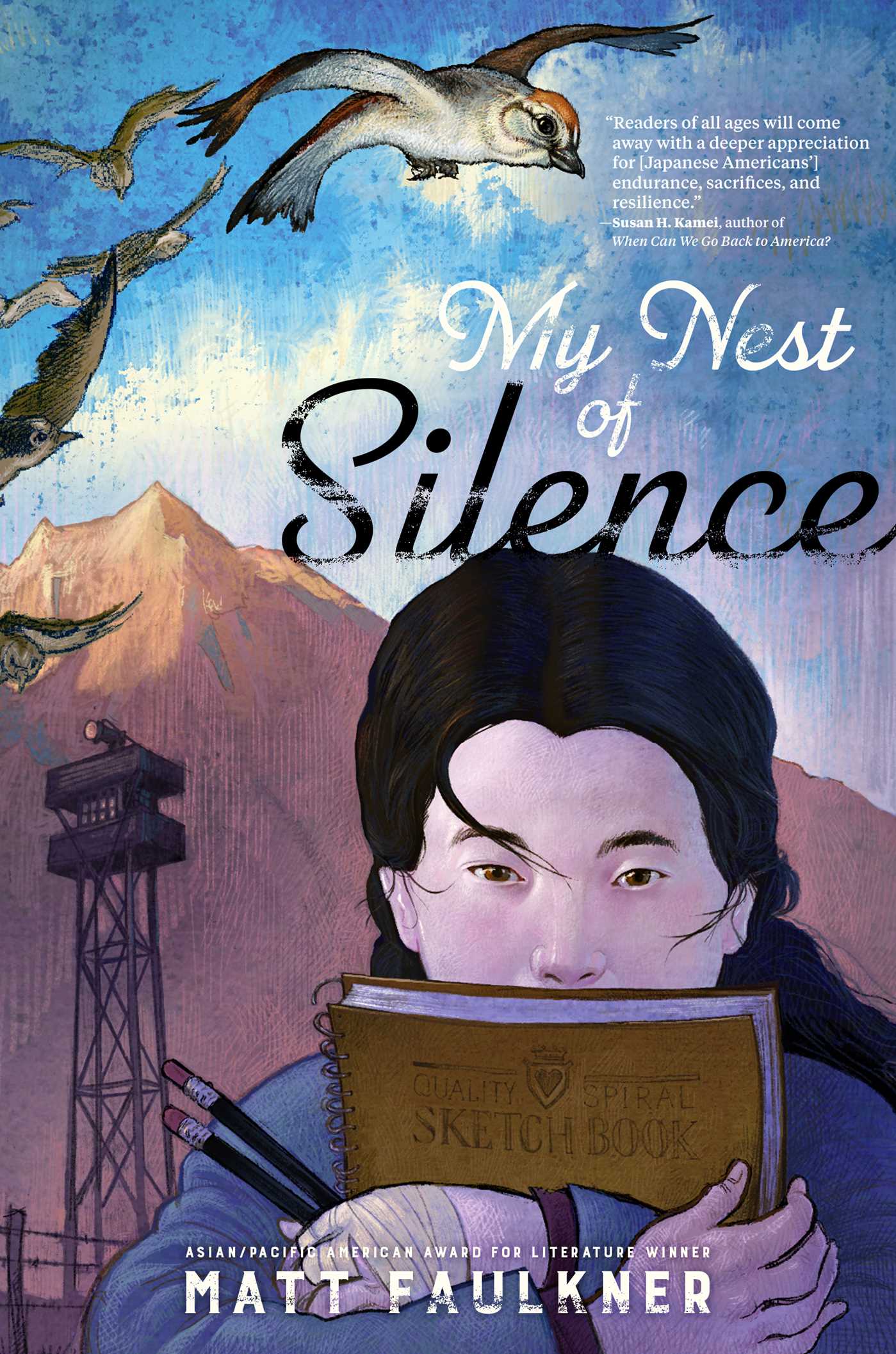
My Nest of Silence by Matt Faulkner

Mari Asai, her older brother Makoto and their parents, Ichiro and Aki are living in the Manzanar prison camp in California. They were sent to the camp after Japan bombed Pearl Harbor. Like most other Japanese-Americans, the Asai were forced to sell their farm in Florino, California.

It's April, 1944 and with Mak turning eighteen, he's decided, against his father's wishes, to enlist in the U.S. army. After Mak leaves on a greyhound bus, Mari decides she won't talk anymore. She's angry at Mak for making this decision without talking to her and she's angry at her father for seeming not to care. But being silent hasn't been easy. Mari is hoping that being silent will bring Mak safely home, but her father feels Mari's silence is "abnormal" while Mama understands that Mari is "upset over Mak leaving." The adults at the camp see Mari's silence as insulting.

Finally after two weeks, a letter from Mak arrives. He tells her that the bus ride from Manzanar to Camp Shelby in Mississippi was long. Although he tells Mari that their drill sergeants are "not a bad bunch of fellows" they are yelled at, have their heads shaved and are sent on a five mile "hike" before bed. Mari suspects that Mak is not telling her the whole story.

Life at Manzanar consists of lots of dust and bad food, although it's not as bad as when they first arrived. Eventually, the Issei and Nisei took over cooking at the camp. But the dust and windstorms are still a problem. One of the oldest people in the camp is Oba-chan Yuki who Mari likes and who is a great storyteller. Oba-chan Yuki has a terrible cough which the constant dust makes worse. One morning after telling Mari and her mother a story, Oba-chan Yuki asks to see Mari's sketchbook. She tells them her daughter Eunice is a water colour painter who has created artwork for Reader's Digest magazine and she offers to have Mari meet Eunice.

Another letter from Mak in July, 1944 tells about the schedule at Camp Shelby and meeting boys who are from Hawai'i. He asks Mari to have Father write to him. A third letter mentions his friend Kazuo (Kaz) who is from Hawai'i and how the Hawaiian Buddhaheads and the Mainland Kotonks are at odds with one another.  But when Kaz learns that Mak's family is in a prison camp, he is proud that Mak enlisted. A fourth letter from Mak reveals that he's put in to be an army mechanic while his friend Whitey Kurasaki has been made a unit leader. 

Back in Manzanar, Mari meets Eunice who praises her artwork and invites Mari to join her art class at the camp. But during her first art class, Mari cuts her finger with a razor blade while sharpening her pencil and her father refuses to allow her to return to the class. After Oba-chan Yuki dies in her sleep, Mari falls ill with pneumonia. As she begins to recover, Mari learns that Eunice and her family have left the camp after obtaining a waiver to move to Chicago, and that baby Keiko and the other orphans have been adopted out. 

As the war drags on, Mari struggles to recover from pneumonia and she becomes emotionally distraught. Mari is worried and sad. After becoming delusional in the old camouflage factory, Mari is hospitalized with a serious fever.  As the U.S. government no longer sees the Japanese as a serious threat and more people leave Manzanar, Mari's parents  argue about where to move after the war, with Father wanting to return to their hometown and Mama wanting to move East where they will be accepted. 

Meanwhile, Mak is determined to help out the war effort in a more meaningful way then driving a jeep. He begs to be sent to the front so he can help his friends Kaz and Whitey but is refused. When the lieutenant he drives for, abandons his orders to go to the front at Bruyeres, Mak and Harry decide to push on and find themselves in a deadly situation that sees them going missing and almost costs them their lives. 

At home, Mari and her parents learn only bits and pieces of what is going on overseas, further adding to Mari's stress. With a second telegram, Mari is certain Mak is dead, leading to a serious crisis. Once Mak's situation is clarified, the Asai family make a decision for their future, Mari begins to hope that life will be better.

Discussion

My Nest of Silence is a novel that combines two stories, one written in narrative prose, the other in graphic novel format. The two stories serve to contrast one another: Mari and her parents struggling to cope amid the injustice and racism of the Japanese internment, while their brother/son willingly sacrifices for the country that has treated them so badly.

The narrative story focuses on a Japanese-American family, the Asai's, sent to Manzanar prison camp and is told from the point of view of their ten-year-old daughter, Mari who decides to take a vow of silence both to punish her father and to protect her beloved brother Mak who has enlisted in the U.S. Army.  Mari's narrative exposes the reality of  life in Manzanar, showing the suffering Japanese American families endured but also highlighting their determination and resiliency in the face of racism and injustice. Mari's family who were farmers in Florin, California have lost their home and all their possessions. They live in dusty, cold barracks, surrounded by barbed wire. Even orphans and the elderly are incarcerated.

Mari struggles to cope with her older brother Mak enlisting and what seems like a lack of understanding by her father. The camp conditions, stress and worry about her brother and their future, lead her to become seriously ill. But Mari's real crisis comes when she believes a second telegram is about Mak having died and she climbs into the rafters of the old camouflage factory. She is almost seriously injured but saved by her father. 

Interspersed with Mari's narrative is Mak's story told through the use of graphic art. Mari receives  letters sent home to her by her brother Makato. These are dated and have some short text. However, the content of the letters is contradicted by what is shown in the graphic novel panels. Mak reveals the strenuous training, awful food, and the struggle to get along with the "Hawaiian Buddhaheads" who dislike the Japanese-American (Kotonk) soldiers as well as their white (haole) superiors, and the racism they encounter from other soldiers. In his letters, Mak doesn't reveal to his sister or family the dangers he and his fellow Japanese-American soldiers encounter, nor the real extent of his wounds later on. Instead, knowing the difficulties his family must deal with at Manzanar, he is positive, encouraging and humorous.

But it is the graphic novel pages that really are the novel's outstanding strength. Faulker successfully captures the sacrifice, bravery and fortitude of these young Japanese-American men, who, in spite of being imprisoned along with their families, chose to fight for their country. They put aside the injustice, the hatred and indignity shown them, and enlisted, perhaps believing in a better America in the future. Set against this sacrifice, is the suffering of their families imprisoned back home.  It is a debt as Faulkner writes in his blog, that must be remembered: 
"I believe it's essential that our country regularly express regret for what we did. That expression won’t fix the vastness of what was done to that community. But it might help. Let’s learn the history of the internment and share it with others. Let’s never forget what we did as a nation to Japanese Americans, so that we can help them heal and so that we may never do it again. Not ever again."

It is novels like My Nest of Silence that will help Americans remember, and move forward the process of healing and forgiveness that is so necessary. 

Book Details:

My Nest of Silence by Matt Faulkner
New York: Atheneum Books for Young Readers    2022
373 pp.

Tuesday, July 5, 2022

They Called Us Enemy by George Takei

They Called Us Enemy is the graphic memoir for actor/author/activist George Takei who along with his family endured imprisonment in a Japanese internment camp during World War II.

George and his younger brother, Henry are woken up during the night by their father and told to get dressed quickly. As they are packing, police come to the door and tell George's father, Takekuma Norma Takei, that under Executive Order 9066, the must leave immediately. He is given ten minutes to pack. Both George and Henry do not understand and watch their mother tearfully carry their baby sister out of the house.

George, speaking at a TEDxKyoto talk in Japan in 2014, tells the audience he was never able to forget that scene and goes on to describe what led to it and what happened afterwards. Takei tells the audience he is a veteran of the Starship Enterprise whose mission was "to explore strange new worlds, seek out new live and new civilizations...to boldly go where no one has gone before." Takei was "the grandson of immigrants who went to America. Boldly going to a strange new world."

His father, Takekuma Norman Takei, was born in Yamanshi, Japan and came to America as a teenager. He attended high school and then opened a dry-cleaning business in Los Angeles. Takei's mother, Fumiko Emily Nakamura was born in Florin, California and educated in Japan to avoid school segregation. Takekuma and Fumiko married in Los Angeles and George was born in 1937.

The Takei's had lost their first child at three months of age. They named George after King George VI of England. Henry came next, named after Henry VIII, followed by a girl they named Nancy Reiko after a beautiful woman the Takei's knew.

But on Sunday, December 7, 1941, their lives would change forever. While preparing for Christmas, the Takei family learned of the bombing of Pearl Harbor by the Japanese. That day, President Roosevelt signed a proclamation declaring adult Japanese citizens as "alien enemies". They would now have to follow strict regulations.

In a speech broadcast over the radio, the nation listened as Roosevelt asked Congress to declare a state of war with Japan because of the attack on the Hawaiian Islands. Earl Warren, Attorney General of California, aspiring to be Governor of California, made very racist remarks about the Japanese Americans. Because there was no evidence of Japanese spying, sabotage or fifth column activities and because the Japanese Americans are "inscrutable", they should be locked up before they do anything! The major of Los Angeles, Fletcher Bowron testified that the Japanese would always be loyal to Japan no matter how many generations have been in the United States.

The result was that on February 19, 1942, the President signed Executive Order 9066. It authorized the military to create areas "from which any or all persons may be excluded." It never specifically identified "Japanese" Americans or mentioned "camps"  but it soon became obvious that it was people of Japanese heritage who were targeted.

In the spring of 1942, civilian exclusion orders were posted, ordering all Japanese living in specific districts "to report to their designated landmark for processing and removal." The bombing of Pearl Harbor had led to the U.S. Government freezing bank accounts and financial assets of Japanese Americans. George Takei's parents found their bank account frozen. With the signing of E.O. 9066, the property and business of almost all Japanese Americans was seized. Japanese farmers had their crops seized by private citizens.

Attorney General Warren was unsympathetic to their plight. Lt. General John L. Dewitt, Commander of the Western Defense Command stated that the implementation of a curfew for all people of Japanese ancestry was to prevent sabotage and fifth column activities. 

It wasn't long before George and his family were forced to leave their home. In the spring of 1942, they were taken by bus to the Santa Ana Racetrack and made to live in the stables that reeked of horse manure. It was the beginning of a journey that would see them sent by train across the country to Camp Rohwer in Arkansas, and to the notorious Camp Lake Tule. 

Discussion
 
In They Called Us Enemy, actor and author, George Takei takes readers through his family's loss of all their possessions and family business, their imprisonment in two different camps: Camp Rohwer in Arkansas and then in Camp Tule Lake, notorious for this three layers of barbed wire, machine gun towers and tanks.  He also relates how his parents were "no-no's" - Japanese Americans who responded "No-No" on the loyalty questionnaire. This mandatory questionnaire attempted to determine the loyalty of Japanese Americans the government had imprisoned. America needed soldiers and in 1943, even Japanese Americans would do. Like many Japanese Americans, George Takei's parents answered no to two questions regarding their willingness to serve in the US Armed Forces and to swear allegiance to the United States of America.

George also attempts to convey to readers how the war and imprisonment affected his parents. His parents were shocked by the conditions they were required to endure, but knew they were powerless to change things. His mother worked hard to take special care of the children, and her act of resistance was to save her beloved sewing machine! Takei's  mother was devastated to learn of the bombing of Hiroshima, where her parents lived. Reports of the destruction were incomprehensible and left many without hope for their loved ones. In the post-war period, when the Takei's had to start completely over, without any government help, they endured living first on skid row and then in rundown lodgings in Los Angeles. They were resourceful and determined.

Takei notes that many of his memories were coloured by the innocence of childhood but once the war was over and he began to grow up, the reality of what the camps were and what they represented began to become apparent. As he went through the American school system, George began to notice that American history books never mentioned the imprisonment of thousands of Americans of Japanese ancestry, nor the loss of all of their possessions and businesses. There was no reflection on what had happened - after all America and its allies had won the war. But in this graphic book memoir, George Takei effectively shows that the reaction by key political figures was racist and a form of hysteria and fear that was completely unwarranted.

Takei acknowledges the major influence his father had on him especially after the war as he was growing up. Takei's father was actively involved in the camps, helping his fellow prisoners and attempting to make their lives easier. At first Takei criticized his father for what he saw as a lack of action and passivity in not standing up to the order sending them to the camps. He writes that his arrogant outburst demonstrated that he did not understand "...a man who knew the anguish of those dark internment years more intensely than that boy could ever understand. " Despite what happened, all the loss and hardship his father had endured, Takei's father was a firm believer in participatory democracy and took the time to fill in the gaps that his young son missed during those years. His belief in the American form of democracy and that people can effect change, was a huge influence on George Takei's own life.

They Called Us Enemy is important memoir for all people.  The events George Takei and his family experienced, along with thousands of fellow Japanese Americans, demonstrate what can happen when hate and racism, fueled by hysteria take hold. Prejudice against people of Asian ethnicity had existed unchecked for decades in the United States. Pearl Harbor became the catalyst for government leaders to act in ways that dehumanized an entire race of people, stripping them of their Constitutional rights. The imprisonment of over one hundred, twenty thousand Japanese Americans reminds us that these events can happen again unless we all work to counter discrimination in all forms. Takei's lesson, learned from his father, is that ordinary people working together within the framework of democracy can work to make the world a better place for all.
 
Book Details:

They Called Us Enemy by George Takei
Marietta, GA: Top Shelf Productions     2019
204 pp.

Monday, October 11, 2021

Gaijin: American Prisoner of War by Matt Faulkner

It is Koji Miyamoto's thirteenth birthday on Sunday, December 7th, 1941. He has the radio on, listening to the Lone Ranger when the broadcast is interrupted by the announcement that the Japanese have attacked Pearl Harbor. Koji and his mother don't know where Pearl Harbor is, so they get out their atlas. Meanwhile they learn that thousands are reported dead or wounded.

Koji wonders if his father might have flown one of the attacking planes but his mother tells him this is ridiculous. Rumors are that President Roosevelt will declare war on Japan.

Although Koji tries to focus on his homework, it is impossible. That night he has a dream that his father was flying on the planes.

The next day Koji begins to experience hostility from people as he walks to school. He overhears people suggesting that every Japanese person should be sent back to Japan. And at school he gets into a fight after another student calls him a "Jap". Instead of helping him, Principal Dorfman accuses Koji of being a troublemaker.

Koji eats lunch alone and is refused entry onto a streetcar. He arrives home to find his mother crying and learns that FBI agents have taken their radio from anyone who is Japanese.

Koji's mother believes that things will quiet down, but the abuse continues both at school and on the street. Then they receive a letter informing them that Koji is to be sent to a "relocation camp" because he's considered an "enemy alien". 

The next morning his mother's attempted intervention at the army office doesn't work and instead Koji and his mother are assigned to the Alameda Downs Assembly Center. At home they learn they can only take two suitcases with them and they sell the rest of their possessions. They are also questioned by the FBI who want to know when Koji's mother last heard from her husband and Koji's father, Ichiro. She tells them he returned to Japan because his father was ill.

On relocation day, Koji and his mother Adeline are placed on a bus where they meet Ichiro's former employers, Hana and Yoshi Asai. They travel across San Francisco Bay to the Alameda Downs Assembly Center, which used to be a horse-racing track. There they are assigned to Stall 33, a horse stall that stinks of horse manure and urine. Dinner is a large room crammed with people eating spam, beans and turnip. 

The next morning when Koji takes a walk through the camp he is set upon by a group of teens and called "gaijin". Kohi gets into a fight, breaks a window and is taken to the commander who assigns him to work with his family's friend Mr. Asai. 

As the weeks go by, Koji continues to deal with the Japanese boys who refuse to accept him because of his fair hair and freckles, and who force him into stealing. He also believes his mother's apparent friendship with the camp commander is the source of gossip about her. But with Mr. Asai's help, Koji is able to break free of the gang tormenting him.

Discussion

Gaijin is based on the real life story of the author's great-grandmother Adeline Conlin, an Irish American woman who married a Japanese man in the 1920's. This inter-racial marriage was not accepted in neither Japan where the couple lived and had a daughter named Mary, nor in America where Adeline and Mary returned after the devastating earthquake of 1923. However, they found they were not accepted in Boston either, so they moved to Los Angeles, California. Mary married and had two children. With the bombing of Pearl Harbor, because Mary was part Japanese, she was forced to move with her two children to an internment camp. Adeline, who was not Japanese went with her daughter and grandchildren, travelling to Owens, California and then to Manzanar War Relocation Center. In 1943, the family was sponsored to move eastward, to Chicago. Falkner, in his back material titled, Finding Adeline, only learned about his family's past when he saw a post on the National Park Service-Manzanar website by Adeline's great-granddaughter, Anita asking for anyone who might be related to Adeline to contact her.

Through the graphic novel format, Faulkner portrays the story of a young Japanese American boy trying to find his place in the tumultuous world of World War II and the Pearl Harbor attack. The story is a personal one, because his own family experienced the lack of acceptance in both Japan and in America for being biracial. The focus in Gaijin is on the racism that a Japanese American boy, Koji experiences when America is attacked by the Japanese. The attack serves to focus the underlying racism towards Asian Americans that already existed in California and in other parts of the United States up until this time.

Koji not only experiences racism from white Americans, but when he arrives at the internment camp, he finds himself being attacked by Japanese Americans as well. He is called "gaijin", a derogatory term that means "outsider". Mr. Asai explains to Koji that the term is a very unkind one and he tells him to refer to his father as Issei or first generation, and that Koji is Nisei or second generation. 

Faulkner is able to effectively portray many of the problems Japanese Americans experienced during World War II. For example, many Japanese Americans were interrogated by the FBI who suspected them of being spies. In another example, Mr. and Mrs. Asai assume they have found someone decent to rent their home while they are away, in the internment camp. However, when Mr. Asai visits his property on a day pass, he discovers the tenants have broken into his shed and are using his property as though it is their own. Many Japanese Americans lost everything they owned prior to being sent to the camps, including their possessions, their homes, their businesses and their land.

Koji and Adeline's experiences are portrayed in illustrations using mainly brown, sepia and blue, creating a dreary and sad mood expected in being sent away to a concentration camp in a dusty desert. Koji's dreams are done in vivid red, orange and yellow.

Gajin offers young readers an excellent starting point for learning about this important era in United States history and to explore racism and how it impacts both perpetrators and victims.  Faulkner includes a variety of resources at the back including Books and Periodicals, Documentary Films and Websites.

Book Details:


Gaijin: American Prisoner of War by Matt Faulkner
New York: Hyperion Books      2014