Showing posts with label Manzanar. Show all posts

Wednesday, May 24, 2023

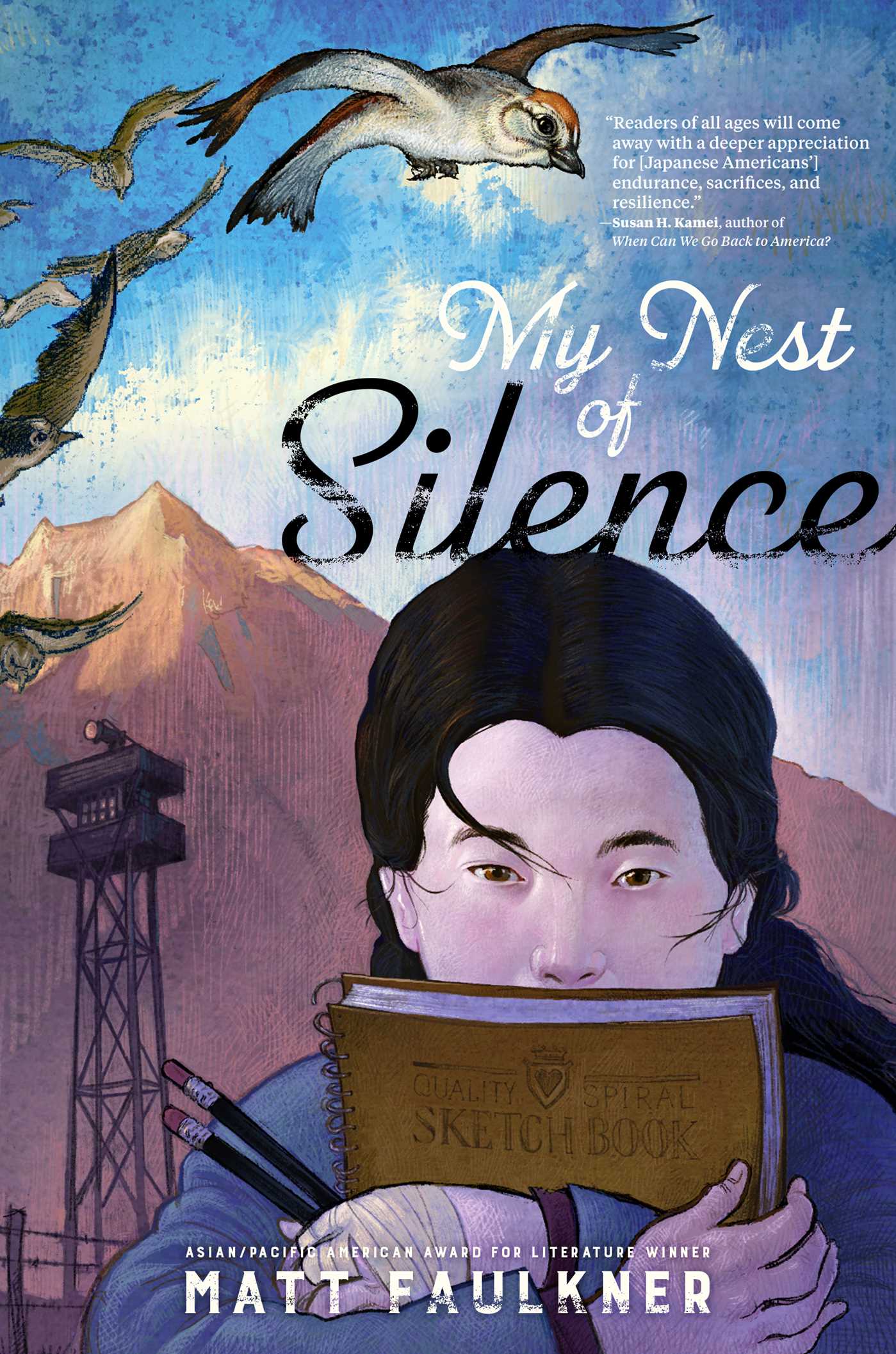
My Nest of Silence by Matt Faulkner

Mari Asai, her older brother Makoto and their parents, Ichiro and Aki are living in the Manzanar prison camp in California. They were sent to the camp after Japan bombed Pearl Harbor. Like most other Japanese-Americans, the Asai were forced to sell their farm in Florino, California.

It's April, 1944 and with Mak turning eighteen, he's decided, against his father's wishes, to enlist in the U.S. army. After Mak leaves on a greyhound bus, Mari decides she won't talk anymore. She's angry at Mak for making this decision without talking to her and she's angry at her father for seeming not to care. But being silent hasn't been easy. Mari is hoping that being silent will bring Mak safely home, but her father feels Mari's silence is "abnormal" while Mama understands that Mari is "upset over Mak leaving." The adults at the camp see Mari's silence as insulting.

Finally after two weeks, a letter from Mak arrives. He tells her that the bus ride from Manzanar to Camp Shelby in Mississippi was long. Although he tells Mari that their drill sergeants are "not a bad bunch of fellows" they are yelled at, have their heads shaved and are sent on a five mile "hike" before bed. Mari suspects that Mak is not telling her the whole story.

Life at Manzanar consists of lots of dust and bad food, although it's not as bad as when they first arrived. Eventually, the Issei and Nisei took over cooking at the camp. But the dust and windstorms are still a problem. One of the oldest people in the camp is Oba-chan Yuki who Mari likes and who is a great storyteller. Oba-chan Yuki has a terrible cough which the constant dust makes worse. One morning after telling Mari and her mother a story, Oba-chan Yuki asks to see Mari's sketchbook. She tells them her daughter Eunice is a water colour painter who has created artwork for Reader's Digest magazine and she offers to have Mari meet Eunice.

Another letter from Mak in July, 1944 tells about the schedule at Camp Shelby and meeting boys who are from Hawai'i. He asks Mari to have Father write to him. A third letter mentions his friend Kazuo (Kaz) who is from Hawai'i and how the Hawaiian Buddhaheads and the Mainland Kotonks are at odds with one another.  But when Kaz learns that Mak's family is in a prison camp, he is proud that Mak enlisted. A fourth letter from Mak reveals that he's put in to be an army mechanic while his friend Whitey Kurasaki has been made a unit leader. 

Back in Manzanar, Mari meets Eunice who praises her artwork and invites Mari to join her art class at the camp. But during her first art class, Mari cuts her finger with a razor blade while sharpening her pencil and her father refuses to allow her to return to the class. After Oba-chan Yuki dies in her sleep, Mari falls ill with pneumonia. As she begins to recover, Mari learns that Eunice and her family have left the camp after obtaining a waiver to move to Chicago, and that baby Keiko and the other orphans have been adopted out. 

As the war drags on, Mari struggles to recover from pneumonia and she becomes emotionally distraught. Mari is worried and sad. After becoming delusional in the old camouflage factory, Mari is hospitalized with a serious fever.  As the U.S. government no longer sees the Japanese as a serious threat and more people leave Manzanar, Mari's parents  argue about where to move after the war, with Father wanting to return to their hometown and Mama wanting to move East where they will be accepted. 

Meanwhile, Mak is determined to help out the war effort in a more meaningful way then driving a jeep. He begs to be sent to the front so he can help his friends Kaz and Whitey but is refused. When the lieutenant he drives for, abandons his orders to go to the front at Bruyeres, Mak and Harry decide to push on and find themselves in a deadly situation that sees them going missing and almost costs them their lives. 

At home, Mari and her parents learn only bits and pieces of what is going on overseas, further adding to Mari's stress. With a second telegram, Mari is certain Mak is dead, leading to a serious crisis. Once Mak's situation is clarified, the Asai family make a decision for their future, Mari begins to hope that life will be better.

Discussion

My Nest of Silence is a novel that combines two stories, one written in narrative prose, the other in graphic novel format. The two stories serve to contrast one another: Mari and her parents struggling to cope amid the injustice and racism of the Japanese internment, while their brother/son willingly sacrifices for the country that has treated them so badly.

The narrative story focuses on a Japanese-American family, the Asai's, sent to Manzanar prison camp and is told from the point of view of their ten-year-old daughter, Mari who decides to take a vow of silence both to punish her father and to protect her beloved brother Mak who has enlisted in the U.S. Army.  Mari's narrative exposes the reality of  life in Manzanar, showing the suffering Japanese American families endured but also highlighting their determination and resiliency in the face of racism and injustice. Mari's family who were farmers in Florin, California have lost their home and all their possessions. They live in dusty, cold barracks, surrounded by barbed wire. Even orphans and the elderly are incarcerated.

Mari struggles to cope with her older brother Mak enlisting and what seems like a lack of understanding by her father. The camp conditions, stress and worry about her brother and their future, lead her to become seriously ill. But Mari's real crisis comes when she believes a second telegram is about Mak having died and she climbs into the rafters of the old camouflage factory. She is almost seriously injured but saved by her father. 

Interspersed with Mari's narrative is Mak's story told through the use of graphic art. Mari receives  letters sent home to her by her brother Makato. These are dated and have some short text. However, the content of the letters is contradicted by what is shown in the graphic novel panels. Mak reveals the strenuous training, awful food, and the struggle to get along with the "Hawaiian Buddhaheads" who dislike the Japanese-American (Kotonk) soldiers as well as their white (haole) superiors, and the racism they encounter from other soldiers. In his letters, Mak doesn't reveal to his sister or family the dangers he and his fellow Japanese-American soldiers encounter, nor the real extent of his wounds later on. Instead, knowing the difficulties his family must deal with at Manzanar, he is positive, encouraging and humorous.

But it is the graphic novel pages that really are the novel's outstanding strength. Faulker successfully captures the sacrifice, bravery and fortitude of these young Japanese-American men, who, in spite of being imprisoned along with their families, chose to fight for their country. They put aside the injustice, the hatred and indignity shown them, and enlisted, perhaps believing in a better America in the future. Set against this sacrifice, is the suffering of their families imprisoned back home.  It is a debt as Faulkner writes in his blog, that must be remembered: 
"I believe it's essential that our country regularly express regret for what we did. That expression won’t fix the vastness of what was done to that community. But it might help. Let’s learn the history of the internment and share it with others. Let’s never forget what we did as a nation to Japanese Americans, so that we can help them heal and so that we may never do it again. Not ever again."

It is novels like My Nest of Silence that will help Americans remember, and move forward the process of healing and forgiveness that is so necessary. 

Book Details:

My Nest of Silence by Matt Faulkner
New York: Atheneum Books for Young Readers    2022
373 pp.

Tuesday, October 15, 2019

Within These Lines by Stephanie Morrill

Within These Lines is a heartrending story of love and loyalty in a time of when war breeds hatred and fear. It tells the story of two teenagers, one white and one Asian, a mixed race couple, a forbidden love and two people who choose to challenge the social conventions of a country at war. Within These Lines begins three months after the Japanese bombing of Pearl Harbor. The story spans the period from March 21 to December 25, 1942 and is told in the alternating voices of Evalina Cassano and Taichi Hamasaki.

Evalina Cassano, an Italian-American awakens to the news that over sixty Japanese Americans living in Los Angeles have been voluntarily relocated to Manzanar in Southern California.

When Evalina expresses her concern to her mother that all the Japanese, even those born in America such as the Hamasaki children will also be forced out, her mother tries to reassure Evalina that they are safe. But Evalina is concerned because she has been secretly seeing Taichi Hamasaki, whose family supplies the produce to Alessandro's, the Casanova family restaurant.

Distraught, Evalina heads down to the market on the waterfront. But the Hamasaki's green Chevy truck is not there and someone else occupies the space where their table is usually set. This leads Evalina to take the ferry to Alameda.

Taichi's family live on a farm in Alameda, across the bay from San Francisco. On the same morning, Taichi's family is visited by FBI agents who search their home. After the bombing of Pearl Harbor, Taichi's family burned everything they owned that tied them to Japan including letters, family photographs, Japanese books and kimonos. Taichi's family is in the process of packing suitcases because they are moving to his Aunt Chiyu's home.

Evalina phones Taichi and they meet at the dock. Before he leaves to see Evalina, Taichi's older sister Aiko forces him to tell her about his secret relationship with Evalina. She was also in a forbidden relationship with a Caucasian and suffered a miscarriage. When Evalina and Taichi meet, she admits her fear for him. Taichi reveals that his family has reallocated their land back to their neighbours, the Medinas while they are away. The bombing of Pearl Harbor has changed all of Evalina and Taichi's future plans. Evalina has earned a scholarship to attend University of California Berkeley and they hoped Taichi would be able to do the same. The war has also changed the future for others too; Taichi's best friend Diego Medina will not enlist in the U.S.Navy and Eva's best friend Gia LaRocca is planning to marry her boyfriend Lorenzo.

Several days later, Taichi and his father Katsumi make their last delivery to the Cassano's restaurant. During this meeting, Taichi passes a note to Evalina asking her to meet him at Lafayette Park. The two have an emotional meeting, with Evalina giving Taichi her address, begging him to write and let her know what's happening. The Friday afternoon before they are due to leave, Taichi visits Evalina's home, expecting her to be alone. Instead her mother greets him and with Evalina the two say their goodbyes. Taichi reveals that they will be evacuated on Tuesday, likely to Manzanar. In a private moment, Evalina learns the Hamasaki family will leave from the civic center at noon. After Taichi leaves, Evalina's mother offers her sympathy and understanding, but Evalina is not sure how much her mother understands about her relationship with Taichi.

On Tuesday April 7, Taichi and his family arrive at the civic center to leave San Francisco. They find a long line of other Japanese American families, overseen by guards. A group with the First Congregational Church hands out sandwiches and water. It is hot and tiring waiting. Aiko spots Evalina, who as promised has come to see them. Just before he boards the bus, Evalina promises Taichi that she will wait for him and will write him.

The next morning Evalina is furious at the coverage of the "evacuation" in the local newspapers. Meanwhile Taichi and his family arrive at Manzanar and come to realize that the camp is not ready for them. As the months pass by and life goes on for Evalina, Taichi begins to wonder if they can really continue their relationship. Will he ever leave the camp? While Evalina continues to advocate for the Japanese Americans, Taichi finds himself drawn into a deadly revolt that costs a friend his life and endangers his own family.

Discussion

Within These Lines tackles the shameful imprisonment of thousands of Japanese Americans during World War II in response to hysteria over the bombing of Pearl Harbor by the Japanese.  Japanese Americans were displaced from their homes and businesses, and placed in prison camps merely because they looked like the enemy. In this well-crafted novel, Morrill weaves together the forbidden relationship between two American teens and the events of the Japanese internment to portray the reality of life at this time.

Evalina Cassano is an Italian-American whose family has a past history of involvement in the Mafia in Chicago. She forms a strong attachment to Taichi Hamaskai, a first generation Japanese-American boy whose family supplies her family's restaurant with fresh produce. The two teens keep their relationship secret not only because they suspect their families won't approve but also because interracial marriages are illegal in California. The realization that Taichi and his family will be sent away, is devastating to both teens.

Morrill uses Evalina to express the injustice of the government actions. Unlike many of her fellow Americans, Evalina's relationship with Taichi helps her to view Japanese Americans differently, not as potential enemies but as loyal Americans who have the same dreams and desires as any other American. When Evalina visits Taichi at Manzanar and experiences the reality of the internment camp, she is further angered by the injustice of the camps and the mistreatment of these American citizens.

Initially, Evalina writes numerous letters to government officials including General DeWitt as well as to newspaper editors in Los Angeles and San Francisco. Her letters to newspapers have been signed anonymously.  initially expresses her views against the internment to parents and friends. When her mother refers to the evacuees as "Japanese", Evalina points out that "the majority of the Japanese Americans who are being evacuated" have "....done nothing except be born to parents who have Japanese heritage. And most of their parents would have become citizens long ago, except that our government has denied them that option since the 1920s." 

At college Evalina's activism on the internment question spills over into her Comparative Politics class taught by Professor Blake. Despite her having visited two of the camps, Evalina receives a poor grade on her paper discussing the Japanese internment. When Evalina confronts Professor Blake about her mark, it is clear he considers her a Japanese sympathizer and later on tells her she is young and misguided. Over time however, Evalina becomes not only more vocal but also more courageous about speaking up for the rights of Japanese Americans. When Grace Bishop asks Evalina to write an article she decides it's time to sign her name. Evalina had told herself that she would be taken more seriously if people did not know she was an Italian American teenage girl. But she finally admits that she has been afraid. "I have felt afraid of people knowing that it was me, Evalina Cassano, who wrote those angry words. Afraid of being laughed at, ridiculed, told that I should just be quiet and feel grateful. Told that I'm too young to understand or too Italian to be a real American...I feel afraid of people knowing that this fight I'm fighting isn't just about the evils of racism, but that it's personal to me...." Evalina begins signing her name to her writing....

Morrill captures the era with her realistic portrayal of 1940's America attitudes and customs, especially as they related to Americans of Asian heritage. While Evalina's parents are more accepting and compassionate towards Japanese Americans, Evalina encounters others who are not. For example, her best friend's mother, Mrs LaRocca derogatorily refers to Japanese Americans as "Japs", and states, "I know I'll feel a lot better when they've been cleared out....Not that there aren't nice Japs among them, but why risk it?" This view encapsulated many Americans thoughts on the their fellow Americans of Japanese heritage. Morrill also highlights the common Caucasian tendency to lump all people from Asia together. When Evalina arrives at the market and discovers the Hamasaki's are not there she also notices that Mrs. Ling has posted a sign at her table that reads "We Are Chinese". Mrs. Ling tells Evalina that she has posted the sign because, "Some white people get confused. They think we are the enemy." 

As expected, the newspapers of the time propagandized what was being done to Japanese Americans. Evalina is furious when she reads the account of the evacuation because it is portrayed as something joyful, with "the air of an outing." The public is told that military guards were there to protect the Japanese Americans from curious onlookers when in reality the soldiers were guarding the evacuees as though they were dangerous. "Was I at the same place as this moronic journalist? Because I saw no victory signals. No broad smiles. No bobbing heads. And the only raised thumb was mine to reassure my friend that I was okay. What a load of propaganda. In America! In my own newspaper!" Evalina wonders how many Americans will think that for the Japanese Americans, this will be a fun experience. "He made having your property seized and being loaded onto a bus while surrounded by military police sound like heading off for some kind of vacation!" 

The reality of life in the internment camps is seen through Taichi's narratives. The camp consists of crudely constructed houses that in reality are barracks. There are armed guards to greet them. The barrack "floors are bare planks, coated in a layer of sand that's blown up and in. The only thing separating us from the other families already living in the barrack are the olive-colored blankets like those we're holding in our hands draped from the roof beams. One bare lightbulb dangles over each apartment, which I can see because of the open rafters." There are few working toilets, little privacy, and strange food.

Morrill describes the humiliation and shame the evacuees feel through the character of Taichi. When Taichi sees that his family of five will share a twenty-five by ten foot space for an indefinite period, he thinks, "My heart feels like a fist as it pounds in my chest. This is too much. Too much to take in. Too much to be asked of us. Too much dignity to lose all in twenty-four hours. How can this be real?"  During his first night when he has to use the toilet, a searchlight follows him from the barrack to the toilet and continues to light the steps until he reappears, following him back to his barracks. "I lie on my lumpy mattress, hot with shame as the cold Manzanar wind continues through the night." While the average American believed the camps were a place of leisure and plenty, the reality was much different.
 
The poor living conditions are not the only difficulty as Taichi and his family discover. Although the Hamasaki family is fictional, the conditions described at Manzanar and the riot that occurred there were not. The Black Dragons were are real gang that were pro-Imperial Japan and who attempted to take over the camp.

Morrill's characters are realistic, well crafted. The forbidden romance between Taichi and Evalina, set in the uncertainty of war and displacement serves to successfully draw the reader into the story. If you didn't comprehend the reality of the internment of Japanese Americans, you will after reading Within These Lines. Look for further information about the camps and the events described in the author's About The History in the book's back matter.

Book Details:

Within These Lines by Stephanie Morrill
Grand Rapids, MI: Blink     2019
350 pp.

Tuesday, January 24, 2017

Paper Wishes by Lois Sepahban

Paper Wishes is a story for younger children about the internment of thousands of Japanese Americans during World War II and how one young girl's life is forever changed.

Ten-year-old Manami Tanaka lives with her parents on Bainbridge Island off the coast of Washington state. It is March 1942, three months after the Japanese bombing of Pearl Harbor and the country is at war with Japan. Manami loves walking on the beach with Grandfather and their beloved little dog, Yujiin. They notice a warship off their island and Manami tells Grandfather that the soldiers make her scared. Grandfather tells her "When the soldiers see you, they are scared, too,". He tells her that the soldiers think "people with Japanese faces and Japanese names will betray us,". 

After school one day Manami's teacher Mrs. Brown asks Manami, her friend Kimmi, Ryo and a few others to stay after school. Mrs. Brown tells them that this is their last day at school and that what is happening is not their fault.

At home the next day, Manami is instructed by her mother to gather the herbs and to pull the onion and garlic bulbs from their garden. Her mother washes all their clothing, towels and sheets. Despite her repeated questions about what is happening, Manami is not told anything until the next day when she learns they must leave their home and their island. But Manami's mother does not know why or where they will go or for how long.

When they walk into town to register and get a medical check-up, Manami notes that all those doing so also have dark hair and dark eyes, just like her family. They are assigned a family number and go home to pack. Several days later Manami's family leave their home along with other Japanese. They take a truck to the port but before they leave Manami hides their little dog, Yujiin in her coat. They board the ferry to the mainland and then prepare to take a bus to the train station. However, just before boarding the bus, Yujiin is discovered and taken away and put in a crate. This upsets Manami terribly. Their train trip takes two days, during which Manami sits still and does not speak.

When they leave the train Manami's family are taken by bus to a place called Manzanar which has barbed wire fences, a guard tower and "buildings covered with black paper." Manzanar is in the middle of a prison and Manami's mother recognizes it for what it really is - a prison. The prison is divided into blocks with each block having fourteen barracks.  Manami's family is assigned to Block 3, Barrack 4. They share their building with another family, the Soto family. Manami learns that her friend Kimmi is in Block 7.

At Manzanar, Manami finds she cannot speak.
"But when I open my mouth to speak, the dirt no longer feels like sand. It sticks to my lips and tongue like red mud. It coats my throat so that I cannot speak.
I think this is what happened to me.
I wish the dirt would cloud my eyes, so that I would not see this place that is and is not my home without Yujiin."

Manami is both sad and angry. So sad and angry that she cannot speak. Her mother presses her to speak but Grandfather tells her to give her time. Eventually the family moves to a newly completed barracks, Barrack 8 in Block 3. Mother takes her seeds and the bulbs and plants a garden. She plants zucchini, tomatoes, cucumbers and cantaloupes. The planting of the garden makes Manami realize they may be at Manzanar for a long time.

As time passes the garden begins to sprout but only because Manami must water it everyday. Her father works building new barracks while her mother begins work as a cook. Manami still does not talk and she believes she sometimes hears Yujiin. Kimmi tells her that there will soon be a school in Block 7. Even when her older brother Ron comes to Manzanar, Manami does not speak. The starting of school nor the forced recitation of the pledge does not help, as Manami simply cannot speak. Will she ever find her voice again? Will she ever find Yujiin again?

Discussion

Paper Wishes is a touching story of a young girl who is so deeply affected by the forced move of her family to an internment camp and the loss of her beloved dog Yujiin that she cannot speak. Sepahban tells her story in the form of ten parts labelled from March to December of 1942. Paper Wishes captures the emotions and hardships Japanese Americans experienced as they were forced from their homes, leaving behind everything they had worked for, mainly due to fear and prejudice.

With the bombing of Pearl Harbor, Japanese Americans were forced to relocate to camps further inland as result of President Franklin D. Roosevelt's signing of Executive Order 9066. This presidential order resulted in the relocation of approximately 122,000 Japanese Americans from the west coast of the United States. Interestingly as noted by the Japanese American Relocation Digital Archive website, Japanese in Hawaii where Pearl Harbor is located were not relocated or incarcerated. As the website suggests, "The fact that so few Japanese Americans were incarcerated in Hawaii suggests that their mass removal on the West Coast was racially motivated rather than born of "military necessity." Agricultural interest groups in western states and many local politicians had long been opposed to the presence of Japanese Americans and used the attack on Pearl Harbor to step up calls for their removal."

Poster on Bainbridge Island

Sepahban touches on the racism that led to the decision to relocate Japanese Americans but in a gentle way for younger readers. Grandfather remarks to Manami that the soldiers are afraid of her. Manami notices that all the people being sent from their homes look just like her. But the author also shows that not all Americans are prejudiced through the character of Miss Rosalie who tries to befriend Manami. Miss Rosalie is kind, gentle and understanding towards Manami and encourages her to draw. She shows respect towards Manami's family.  She also falls in love with Manami's brother Ron, demonstrating that she is not afraid of someone who is different.

The theme of loss is explored in the novel in several ways; Manami and her family's grief at losing their way of life and their culture, Miss Rosalie's loss when Ron is sent to another camp for his own safety, and especially the loss of  Yujiin which is keenly felt by Grandfather and Manami. Manami is so overwhelmed by the loss of Yujiin she stops speaking. She comes to believe that it is her fault "that Yujiin is alone on the mainland, far from the island." She also believes that it is her "fault that Grandfather has stopped laughing." And she wonders if it is her "fault that Ron is with us in this prison-village, far from college." Manami believes that Yujiin is out there somewhere trying to get back to her. She decides to draw pictures of Yujiin and write promises on the paper: "Come, Yujiin and you can sleep in my bed." Then she walks to the edge of the camp and making a wish releases the paper into the wind. "I have added my paper promises to the air." Manami releases over thirty drawings but Yujiin does not return and Manami wonders if he did not get her drawings. Eventually Manami's loss is acknowledged by Grandfather and eventually he tells Manami she must stop looking for him because he will not come. Acknowledging her grief allows Manami to begin to move forward.

The inner journey Manami makes is reflected in the garden she and her mother plant in the barren desert. Every day the seeds must be watered and they flourish despite the hot, dry climate and a pounding rain storm that batters them into the ground. In October, Manami and her mother dig up the remnants of the garden and prepare it for next year. Manami's mother tells her that this garden was better than the island garden. "The island garden had plenty of rain," Mother says. "So much rain that it only grew shallow roots. This garden never had enough rain. So it had to grow deep roots. The island roots would never have survived the desert summer." The garden is a metaphor for Manami's struggles which have made her a stronger person with "deeper roots".

Paper Wishes explores the themes of family too. When Manami and her family report to register, her father makes sure that the soldiers understand that despite Grandfather's different surname of Ishii, he is part of their family. Manami's brother Ron is the oldest child and a young man and therefore considered responsible for his family. Because of this he returns from college to be with his father and mother, grandfather and Manami.

Paper Wishes would have benefited tremendously from good pencil illustrations. It's a shame so much new juvenile fiction goes without illustrations to accompany the story. Sepahban's character, Manami Tanaka has a very simple interior dialogue suggesting the book is definitely for younger readers. But readers of all ages will find themselves wanting pictures of Manami and her Grandfather walking on the beach with Yujiin, of the soldiers loading the trains or buses, of Manzanar and its barracks with the mountains in the distance, of Miss Rosalie and the school, of the mess hall, of Kimmi and Manami, of Manami sending her pictures into the wind, and of Yujiin.

The author includes a detailed Author's Note and a list of Resources at the back of this delightful short novel. This information will help young readers understand the context of the story. The riot mentioned in the novel actually did happen and was known as the Manzanar Riot.

Overall Paper Wishes is a beautiful and thoughtful treatment of a very sad event in American history.

Image credits: 
Poster: http://www.drshute.com/archives/000099.html  

For more information on the Manzanar War Relocation Center readers are directed to the National Park Service website: https://www.nps.gov/manz/learn/historyculture/japanese-americans-at-manzanar.htm. There is a webpage specifically about Japanese Americans as well as a cache of photographs of the people who lived there and the center.

The Japanese American Relocation Digital Archive:  https://calisphere.org/exhibitions/t11/jarda/ 
has a wealth of images and information on the incarceration of Japanese Americans from the west coast.

The University of Washington Libraries Special Collections has a website on Bainbridge Island:http://www.lib.washington.edu/specialcollections/collections/exhibits/harmony/exhibit/bainbridge

Information specific to the Japanese American community on Bainbridge Island can be found at the Bainbridge Island Japanese American Community website, https://bijac.org/.

Book Details:

Paper Wishes by Lois Sepahban
New York: Margaret Ferguson Books    2016
181 pp.